
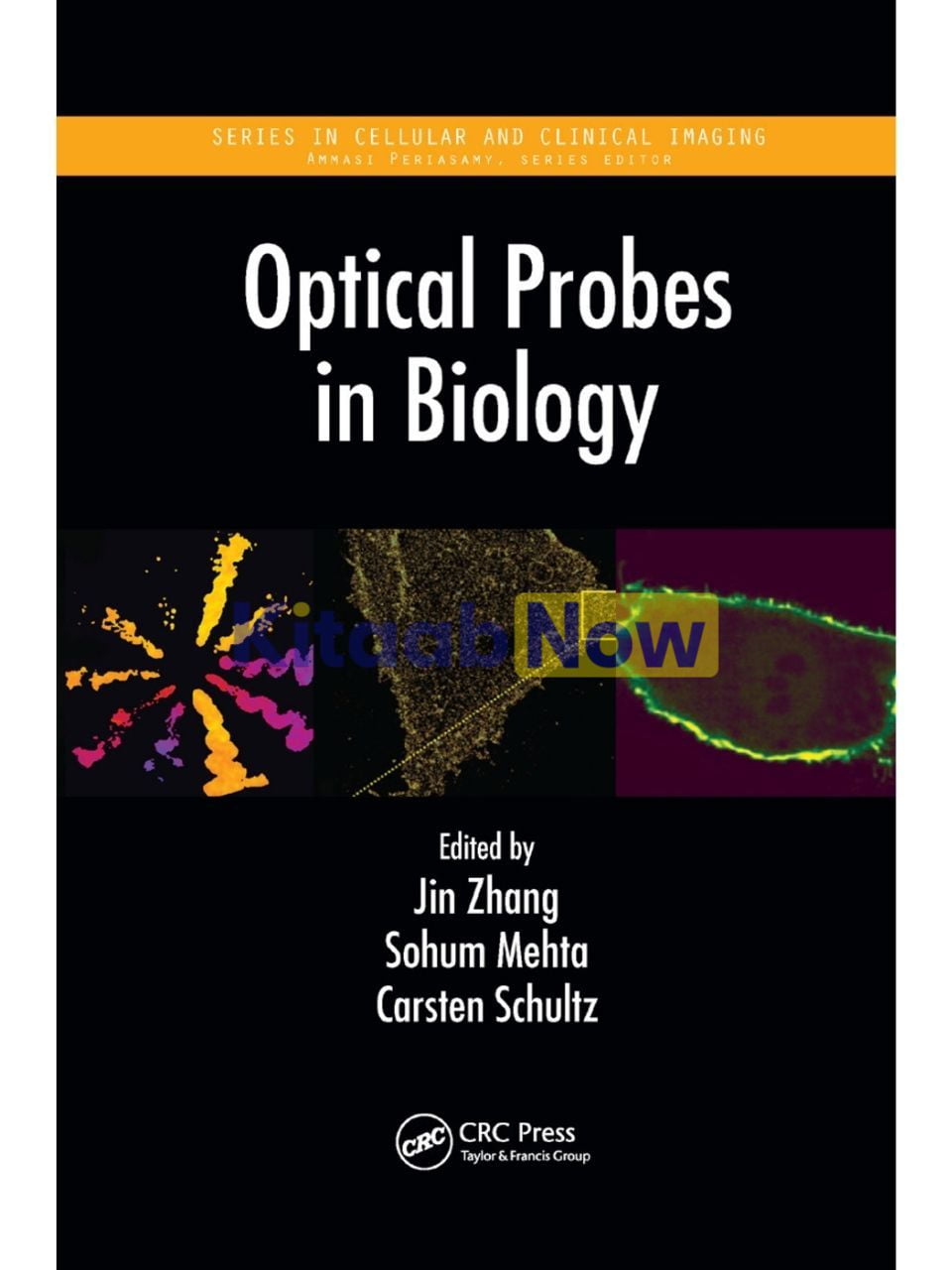
Optical Probes in Biology
- Edited By: Jin Zhang, Sohum Mehta, Carsten Schultz
- ISBN: 9781138199934
- Publisher: CRC Press
- Edition: 1st
- Publication Date: April 13, 2018
- Format: Paperback – 511 pages
- Language: English
Description
Optical probes, particularly the fluorescent varieties, enable researchers to observe cellular events in real time and with great spatial resolution. Optical Probes in Biology explores the diverse capabilities of these powerful and versatile tools and presents various approaches used to design, develop, and implement them.
The book examines the use of optical probes to detect and track numerous molecular processes in living cells, including GTPase and kinase activities, membrane lipids, voltage, metal ions, metabolic signals, RNA, and histone modifications. It critically reviews the different probe designs and delves into the strategies for developing new fluorescent protein varieties with enhanced capabilities. It also covers sophisticated imaging techniques and equipment, such as intensity and lifetime-based fluorescence microscopy methods, used to visualize and track optical probes.
In addition, the book goes beyond live-cell tracking to discuss the growing application of activity-based probes for performing pharmacological drug screening and probing molecular processes in living animals. It also discusses emerging techniques that are expanding optical probe-based approaches into new biological frontiers.
With contributions from top international scientists, this book offers a thorough overview of the latest optical probes in cell biology and biochemistry. Both newcomers and established researchers will discover how to incorporate state-of-the-art optical probes and fluorescence imaging into their research.
Table of Contents
- Introduction and Basics
- Engineering of Optimized Fluorescent Proteins: An Overview from a Cyan and FRET Perspective – Lindsay Haarbosch, Joachim Goedhart, Mark A. Hink, Laura van Weeren, Daphne S. Bindels, and Theodorus W.J. Gadella
- Fluorescent Imaging Techniques: FRET and Complementary Methods – Stefan Terjung and Yury Belyaev
- Engineering of Optimized Fluorescent Proteins: An Overview from a Cyan and FRET Perspective – Lindsay Haarbosch, Joachim Goedhart, Mark A. Hink, Laura van Weeren, Daphne S. Bindels, and Theodorus W.J. Gadella
- Tracking: Sensors for Tracking Biomolecules
- Protein-Based Calcium Sensors – Thomas Thestrup and Oliver Griesbeck
- Monitoring Membrane Lipids with Protein Domains Expressed in Living Cells – Peter Varnai and Tamas Balla
- Biosensors of Small GTPase Proteins for Use in Living Cells and Animals – Ellen C. O’Shaughnessy, Jason J. Yi, and Klaus M. Hahn
- Molecular Beacon–Type RNA Imaging – Felix Hövelmann and Oliver Seitz
- Optical Probes for Metabolic Signals – Yin Pun Hung and Gary Yellen
- Genetically Encoded Voltage Indicators – Hiroki Mutoh, Walther Akemann, and Thomas Knöpfel
- Prototypical Kinase Sensor Design Motifs for – In Vitro and In Vivo Imaging Gary C.H. Mo, Ambhighainath Ganesan, and Jin Zhang
- RNA – Samie R. Jaffrey
- Fluorescent Sensors for Imaging Zinc Dynamics in Biological Fluids – Wen-hong Li
- Histone Modification Sensors in Living Cells – Hiroshi Kimura and Yuko Sato
- Protein-Based Calcium Sensors – Thomas Thestrup and Oliver Griesbeck
- Beyond Live-Cell Tracking: Sensors for Diverse Applications
- Chemical Probes for Fluorescence Imaging in Living Mice – Toshiyuki Kowada, Hiroki Maeda, and Kazuya Kikuchi
- Optical Probes for In Vivo Brain Imaging – Ksenia V. Kastanenka, Michal Arbel-Ornath, Eloise Hudry, Elena Galea, Hong Xie, and Brian J. Bacskai
- Smart Imaging Probes for the Study of Protease Function – Ehud Segal and Matthew Bogyo
- Chemical Probes for Fluorescence Imaging in Living Mice – Toshiyuki Kowada, Hiroki Maeda, and Kazuya Kikuchi
- Emerging Techniques
- Super-Resolution Imaging – Robert K. Neely, Wim Vandenberg, and Peter Dedecker
- Imaging in Optogenetics – Xiaobo Wang, Li He, Carol A. Vandenberg, and Denise Montell
- Super-Resolution Imaging – Robert K. Neely, Wim Vandenberg, and Peter Dedecker
- Index
Reviews
“… the editors of Optical Probes in Biology have successfully gathered the finest molecular tool crafters in this research field to provide readers with a comprehensive view of state-of-the-art developments and applications of optical probes. Additionally, the practical information discussed makes this book an invaluable reference guide to the scientific community to improve the process of proper probe selection. I highly recommend this book to every scientist considering employing optical probes to facilitate their investigations.”
—Microscopy & Microanalysis, 2015
“Among the wide range of techniques elucidated in this book are GTPase and kinase activities, membrane lipids, metal ions, metabolic signals and histone modifications. Relevant chapters are written by experts in their fields who collectively provide readers with the means for bringing state-of-the art optical probe technques into their research.”
—K. Alan Shore, Bangor University, U.K.
Editors Biography
Dr. Jin Zhang is a professor of pharmacology, neuroscience, and oncology in the Johns Hopkins University School of Medicine with a joint appointment in the Department of Chemical and Biomolecular Engineering in the Johns Hopkins University Whiting School of Engineering. She has received the American Heart Association National Scientist Development Award, the Biophysical Society Margaret Oakley Dayhoff Award, the National Institutes of Health Director’s Pioneer Award, the American Society for Pharmacology and Experimental Therapeutics John J. Abel Award in Pharmacology, and the American Chemical Society Pfizer Award in Enzyme Chemistry. She was elected a fellow of the American Association for the Advancement of Science (AAAS) in 2014.
Dr. Sohum Mehta is a postdoctoral fellow at the Johns Hopkins University School of Medicine, where he is using genetically encoded biosensors to investigate the spatiotemporal mechanisms of calcineurin in living cells and developing novel genetically encoded tools to study intracellular signaling.
Dr. Carsten Schultz is a senior scientist at the European Molecular Biology Laboratory in Heidelberg, Germany. He is a member of the German Center for Lung Research. His research focuses on the manipulation and visualization of intracellular signaling networks, with a strong emphasis on lipid and membrane signaling as well as the use of optical probes in translational research. He has received the Heidelberg Molecular Life Science Award and the MRN Innovation Award.
Additional information
| Weight | 0.839 kg |
|---|
Only logged in customers who have purchased this product may leave a review.
Related Products


Reviews
There are no reviews yet.