
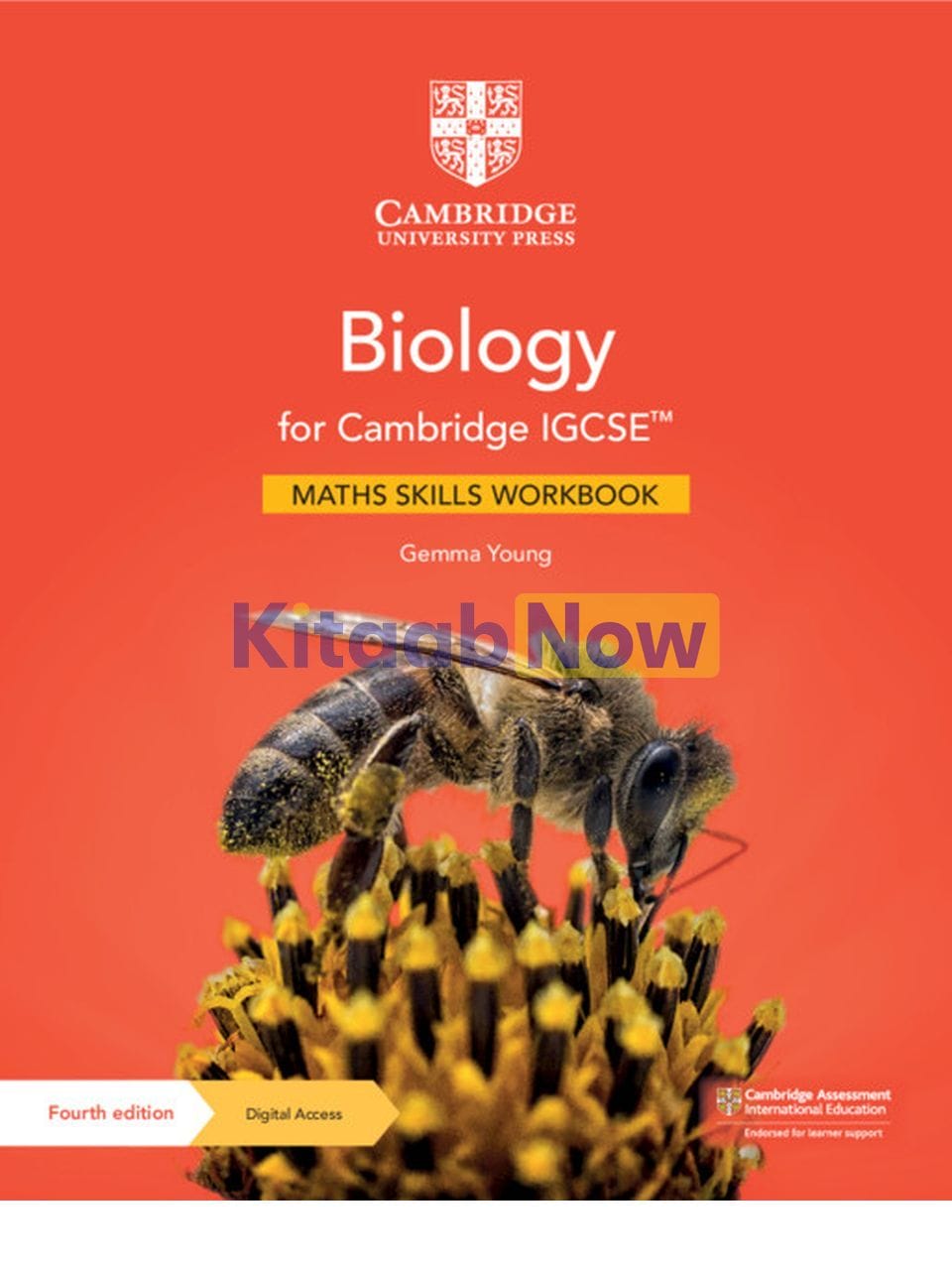
Biology for Cambridge IGCSE™ Maths Skills Workbook with Digital Access (2 Years)
- Author: Gemma Young
- ISBN: 9781108947527
- Publisher: Cambridge University Press
- Edition: 4th
- Format: Paperback – 154 pages
- Language: English
Description
The maths skills workbook helps learners to develop their maths skills in the context of the Cambridge IGCSE™ Biology syllabus. These skills are crosslinked to the coursebook to help students understand how to use them. Practice exercises provide opportunities for learners to practise each maths skill. To support students in acquiring these skills, the exercises gradually increase in complexity. Practice questions provide opportunities for students to practise their skills in an active learning format such as discussion opportunities and pair work. Exam-style questions give students the chance to apply the skills they have learnt in an exam-style context. In the last chapter, students will need to select which maths skills they ought to apply in different contexts, without the structure and guidance provided in each of the chapters, helping them become confident, independent learners.
Key Features
- Written by experts in both biology and mathematics based on research carried out by the Nuffield Foundation and the Association for Science Education (ASE)
- Maths skills are crosslinked to other resources in the series to help students understand how to use them
- Practice exercises gradually increase in complexity to support students in developing maths skills
- Worked examples illustrate the concept, provide a skills-based step-by-step approach to answering a question, helping learners to develop their thinking processes
- The ‘Look out’ feature makes students aware of common misconceptions that might be holding them back
- Exam-style questions require students to select which maths skills they ought to apply in different contexts, without the structure and guidance provided in each of the chapters, helping them become confident, independent learners
Table of Contents
- How to use this series
- How to use this book
- Introduction
- Skills grid
- Representing values
- Using units
- Choosing the correct unit
- Using unit symbols
- Using derived units
- Representing very large and very small numbers
- Writing very large numbers in standard form
- Writing very small numbers in standard form
- Using unit prefixes and converting units
- Using powers of ten
- Using negative powers of ten
- Using unit prefixes
- Converting units
- Exam-style questions
- Working with data
- Naming types of data
- Identifying independent and dependent variables
- Identifying types of data
- Collecting data
- Choosing a suitable measuring instrument
- Reading the correct value on measuring instruments
- Using the correct number of significant figures
- Recording and processing data
- Designing a suitable results table
- Calculating the mean
- Exam-style questions
- Drawing graphs and charts
- Drawing bar charts
- Choosing a suitable scale for the y-axis
- Drawing histograms
- Putting the data into classes
- Drawing line graphs
- Drawing the axes
- Plotting the data points
- Drawing the line or curve of best fit
- Exam-style questions
- Interpreting data
- Interpreting bar charts, histograms and pie charts
- Identify the categories and describe what the data show
- Interpreting relationships in graphs
- Interpreting straight-line graphs
- Interpreting more complex line graphs
- Interpreting scatter graphs
- Reading values from a line graph
- Interpolation
- Extrapolation
- Exam-style questions
- Doing calculations
- Calculating percentages
- Calculating percentages
- Calculating percentage change
- Using scale drawings and magnification
- Interpreting scale drawings
- Using the magnification formula
- Understanding ratio and probability
- Calculating ratio
- Calculating probability
- Exam-style questions
- Working with shape
- Calculating area
- Calculating the surface area of a cube and a rectangular block
- Calculating the area of a circle
- Exam-style questions
- Additional questions involving several maths skills
- Glossary
- Acknowledgements.
Additional information
| Weight | 0.430 kg |
|---|
Only logged in customers who have purchased this product may leave a review.
Related Products

Reviews
There are no reviews yet.