
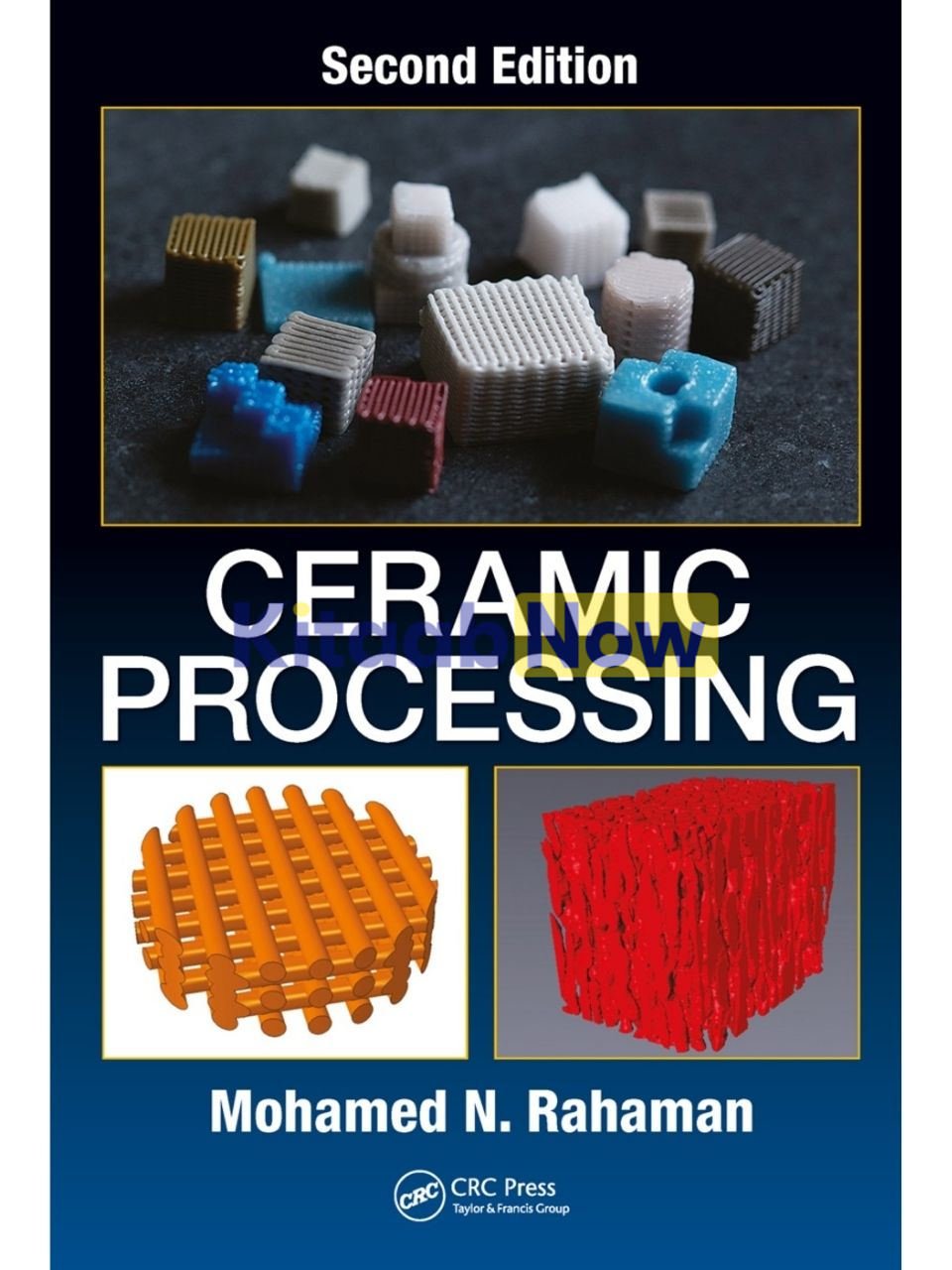
Ceramic Processing
- Author: Mohamed N. Rahaman
- ISBN: 9781498716413
- Publisher: CRC Press
- Edition: 2nd
- Publication Date: June 7, 2017
- Format: Hardback – 550 pages
- Language: English
Description
Many of the properties critical to the engineering applications of ceramics are strongly dependent on their microstructure which, in turn, is dependent on the processing methods used to produce the ceramic material. Ceramic Processing, Second Edition provides a comprehensive treatment of the principles and practical methods used in producing ceramics with controlled microstructure.
Covering the main steps in the production of ceramics from powders, the book also provides succinct coverage of other methods for fabricating ceramics, such as sol−gel processing, reaction bonding, chemical vapor deposition and polymer pyrolysis.
While maintaining the objectives of the successful first edition, this new edition has been revised and updated to include recent developments and expanded to feature new chapters on additives used in ceramic processing; rheological properties of suspensions, slurries, and pastes; granulation, mixing, and packing of particles; and sintering theory and principles.
Intended as a textbook for undergraduate and graduate courses in ceramic processing, the book also provides an indispensable resource for research and development engineers in industry who are involved in the production of ceramics or who would like to develop a background in the processing of ceramics.
Table of Contents
- Chapter 1 Ceramic Fabrication Processes – An Introductory Overview
- 1. Introduction
- 2. Ceramic Fabrication Processes
- 3.Fabrication of Ceramics from Powders: An Overview
- 1.3.1 Powder Synthesis and Characterization
- 1.3.2 Powder Consolidation
- 1.3.3 The Sintering Process
- 1.3.4 Ceramic Microstructures
- 1. Case Study in Processing: Fabrication of Al2O3 from Powders
- 2. Concluding Remarks
- References
- Chapter 2 Synthesis and Preparation of Powders: Mechanical Methods
- 2.1 Introduction
- 2.2 Powder Characteristics
- 2.3 Powder Preparation by Mechanical Methods
- 2.4 High Compression Roller Mills
- 2.5 Jet Mills
- 2.6 Ball Mills
- 2.7 High-Energy Ball Milling
- 2.8 Concluding Remarks
- Problems
- References
- Chapter 3 Powder Synthesis by Chemical Methods
- 3.1 Introduction
- 3.2 Solid State Reactions
- 3.2.1 Decomposition
- 3.2.2 Reaction between Solids
- 3.3.2 Reduction
- 3.3 Precipitation from Liquid Solutions
- 3.3.1 Principles of Precipitation from Solution
- 3.3.2 Methods for Preparing Powders by Precipitation from Solution
- 3.3.3 Precipitation Methods Based on Evaporation of the Liquid
- 3.4 Freeze Drying
- 3.5 Gel Routes
- 3.5.1 Sol- Gel Processing
- 3.5.2 Pechini Method
- 3.5.3 Citrate Gel Method
- 3.5.4 Glycine Nitrate Process
- 3.6 Non-Aqueous Liquid Reactions
- 3.7 Vapor Phase Reactions
- 3.7.1 Gas- Solid Reaction
- 3.7.2 Reaction between Gases
- 3.8 Concluding Remarks
- Problems
- References
- Chapter 4 Synthesis of Ceramic Nanoparticles
- 4.1 Introduction
- 4.2 Methods for Synthesizing Ceramic Nanoparticles
- 4.3 Solid- Solid Methods
- 4.4 Solid- Vapor- Solid Methods
- 4.5 Liquid- Solid Methods
- 4.6 Liquid- Vapor- Solid Methods
- 4.7 Concluding Remarks
- Problems
- References
- Chapter 5 Powder Characterization
- 5.1 Introduction
- 5.2 Physical Characterization
- 5.2.1 Types of Particles
- 5.2.2 Particle Size and Particle Size Distribution
- 5.2.3 Particle Shape
- 5.2.4 Measurement of Particle Size and Size Distribution
- 5.2.5 Surface Area
- 5.2.6 Porosity of Particles
- 5.3 Chemical Composition
- 5.4 Crystal Structure and Phase Composition
- 5.5 Surface Characterization
- 5.5.1 Surface Structure
- 5.5.2 Surface Chemistry
- 5.6 Concluding Remarks
- Problems
- References
- Chapter 6 Science of Colloidal Processing
- 6.1 Introduction
- 6.2 Types of Colloids
- 6.3 Attractive Surface Forces
- 6.3.1 Van der Waals Forces between Atoms and Molecules
- 6.3.2 Van der Waals Forces Macroscopic Bodies
- 6.3.3 The Hamaker Constant
- 6.3.4 Effect of the Intervening Medium
- 6.4 Stabilization of Colloidal Suspensions
- 6.5 Electrostatic Stabilization
- 6.5.1 Charges on Particles in a Liquid
- 6.5.2 Origins of the Electrical Double Layer
- 6.5.3 Isolated Double Layer
- 6.5.4 Surface Charge
- 6.5.5 Repulsion between Two Double Layers
- 6.5.6 Stability of Electrostatically Stabilized Colloids
- 6.5.7 Kinetics of Flocculation
- 6.5.8 Electrokinetic Phenomena
- 6.6 Steric Stabilization
- 6.6.1 Adsorption of Polymers from Solution
- 6.6.2 Origins of Steric Stabilization
- 6.6.3 Effect of Solvent and Temperature
- 6.6.4 Stability of Sterically Stabilized Suspensions
- 6.6.5 Stabilization by Polymers in Free Solution
- 6.7 Electrosteric Stabilization
- 6.7.1 Dissociation of Polyelectrolytes in Solution
- 6.7.2 Adsorption of Polyelectrolytes from Solution
- 6.7.3 Stability of Electrosterically Stabilized Suspensions
- 6.8 Structure of Consolidated Colloids
- 6.9 Concluding Remarks
- Problems
- References
- Chapter 7 Rheology of Colloidal Suspensions, Slurries and Pastes
- 7.1 Introduction
- 7.2 Types of Rheological Behavior
- 7.2.1 Viscous Flow Behavior
- 7.2.2 Viscoelastic Behavior
- 7.3 Rheological Measurement
- 7.4 Factors Influencing the Viscosity of Colloidal Suspensions
- 7.4.1 Interparticle Forces
- 7.4.2 Particle Concentration
- 7.4.3 Particle Size and Particle Size Distribution
- 7.4.4 Particle Morphology
- 7.4.5 Suspension Medium
- 7.5 Concluding Remarks
- Problems
- References
- Chapter 8 Processing Additives
- 8.1 Introduction
- 8.2 Types of Additives
- 8.3 Solvents
- Selection of a Solvent
- 8.4 Dispersants
- 8.4.1 Inorganic Acid Salts
- 8.4.2 Surfactants
- 8.4.3 Low to Medium Molecular Weights Polymers
- 8.5 Binders
- 8.5.1 Inorganic Binders
- 8.5.2 Synthetic Organic Binders
- 8.5.3 Natural Organic Binders
- 8.5.4 Selection of a Binder
- 8.6 Plasticizers
- 8.7 Other Potential Additives
- 8.8 Concluding Remarks
- Problems
- References
- Chapter 9 Granulation, Mixing and Packing of Particles
- 9.1 Introduction
- 9.2 Granulation of Particles
- 9.2.1 Desirable Characteristics of Binders
- 9.2.2 Preparation of Granules
- 9.2.3 Spray Drying
- 9.2.4 Factors Controlling the Strength of Granules
- 9.2.5 Spray Freeze Drying
- 9.3 Mixing of Particles
- 9.3.1 Mixing and Segregation Mechanisms
- 9.3.2 Mixture Composition and Quality
- 9.3.3 Statistical Methods
- 9.3.4 Measurement Techniques
- 9.3.5 Mixing Technology
- 9.4 Packing of Particles
- 9.4.1 Regular Packing of Monosize Spheres
- 9.4.2 Random Packing of Particles
- 9.4.3 Packing of Continuous Size Distributions
- 9.5 Concluding Remarks
- Problems
- References
- Chapter 10 Forming of Ceramics; Conventional Methods
- 10.1 Introduction
- 10.2 Dry and Semi-Dry Pressing
- 10.2.1 Die Pressing
- 10.2.2 Isostatic Pressing
- 10.3 Suspension-Based Methods
- 10.3.1 Slip Casting
- 10.3.2 Pressure Casting
- 10.3.3 Tape Casting
- 10.3.4 Centrifugal Consolidation
- 10.3.5 Dip and Spin Coating
- 10.3.6 Electrophoretic Deposition
- 10.3.7 Freeze Casting
- 10.3.8 Gelcasting
- 10.3.9 Direct Coagulation Casting
- 10.3.10 Aqueous Injection Molding
- 10.4 Plastic Forming Methods
- 10.4.1 Extrusion
- 10.4.2 Injection Molding
- 10.5 Concluding Remarks
- Problems
- References
- Chapter 11 Additive Manufacturing of Ceramics
- 11.1 Introduction
- 11.2 Powder-Based Methods
- 11.2.1 Selective Laser Sintering
- 11.2.2 Three-Dimensional Printing
- 11.3 Particle-Filled Polymer Methods
- 11.3.1 Fused Deposition Modeling
- 11.3.2 Laminated Object Manufacturing
- 11.4 Suspension-Based Methods
- 11.4.1 Stereolithography
- 11.4.2 Inkjet Printing
- 11.4.3 Robocasting
- 11.4.4 Freeze Extrusion Fabrication
- Problems
- References
- Chapter 12 Drying, Debinding and Microstructural Characterization of Green Articles
- 12.1 Introduction
- 12.2 Drying of Granular Ceramics
- 12.2.1 Drying of Drops of a Suspension on a Surface
- 12.2.2 Drying of Adherent Coatings
- 12.2.3 Drying of Three-Dimensional Solids
- 12.2.4 Drying Technology
- 12.3 Binder Removal
- 12.3.1 Extraction by Capillary Flow
- 12.3.2 Solvent Extraction
- 12.3.3 Supercritical Extraction
- 12.3.4 Thermal Debinding
- 12.3.5 Thermal Debinding Process Design
- 12.4 Green Microstructures and Their Characterization
- 12.5 Concluding Remarks
- Problems
- References
- Chapter 13 Sintering Theory and Fundamentals
- 13.1 Introduction
- 13.1.1 Types of Sintering
- 13.1.2 Measurement of Sintering
- 13.1.3 Analysis of Sintering
- 13.2 Solid-State Sintering
- 13.2.1 Driving Force for Sintering
- 13.2.2 Effects of Surface Curvature
- 13.2.3 Grain Boundary Effects
- 13.2.4 Mechanisms of Sintering
- 13.2.5 Stages of Sintering
- 13.2.6 Theoretical Analysis of Solid-State Sintering
- 13.3 Grain Growth in Solid-State Sintering
- 13.3.1 Types of Grain Growth
- 13.3.2 Importance of Controlling Grain Growth
- 13.3.3 Normal Grain Growth
- 13.3.4 Abnormal Grain Growth
- 13.3.5 Ostwald Ripening
- 13.3.6 Control of Grain Growth
- 13.3.7 Grain Growth in Porous Ceramics
- 13.3.8 Simultaneous Densification and Grain Growth
- 13.4 Viscous Sintering
- 13.5 Liquid-Phase Sintering
- 13.5.1 Stages of Liquid-Phase Sintering
- 13.5.2 Microstructures of Liquid-Phase Sintered Ceramics
- 13.5.3 Role of Solid-State Sintering in Liquid-Phase Sintering
- 13.5.4 Thermodynamic and Kinetic Factors
- 13.5.5 Mechanisms of Liquid-Phase Sintering
- 13.5.6 Phase Diagrams in Liquid-Phase Sintering
- 13.6 Pressure-Assisted Sintering
- 13.6.1 Pressure-Assisted Sintering Models
- 13.6.2 Mechanisms of Pressure-Assisted Sintering
- 13.7 Field-Assisted Sintering Techniques
- 13.7.1 Spark Plasma Sintering
- 13.7.2 Flash Sintering
- 13.8 Concluding Remarks
- Problems
- References
- 13.1 Introduction
- Chapter 14 Sintering Process Variables and Techniques
- 14.1 Introduction
- 14.2 Sintering Furnaces and Furnace Supports
- 14.3 Effect of Particle Size and Packing
- 14.3.1 Particle Size
- 14.3.2 Particle Size Distribution
- 14.3.3 Particle Shape and Particle Structure
- 14.3.4 Particle Packing
- 14.3.5 Effect of Green Density
- 14.4 Anisotropic Shrinkage
- 14.4.1 Pore Shape Anisotropy
- 14.4.2 Particle Alignment
- 14.5 Heating Schedule
- 14.5.1 Design and Prediction of the Heating Schedule
- 14.5.2 Effect of Heating Rate on Sintering
- 14.5.3 Special Heating Schedules
- 14.6 Sintering Atmosphere
- 14.6.1 Gases in Pores
- 14.6.2 Effect on Vapor Transport
- 14.6.3 Volatilization and Decomposition
- 14.6.4 Oxidation State
- 14.7 Microwave Sintering
- 14.8 Pressure-Assisted Sintering
- 14.8.1 Hot Pressing
- 14.8.2 Hot Isostatic Pressing
- 14.9 Spark Plasma Sintering
- 14.10 Sintering of Ceramic Composites, Coatings and Multilayers
- 14.10.1 Sintering of Ceramic Composites
- 14.10.2 Sintering of Adherent Coatings
- 14.10.3 Co-sintering of Ceramic Multilayers
- 14.11 Conclusions
- Problems
- References
- Chapter 15 Sol−Gel Processing
- 15.1 Introduction
- 15.2 Sol−Gel Processing of Aqueous Silicates
- 15.3 Metal Alkoxides
- 15.3.1 Preparation of Metal Alkoxides
- 15.3.2 Basic Properties of Metal Alkoxides
- 15.4 Sol−Gel Processing of Silicon Alkoxides
- 15.4.1 Precursors
- 15.4.2 Hydrolysis and Condensation
- 15.4.3 Polymer Growth
- 15.4.4 Gelation
- 15.4.5 Drying of Gels
- 15.4.6 Gel Densification during Sintering
- 15.5 Sol−Gel Preparation Techniques
- 15.5.1 Preparation of Particulate Gels
- 15.5.2 Preparation of Polymeric Gels
- 15.6 Applications of Sol−Gel Processing
- 15.6.1 Thin Films and Coatings
- 15.6.2 Fibers
- 15.6.3 Monoliths
- 15.6.4 Porous Materials
- 15.6.5 Porous Materials
- 15.7 Concluding Remarks
- Problems
- References
- Chapter 16 Ceramic Fabrication Methods for Specific Shapes and Architectures
- 16.1 Introduction
- 16.2 Chemical Vapor Deposition
- 16.2.1 Plasma-Assisted Chemical Vapor Deposition
- 16.2.2 Chemical Vapor Infiltration
- 16.3 Directed Metal oxidation
- 16.4 Reaction Bonding
- 16.4.1 Reaction-Bonded Silicon Nitride
- 16.4.2 Reaction-Bonded Silicon Carbide
- 16.4.3 Reaction Bonding of Oxide Ceramics
- 16.5 Polymer Pyrolysis
- 16.6 Fabrication Routes for Fiber-Reinforced Ceramic Matrix Composites
- 16.6.1 Processing of SiC Fiber-Reinforced SiC Matrix Composites
- 16.6.2 Processing of Oxide Fiber-Reinforced Oxide Matrix Composites
- 16.7 Concluding Remarks
- Problems
- References
- Appendix A: Physical Constants
- Appendix B: SI Units – Names and Symbols
- Appendix C: Conversion of Units
- Appendix D: Aperture size of U.S. Standard Wire Mesh Sieves (ASTM E 11:87)
- Appendix E: Densities and Melting Points of Some Elements, Ceramics and Minerals
Author Description
Mohamed N. Rahaman is Professor of Ceramics in the Department of Materials Science and Engineering, University of Missouri–Rolla. He received B.A. (Hons) and M.A. degrees from the University of Cambridge, England, and a Ph.D. degree from the University of Sheffield, England. Prior to joining the University of Missouri in 1986, Dr. Rahaman held positions at the University of Leeds, England; the University of the West Indies, Trinidad; and the Lawrence Berkeley National Laboratory, Berkeley, California. Dr. Rahaman is the author of three books and the author or coauthor of more than 135 publications, most of them in the area of processing and sintering of ceramics.
Additional information
| Weight | 1.157 kg |
|---|
Only logged in customers who have purchased this product may leave a review.
Related Products


Reviews
There are no reviews yet.