

Crime And Behaviour: An Introduction To Criminal And Forensic Psychology
- Author: Majeed Khader
- ISBN: 9789813279339
- Publisher: World Scientific Publishing
- Publication Date: July 10, 2019
- Format: Hardback – 460 pages
- Language: English
Out of stock
Description
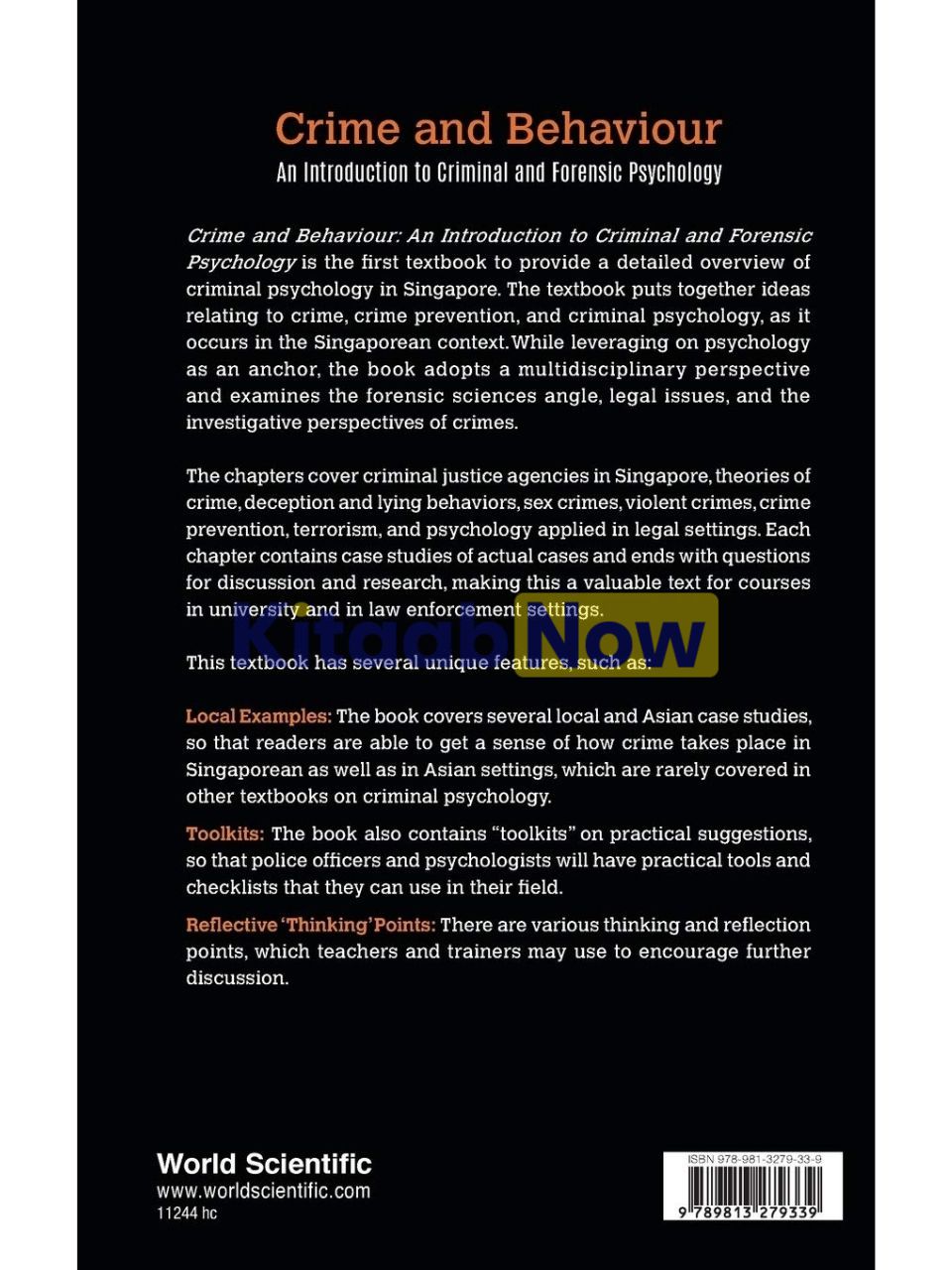
Crime and Behaviour: An Introduction to Criminal and Forensic Psychology is the first textbook to provide a detailed overview of criminal psychology in Singapore. The textbook puts together ideas relating to crime, crime prevention, and criminal psychology, as it occurs in the Singaporean context. While leveraging on psychology as an anchor, the book adopts a multidisciplinary perspective and examines the forensic sciences angle, legal issues, and the investigative perspectives of crimes.
The chapters cover criminal justice agencies in Singapore, theories of crime, deception and lying behaviors, sex crimes, violent crimes, crime prevention, terrorism, and psychology applied in legal settings. Each chapter contains case studies of actual cases and ends with questions for discussion and research, making this a valuable text for courses in university and in law enforcement settings.
Key Features
- Local Examples: The book covers several local and Asian case studies, so that readers are able to get a sense of how crime takes place in Singaporean as well as in Asian settings, which are rarely covered in other textbooks on criminal psychology.
- Toolkits: The book also contains “toolkits” on practical suggestions, so that police officers and psychologists will have practical tools and checklists that they can use in their field.
- Reflective ‘Thinking’ Points: There are various thinking and reflection points, which teachers and trainers may use to encourage further discussion.
Table of Contents
- Introduction to Criminal and Forensic Psychology
- Introduction
- What is Crime?
- What is Criminal and Forensic Psychology?
- Working as a Forensic Psychologist
- Where do forensic psychologists work?
- Related disciplines
- Principles (Mantras) of effective professional practice
- Working as a Forensic Psychologist
- The Criminal Justice System
- Stages in the Criminal Justice Process
- The ‘dark figure’ and measuring crime
- Stages in the Criminal Justice Process
- Organisations within the Criminal Justice System and Related Agencies
- How are Arrests and Investigations Conducted?
- How the Judiciary Works
- The Singapore Judicial System
- Laws and the ‘The Rule of Law’
- Who Makes the Law?
- Crimes and Criminal Behaviour
- Crimes Trends in Singapore
- Theories of Criminal Behaviour
- Situational and Environmental Theories
- Macro Sociological Theories
- Family and Developmental Factors
- Psychological Factors
- Biological and Physiological Factors
- Physiology, drugs, and alcohol
- Summary
- Relevant Journals, Books and Resources
- Some Relevant Legislation
- E-resources
- Some Relevant Legal Cases of Interest
- Sample Research Paper Titles
- References
- Introduction
- Deception and the Detection of Deception
- Introduction
- Defining Deception
- How Frequently Does Deception Occur?
- Types of Lies
- Deception and Demographic Differences
- Deception by Crime Type
- Deception in Psychiatric Patients
- Why Do People Lie?
- Why Are People Poor Lie Detectors?
- Approaches to Understanding Deception
- Techniques for Detecting of Deception (DOD)
- Practical Recommendations to Improve the Detecting of Deception (TOOLKIT)
- Systems Solutions to Better Detect Deception
- Enhancing Personal Lie-Detection Skills During Interview
- Summary
- Relevant Journals
- Useful E-resources
- Sample Research Paper Titles
- References
- Introduction
- Criminal Profiling
- Introduction
- Who Are Profilers?
- What Is Criminal Profiling?
- Nomothetic Profiling (Crime Category Profiling) and Idiographic Profiling (Criminal and Crime Scene Profiling)
- Profiling as a Sub-Area of Investigative Psychology
- Assumptions in Offender Profiling
- The Main Approaches in Criminal Profiling
- Profiling: The Federal Bureau of Investigation (FBI) Approach
- FBI’s profiling process
- More concepts in the FBI’s approach
- Profiling Using Databases
- Profiling Using Clinical Psychology
- Profiling Using Investigative Psychology
- Profiling Using Geographical Profiling
- Profiling Using Criminalistics and Forensic Science
- The CLIP Profiling Approach (Recommended)
- Using CLIP crime profiling in general (nomothetic profile) (for use in crime prevention messaging, policy design and rehabilitation planning)
- TOOLBOX: Using the CLIP approach to narrow down suspects (idiographic applications) — for use in narrowing down suspects, assisting in interviewing and investigation, prosecution, and courtroom work
- Advantages and disadvantages of CLIP
- Profiling: The Federal Bureau of Investigation (FBI) Approach
- Summary
- Relevant Journals
- E-Resources
- Sample Research Essay Titles
- Sample Research Paper Titles
- References
- Sex Offending
- Introduction
- What is Sexual Violence?
- Definition of Rape
- Sub-categories of Rape
- Legislation on Sexual Violence
- Offences in the U.K. and the U.S.
- Sexual Offences in Singapore
- Other Sexual Offences
- Differences between Legal and Psychological/Behavioural Classifications
- Prevalence
- Characteristics of Rapists and Other Sex Offenders
- Child Sex Offending
- Child abuse
- Male and female child sex offenders
- Child abuse in Singapore
- Internet Child Sex Offending
- The Psychological Process of Sexual Grooming
- Child Sex Offending
- Psychological Explanations for Sex Offending
- Common Modus Operandi (MO)
- Forensic Evidence and Criminalistics
- Preventing and Managing Sexual Offending
- Situational Crime Prevention
- TOOLKIT: How to Interview Victims of Sex Crimes
- Sex Offender Registries as Preventative Measure?
- Assessing Sex Offenders
- Sexual Deviance, Paraphilia and Offending
- Treating Sex Offenders
- Summary
- Relevant Journals
- E-Resources
- Some Relevant Legal Cases
- Sample Research Essay Questions
- References
- Violent Offending
- Introduction
- Defining Violence and Homicide
- Defining Violence
- Defining Homicide
- Violence Versus Aggression
- Instrumental Versus Reaction Aggression
- Characteristics of Violent Crimes and Homicides
- Causes of Violence: Theories and Explanations
- Characteristics of Homicide Offenders
- Prevalence Rates of Homicide in Singapore
- Laws Relating to Homicide
- Murder and Culpable Homicide
- Relationship between Homicide Offences and the Law
- Investigating Homicide and Death Scenes
- Evaluating Success in Homicide Investigations
- Forensic Sciences Considerations in Homicide
- Psychology, Behavior, and Crime Scene Evidence
- Psychological Aspects of Violence Risk
- Concept of “Duty to Warn”
- The Possible Link between Domestic Violence and Homicide
- Violence Risk Assessment Using Structured Risk Assessment Tools
- Treating Violent Offenders
- Cultural Inclusiveness in Rehabilitation
- Cultural Approaches to Treatment: ‘In Search of Your Warrior’ (ISYW) Program
- Crime Prevention
- Preventing Homicide Using Multi-Agency Risk Assessment Conference (MARAC)
- Specific Crime Reduction Strategies
- Summary
- Relevant Journals
- E-Resources
- Some Relevant Legal Cases
- Sample Essay Titles
- References
- Responding to Crime
- Introduction
- Primary Crime Prevention Measures
- Crime Prevention through Social Development
- Crime Prevention through Environmental Design
- 25 Crime Prevention Techniques: Combining People and Environment Strategies
- Other Primary Prevention Measures
- Closed Circuit TV (CCTV)
- Neighbourhood watch scheme
- The National Crime Prevention Council
- Community policing
- New developments in policing
- Secondary Crime Prevention Measures
- Engaging ‘At-Risk’ Youths
- The Delta League Story
- Hot Spots Policing
- Big Data and Predictive Policing
- Clubs Against Drugs Campaign
- Anti-Drug Abuse Campaign and ‘Danceworks’
- Deterring Young People through Meetings with Reformed Inmates
- Tertiary Crime Prevention: Punishment and Treatment
- Imprisonment and Punishment
- Rehabilitation and Treatment Programs
- Risks, Needs, and Responsivity Framework (RNR)
- Understanding ‘Risk’
- Understanding ‘Needs’
- Understanding Responsivity
- RNR instruments
- The Good Lives Model for Rehabilitation
- Corrections in Singapore: The Singapore Prisons Service
- New Penologies
- Treatment at the Ministry of Social and Family Development (Centre of Forensic Mental Health)
- Community-based Corrections and Treatments
- Other Criminal Justice Concepts
- Restorative Justice
- Therapeutic Jurisprudence (TJ)
- Summary
- Relevant Journals/Books
- Local books
- E-Resources and Books
- Some Legal Cases of Interest
- Sample Research Essay Titles
- References
- Terrorism and Violent Extremism
- Introduction
- Defining Terrorism
- Types of Terrorism
- Distinguishing Terrorism, Extremism, and Radicalisation: Conceptual Challenges
- Pathways of Radicalisation
- Levels of Explanations for Extremism
- Psychological Characteristics of Terrorists
- Do Terrorists Have Mental Health Issues?
- Assessing the Risk and Protective Factors for Violent Extremists
- Forensic Science Considerations
- Terrorism: The Singapore Experience
- The Jemaah Islamiyah Threat
- Psychological Characteristics of JI Members
- Understanding Other Terrorism Concerns
- ISIS or Daesh
- Violence in Myanmar (969 Movement)
- The Concern with Lone Wolves
- Developing Effective Counterterrorism Measures
- Summary
- Relevant Journals
- E-Resources
- Sample Research Essay Titles
- References
- Introduction
- Applying Forensic Psychology in Legal Settings
- Introduction
- Roles of a Forensic-Legal Psychologist
- Special Topics in Criminal Law Applications
- Eyewitness Testimony
- False Memories
- Investigative Interviewing
- Psychological Impact of Criminal Victimisation
- Special Topics Under Civil Law
- Child Custody Evaluations
- Work-Related Stress
- Assessment of Personal Injury
- Assessment of Sexual Harassment
- Summary
- E-Journals and Books
- Some Relevant Legal Case Studies
- Sample Research Essay Titles
- References
- Introduction
Author Biography
With over 26 years of applied working experience as a forensic and criminal psychologist, Dr Majeed Khader is Chief Psychologist at the Ministry of Home Affairs, Singapore. A pioneering police psychologist, he is Senior Consultant Psychologist and Director of the Home Team Behavioural Sciences Center. Trained in crisis negotiation and profiling, he was deputy commander of the police crisis negotiation unit and currently remains as Mentor to the unit. Majeed holds a Master’s degree (with Distinction) in Forensic Psychology from Leicester University (UK) and a PhD in Psychology, (Crisis Management) from Aberdeen University (Scotland). During his career, he has overseen the development of psychological services in the areas of employee selection, resilience, leadership, criminal profiling, terrorism and crisis psychology. He was awarded the National Day Award (Bronze) in 2005 and NDA (Silver Award) in 2014 by the President of Singapore. Dr Majeed is an Associate Professor (Adjunct) at the Department of Psychology at Nanyang Technological University (NTU), Singapore, where he has been teaching criminal psychology for more than a decade. He has presented at the National University of Singapore, James Cook University (Singapore), University of Liverpool, Leicester University and Cambridge University. He is also a Member of the School Advisory Committee for Temasek Polytechnic (Psychology Program), and an Associate Member of the Forensic and Investigative Department of the University of Liverpool (UK). He is Asian Director for the Society of Police and Criminal Psychology (USA) and a member of the Asia Pacific Association of Threat Assessment Professionals. He holds memberships with the American Psychological Association, The British Psychological Society and the Singapore Psychological Society. He has given lectures at the Federal Bureau of Investigations (FBI), Royal Canadian Mounted Police (RCMP), and London Metropolitan Police. He has also published widely in journals and book chapters and is the author and co-author of Combating Violent Extremism and Radicalization in the Digital Era, The Ostrich, The Ah Long, The Con Woman and the Creepy Guy: The Story of Crime Prevention in Singapore and Learning from Violent Extremist Attacks Behavioural Sciences Insights for Practitioners and Policymakers.
Additional information
| Weight | 0780.18 kg |
|---|
Only logged in customers who have purchased this product may leave a review.
Related Products





Reviews
There are no reviews yet.