
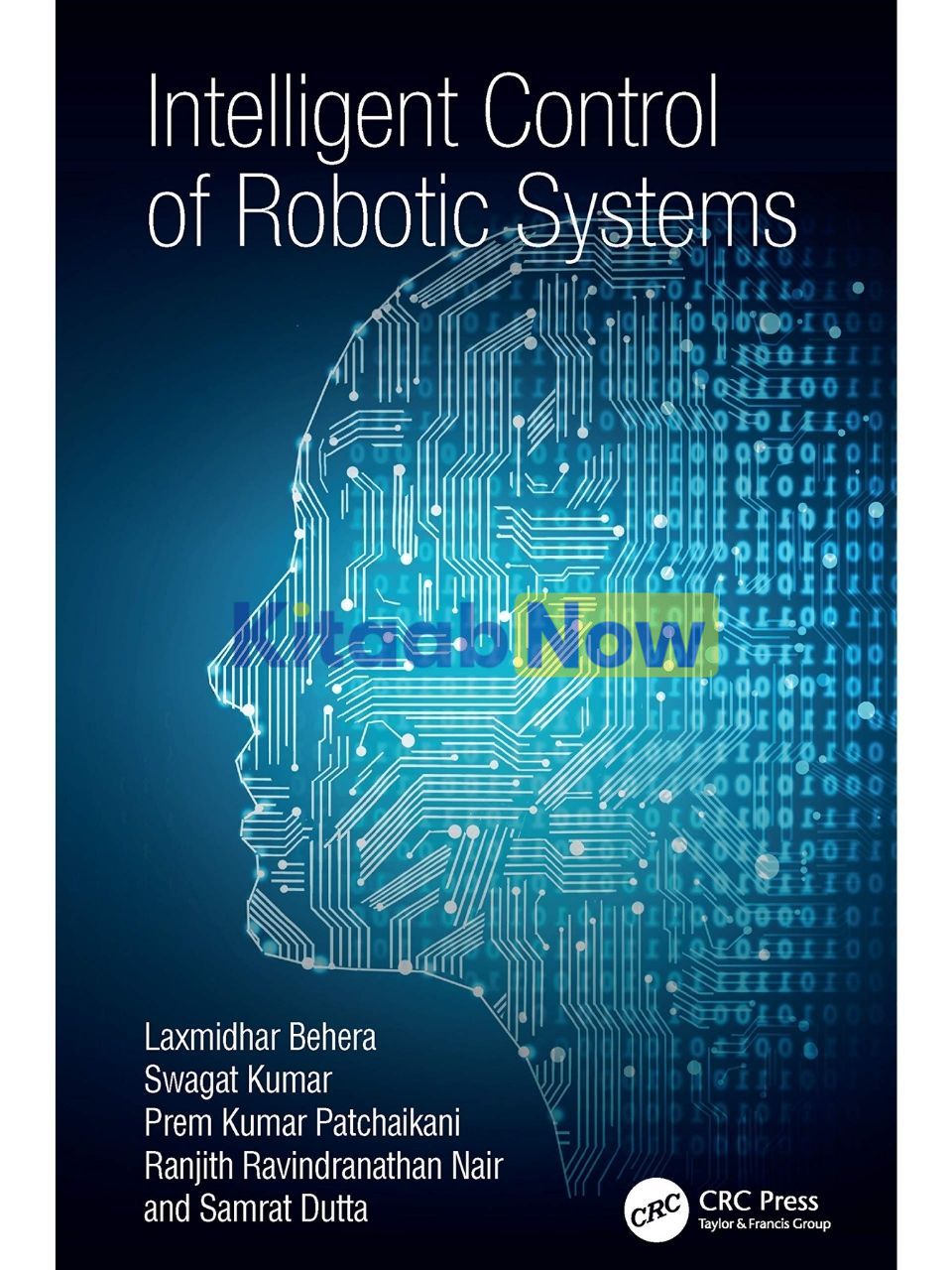
Intelligent Control of Robotic Systems
- Authors: Laxmidhar Behera, Swagat Kumar, Prem Kumar Patchaikani, Ranjith Ravindranathan Nair, Samrat Dutta
- ISBN: 9781138597716
- Publisher: CRC Press
- Publication Date: April 10, 2020
- Format: Hardback – 650 pages
- Language: English
Description
This book illustrates basic principles, along with the development of the advanced algorithms, to realize smart robotic systems. It speaks to strategies by which a robot (manipulators, mobile robot, quadrotor) can learn its own kinematics and dynamics from data. In this context, two major issues have been dealt with; namely, stability of the systems and experimental validations. Learning algorithms and techniques as covered in this book easily extend to other robotic systems as well. The book contains MATLAB- based examples and c-codes under robot operating systems (ROS) for experimental validation so that readers can replicate these algorithms in robotics platforms.
Table of Contents
- Introduction
- Part 1: Manipulators
- Kinematic and Dynamic Models of Robot Manipulators
- Hand-eye Coordination of a Robotic Arm using KSOM Network
- Model-based Visual Servoing of a 7 DOF Manipulator
- Learning-Based Visual Servoing
- Visual Servoing using an Adaptive Distributed Takagi-Sugeno (T-S) Fuzzy Model
- Kinematic Control using Single Network Adaptive Critic
- Dynamic Control using Single Network Adaptive Critic
- Imitation Learning
- Visual Perception
- Vision-Based Grasping
- Warehouse Automation: An Example
- Part 2: Mobile Robotics
- Introduction to Mobile Robotics and Control
- Multi-robot Formation
- Event Triggered Multi-Robot Consensus
- Human Tracking Algorithm using SURF Based Dynamic Object Model.
- Exercises.
- Bibliography.
- Index.
Authors Biography
Laxmidhar Behera received the B.Sc. and M.Sc. degrees in engineering from National Institute of Technology Rourkela, Rourkela, India, in 1988 and 1990, respectively, and the Ph.D. degree from the Indian Institute of Technology (IIT) Delhi, New Delhi, India. During 1995–1999, he was an Assistant Professor with Birla Institute of Technology and Science Pilani. During 2000–2001, he pursued the postdoctoral studies with the German National Research Center for Information Technology (GMD), Sank Augustin, Germany. During 2007–2009, he was a Reader with the Intelligent Systems Research Center, University of Ulster, Derry, U.K., on sabbatical from IIT Kanpur. He has also worked as a Visiting Researcher/Professor with FHG, Germany, and ETH, Zurich, Switzerland. He is currently a Professor with the Department of Electrical Engineering, IIT Kanpur. He has authored or coauthored over 200 papers published in refereed journals and presented in conference proceedings. He has been elected as Fellow of the Indian National Academy of Engineering (INAE) in 2017 for his distinguished contributions in the field of ‘Engineering. His research interests include intelligent control, robotics, information retrieval, neural networks, cyber-physical systems, and cognitive modeling.
Swagat Kumar obtained his Bachelor’s degree in Electrical Engineering from North Orissa University in 2001 and his Master’s and his Ph.D. degree in Electrical Engineering from IIT Kanpur in 2004 and 2009 respectively. He was a postdoctoral researcher at Kyushu University in Japan during 2009-10. He, then, worked as an assistant professor at IIT Jodhpur for about two years before joining TCS Research in 2012. He currently heads the robotics research group at TATA Consultancy Services in New Delhi. His research interests include Robotics, Computer Vision and Machine Learning. He is a member of IEEE Robotics and Automation Society. He has co-authored about 40 articles in peer-reviewed conferences and journals and filed several patents.
Prem Kumar Patchaikani received the B.E. degree in electrical and electronics engineering from Thiagarajar College of Engineering, Madurai, India, in 2003, the M.Tech. degree in power and control from IIT Kanpur, Kanpur, India, in 2005, and the Ph.D. degree from the Department of Electrical Engineering, IIT Kanpur, in 2012. He was a Design Engineer with Larsen & Toubro Ltd., Chennai, India, from 2005 to 2006. He was a Visiting Researcher with the Intelligent System Research Center, University of Ulster, Londonderry, U.K., from 2008 to 2009, and in 2011. He is currently a Lead Engineer with General Electric, Bengaluru, India. His current research interests include visual servoing, redundant manipulator s, neural networks and fuzzy logic-based control, adaptive critic, system identification, and IC engine controls.
Ranjith Ravindranathan Nair received the Master’s degree in guidance and navigational control from the College of Engineering, Thiruvananthapuram, Kerala, India. He received his Ph.D in control and automation from the Department of Electrical Engineering, Indian Institute of Technology (IIT) Kanpur, Kanpur, India. After completing his Ph.D, he was working as a post doctoral research fellow in Intelligent Systems and Control Lab at IIT Kanpur. Currently, he is working as an Assistant Professor in the Department of Electronics & Communication Engineering at Indian Institute of Information Technology Pune, India. His primary research interests include nonlinear control systems, multiagent systems, formation control, Intelligent control, cyber-physical systems and mobile robotics.
Samrat Dutta received the B.Tech. degree in electrical and electronics engineering from the Siliguri Institute of Technology, Siliguri, India, in 2005, and the M.Tech. degree in electrical engineering with a specialization in control system from the Department of Electrical Engineering, Jadavpur University, Kolkata, India, in 2010. He has received his Ph.D. degree in control and Automation from the Department of Electrical Engineering, IIT Kanpur, Kanpur, India in 2018. He was a Cluster Head with Sterling Communications Ltd., Chennai, India, from 2005 to 2007, where he was involved in Tata Teleservices mobile network infrastructure projects in India. He is currently working as a research scientist with TCS innovations Labs, Bangalore, India. His current research interests include Imitation learning, Reinforcement Learning, Intelligent Robots, Robotic Vision, Deep Learning, neural networks and fuzzy logic-based control, and system identification.
Additional information
| Weight | 1.039 kg |
|---|
Only logged in customers who have purchased this product may leave a review.
Related Products




Reviews
There are no reviews yet.