
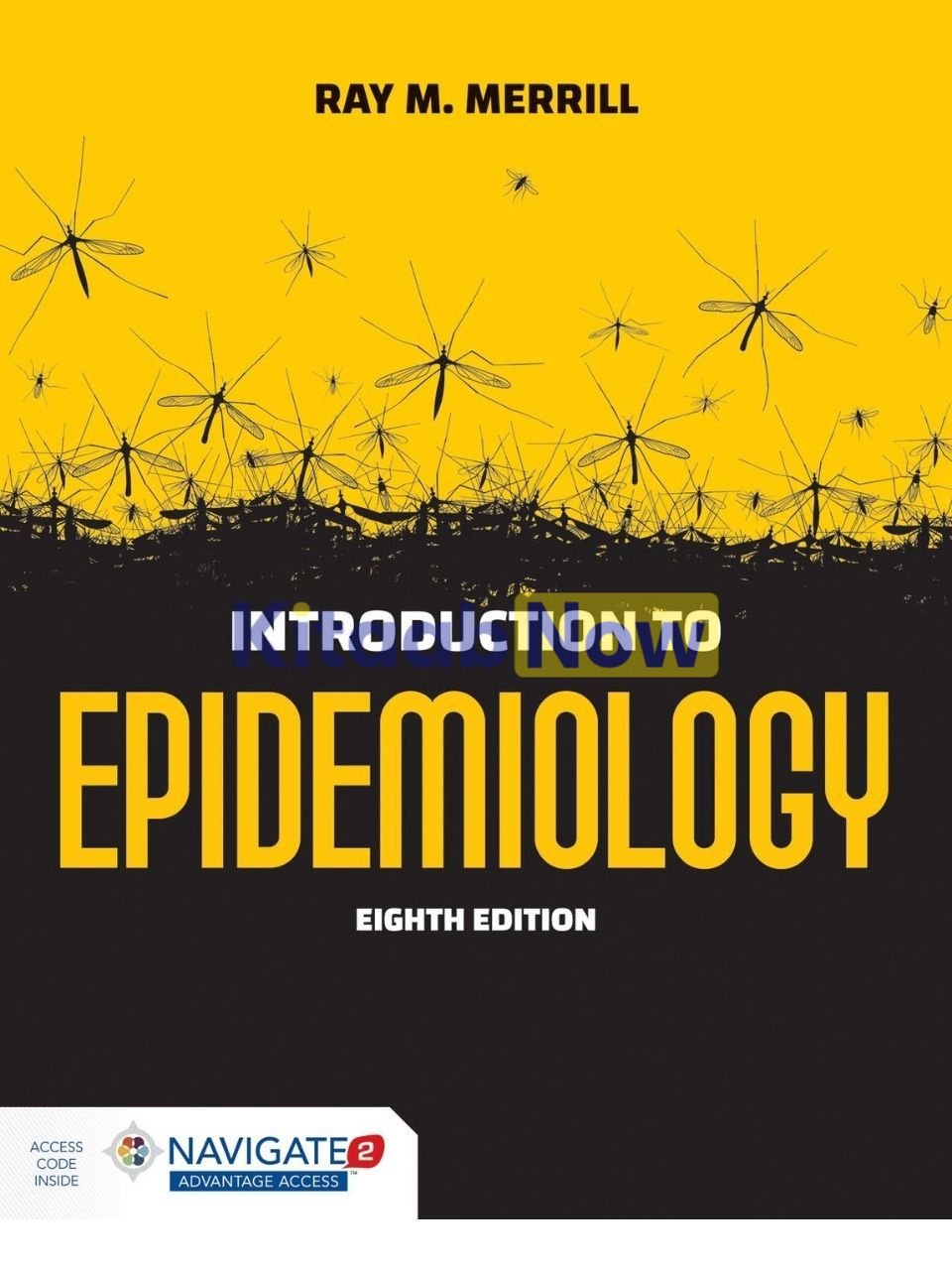
Introduction To Epidemiology (8th Revised Edition)
- Author: Ray M. Merrill
- ISBN: 9781284170702
- Publisher: Jones and Bartlett Publishers
- Edition: 8th Revised
- Publication Date: October 15, 2019
- Format: Paperback – 348 pages
- Language: English
Description
Recognized by Book Authority as one of the best Public Health books of all time, Introduction to Epidemiologyis a comprehensive, reader-friendly introduction to this exciting field. Designed for students with minimal training in the biomedical sciences and statistics, this full-color text emphasizes the application of the basic principles of epidemiology according to person, place, and time factors in order to solve current, often unexpected, and serious public health problems.
Students will learn how to identify and describe public health problems, formulate research hypotheses, select appropriate research study designs, manage and analyze epidemiologic data, interpret and apply results in preventing and controlling disease and health-related events. With real-world examples in the form of case studies and news files in each chapter, Introduction to Epidemiology is an accessible, timely, and highly effective approach to learning epidemiology.
Key Features
- Same organization as the prior edition allowing for easier transition
- New or expanded coverage of the models of causation, methods of age adjustment, age-period cohort models, incubation and latency periods, and receiver operating characteristic (ROC) curves
- Clearer connection between statistical inference and causal inference
- New and updated practical examples and News Files help solidify concepts and show real-world application
- Updated tables and figures throughout
- Access to Navigate 2 Advantage Access; includes a comprehensive and interactive eBook, student practice activities and assessments, learning analytics reporting tools, and more
- A built-in adaptive learning feature enables students to take self-assessments before or after reading a chapter. Based on their performance they can map out their own custom study plan that directs them to the areas of the text to review.
Table of Contents
- Chapter Foundations of Epidemiology
- Chapter Historic Developments in Epidemiology
- Chapter Practical Disease Concepts in Epidemiology
- Chapter Design Strategies and Statistical Methods in Descriptive Epidemiology
- Chapter Descriptive Epidemiology According to Person, Place, and Time
- Chapter General Health and Population Indicators
- Chapter Design Strategies and Statistical Methods in Analytic Epidemiology
- Chapter Experimental Studies in Epidemiology
- Chapter Causality
- Chapter Field Epidemiology
- Chapter Chronic Disease Epidemiology
- Chapter Clinical Epidemiology
- Appendix I Case Studies
- Appendix II Measures of Association Used with Types of Exposure and Outcome Data
- Appendix III Common Study Designs with Selected Measures of Association and Test Statistics
- Appendix IV Summary of Confidence Intervals for Evaluating Selected Hypotheses
- Appendix V Classification and Specialty Journals in Epidemiology
- Appendix VI Epidemiologic Associations and Societies
- Appendix VII Selected Answers to Chapter Questions
Author Biography
Ray M. Merrill, PhD, MPH – Professor of Epidemiology and Biostatistics, Department of Health Sciences, College of Life Sciences, Brigham Young University, Provo, Utah, Adjunct Professor of Epidemiology, Department of Family and Preventive Medicine,University of Utah College of Medicine, Salt Lake City, Utah
Ray M. Merrill, Ph.D., M.P.H. has been actively involved in epidemiology and biostatistics since his professional career began in 1995. As a Cancer Prevention Fellow at the National Cancer Institute, he worked with leading researchers in the area of cancer epidemiology. In 1998 he joined the faculty in the Department of Health Science at Brigham Young University, Provo, Utah, where he continued his research in epidemiology. Since 1999 he has also held an adjunct faculty position in the Department of Family and Preventive Medicine at the University of Utah. In 2001, he spent a sabbatical working in the Unit of Epidemiology for Cancer Prevention at the International Agency for Research on Cancer Administration, Lyon, France. He has won various awards for his research in cancer epidemiology.
Dr. Merrill currently teaches introductory and advanced level classes in epidemiology and biostatistics. He has over 100 professional publications in epidemiology and public health journals. He is currently a full professor of epidemiology and biostatistics at Brigham Young University.
Additional information
| Weight | 0.652 kg |
|---|
Only logged in customers who have purchased this product may leave a review.
Related Products




Reviews
There are no reviews yet.