
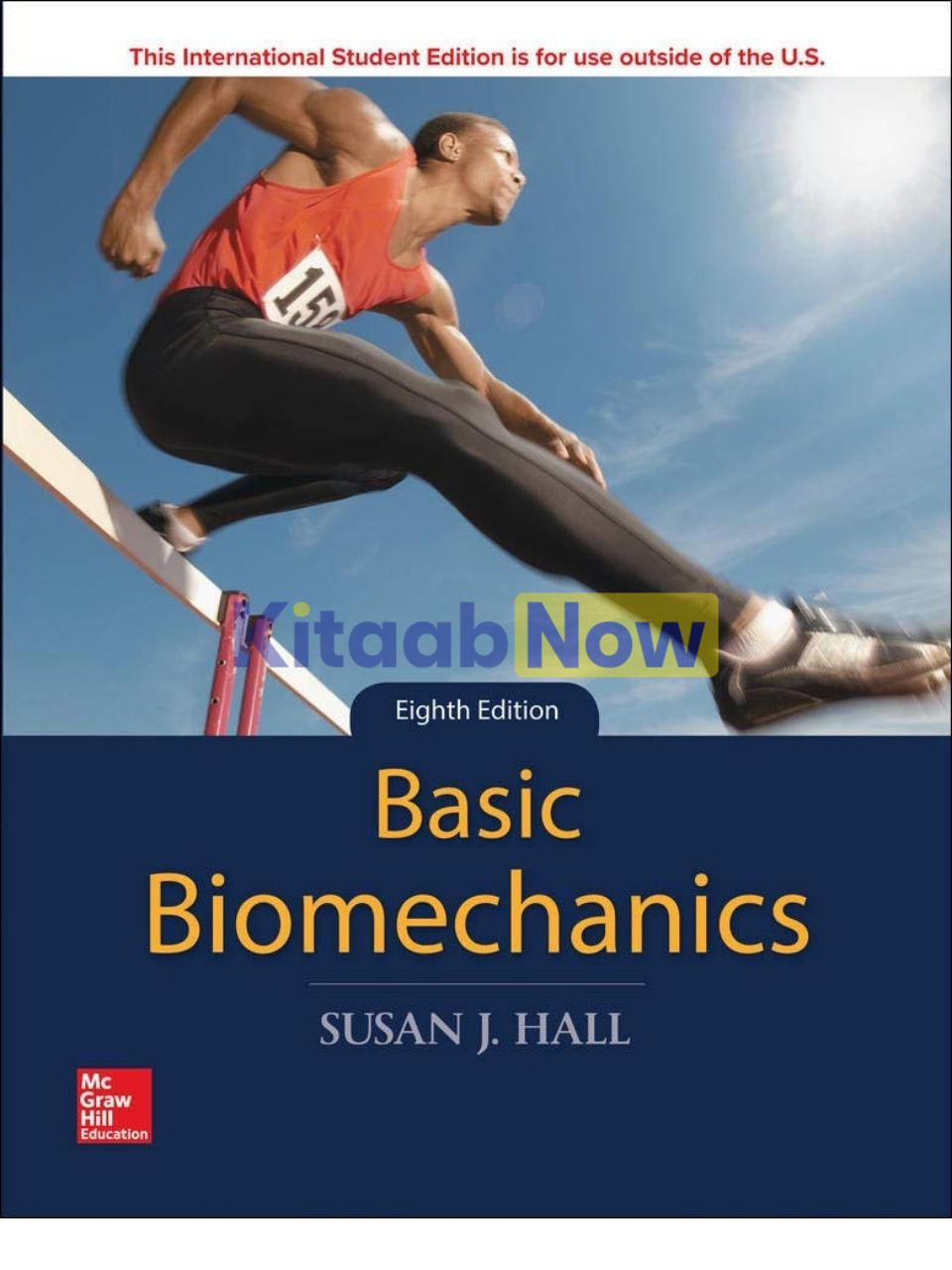
ISE Basic Biomechanics (8th Edition)
- Author: Susan Hall
- ISBN: 9781260085549
- Publisher: McGraw Hill Education
- Edition: 8th
- Publication Date: March 15, 2018
- Format: Paperback – 546 pages
- Language: English
Description
Is running barefoot beneficial? What is the most mechanically efficient way to move a piece of heavy furniture? Can stretching before a competition worsen performance? How do cats always land on their feet? The answers to these questions are all based on the science of biomechanics. In Basic Biomechanics, Eighth Edition, the focus is on the anatomy and movement capabilities of the human body, explained with examples of relevant sport, clinical, and daily living applications. The quantitative aspects of biomechanics are presented in a manageable, progressive fashion, using a structured and problem-based format with practical advice. This edition also retains the important sensitivity to the fact that some beginning students of biomechanics possess weak backgrounds in mathematics. For this reason, it includes numerous sample problems and applications, along with practical advice on approaching quantitative problems. With balanced, integrated coverage of applied anatomy, mechanical principles, and relevant sport and daily living applications, this text introduces you to the basics of biomechanics. The quantitative aspects of biomechanics are presented in a manageable, progressive fashion, with practical advice on approaching both qualitative and quantitative problems in biomechanics. Instructors and students can now access their course content through the Connect digital learning platform by purchasing either standalone Connect access or a bundle of print and Connect access. McGraw-Hill Connect® is a subscription-based learning service accessible online through your personal computer or tablet. Choose this option if your instructor will require Connect to be used in the course. Your subscription to Connect includes the following: SmartBook® – an adaptive digital version of the course textbook that personalizes your reading experience based on how well you are learning the content. Access to your instructor’s homework assignments, quizzes, syllabus, notes, reminders, and other important files for the course. Progress dashboards that quickly show how you are performing on your assignments and tips for improvement. The option to purchase (for a small fee) a print version of the book. This binder-ready, loose-leaf version includes free shipping.
Table of Contents
- Contents
- Preface
- Acknowledgments
- 1 What Is Biomechanics?
- Biomechanics: Definition and Perspective
- What Problems Are Studied by Biomechanists?
- Why Study Biomechanics?
- Problem-Solving Approach
- Quantitative versus Qualitative Problems
- Solving Qualitative Problems
- Formal versus Informal Problems
- Solving Formal Quantitative Problems
- Units of Measurement
- Summary
- Introductory Problems
- Additional Problems
- Laboratory Experiences
- 2 Kinematic Concepts for Analyzing Human Motion
- Forms of Motion
- Linear Motion
- Angular Motion
- General Motion
- Mechanical Systems
- Standard Reference Terminology
- Anatomical Reference Position
- Directional Terms
- Anatomical Reference Planes
- Anatomical Reference Axes
- Joint Movement Terminology
- Sagittal Plane Movements
- Frontal Plane Movements
- Transverse Plane Movements
- Other Movements
- Spatial Reference Systems
- Analyzing Human Movement
- Prerequisite Knowledge for a Qualitative Analysis
- Planning a Qualitative Analysis
- Conducting a Qualitative Analysis
- Tools for Measuring Kinematic Quantities
- Video and Film
- Summary
- Introductory Problems
- Additional Problems
- Laboratory Experiences
- 3 Kinetic Concepts for Analyzing Human Motion
- Basic Concepts Related to Kinetics
- Inertia
- Mass
- Force
- Center of Gravity
- Weight
- Pressure
- Volume
- Density
- Torque
- Impulse
- Mechanical Loads on the Human Body
- Compression, Tension, and Shear
- Mechanical Stress
- Torsion, Bending, and Combined Loads
- The Effects of Loading
- Repetitive versus Acute Loads
- Tools for Measuring Kinetic Quantities
- Vector Algebra
- Vector Composition
- Vector Resolution
- Graphic Solution of Vector Problems
- Trigonometric Solution of Vector Problems
- Summary
- Introductory Problems
- Additional Problems
- Laboratory Experiences
- 4 The Biomechanics of Human Bone Growth and Development
- Composition and Structure of Bone Tissue
- Material Constituents
- Structural Organization
- Types of Bones
- Bone Growth and Development
- Longitudinal Growth
- Circumferential Growth
- Adult Bone Development
- Bone Response to Stress
- Bone Modeling and Remodeling
- Bone Hypertrophy
- Bone Atrophy
- Osteoporosis
- Postmenopausal and Age-Associated Osteoporosis
- Female Athlete Triad
- Preventing and Treating Osteopenia and Osteoporosis
- Common Bone Injuries
- The Biomechanics of Bone Fractures
- Epiphyseal Injuries
- Summary
- Introductory Problems
- Additional Problems
- Laboratory Experiences
- 5 The Biomechanics of Human Skeletal Articulations
- Joint Architecture
- Immovable Joints
- Slightly Movable Joints
- Freely Movable Joints
- Articular Cartilage
- Articular Fibrocartilage
- Articular Connective Tissue
- Joint Stability
- Shape of the Articulating Bone Surfaces
- Arrangement of Ligaments and Muscles
- Other Connective Tissues
- Joint Flexibility
- Measuring Joint Range of Motion
- Factors Influencing Joint Flexibility
- Flexibility and Injury
- Techniques for Increasing Joint Flexibility
- Neuromuscular Response to Stretch
- Active and Passive Stretching
- Ballistic, Static, and Dynamic Stretching
- Proprioceptive Neuromuscular Facilitation
- Common Joint Injuries and Pathologies
- Sprains
- Dislocations
- Bursitis
- Arthritis
- Rheumatoid Arthritis
- Osteoarthritis
- Summary
- Introductory Problems
- Additional Problems
- Laboratory Experiences
- 6 The Biomechanics of Human Skeletal Muscle
- Behavioral Properties of the Musculotendinous Unit
- Extensibility and Elasticity
- Irritability and the Ability to Develop Tension
- Structural Organization of Skeletal Muscle
- Muscle Fibers
- Motor Units
- Fiber Types
- Fiber Architecture
- Skeletal Muscle Function
- Recruitment of Motor Units
- Change in Muscle Length with Tension Development
- Roles Assumed by Muscles
- Two-Joint and Multijoint Muscles
- Factors Affecting Muscular Force Generation
- Force–Velocity Relationship
- Length–Tension Relationship
- Stretch-Shortening Cycle
- Electromyography
- Electromechanical Delay
- Muscular Strength, Power, and Endurance
- Muscular Strength
- Muscular Power
- Muscular Endurance
- Muscle Fatigue
- Effect of Muscle Temperature
- Common Muscle Injuries
- Strains
- Contusions
- Cramps
- Delayed-Onset Muscle Soreness
- Compartment Syndrome
- Summary
- Introductory Problems
- Additional Problems
- Laboratory Experiences
- 7 The Biomechanics of the Human Upper Extremity
- Structure of the Shoulder
- Sternoclavicular Joint
- Acromioclavicular Joint
- Coracoclavicular Joint
- Glenohumeral Joint
- Scapulothoracic Joint
- Bursae
- Movements of the Shoulder Complex
- Muscles of the Scapula
- Muscles of the Glenohumeral Joint
- Flexion at the Glenohumeral Joint
- Extension at the Glenohumeral Joint
- Abduction at the Glenohumeral Joint
- Adduction at the Glenohumeral Joint
- Medial and Lateral Rotation of the Humerus
- Horizontal Adduction and Abduction at the Glenohumeral Joint
- Loads on the Shoulder
- Common Injuries of the Shoulder
- Dislocations
- Rotator Cuff Damage
- Rotational Injuries
- Subscapular Neuropathy
- Structure of the Elbow
- Humeroulnar Joint
- Humeroradial Joint
- Proximal Radioulnar Joint
- Carrying Angle
- Movements at the Elbow
- Muscles Crossing the Elbow
- Flexion and Extension
- Pronation and Supination
- Loads on the Elbow
- Common Injuries of the Elbow
- Sprains and Dislocations
- Overuse Injuries
- Structure of the Wrist
- Movements of the Wrist
- Flexion
- Extension and Hyperextension
- Radial and Ulnar Deviation
- Structure of the Joints of the Hand
- Carpometacarpal and Intermetacarpal Joints
- Metacarpophalangeal Joints
- Interphalangeal Joints
- Movements of the Hand
- Common Injuries of the Wrist and Hand
- Summary
- Introductory Problems
- Additional Problems
- Laboratory Experiences
- 8 The Biomechanics of the Human Lower Extremity
- Structure of the Hip
- Movements at the Hip
- Muscles of the Hip
- Flexion
- Extension
- Abduction
- Adduction
- Medial and Lateral Rotation of the Femur
- Horizontal Abduction and Adduction
- Loads on the Hip
- Common Injuries of the Hip
- Fractures
- Contusions
- Strains
- ]Structure of the Knee
- ibiofemoral Joint
- Menisci
- Ligaments
- Patellofemoral Joint
- Joint Capsule and Bursae
- Movements at the Knee
- Muscles Crossing the Knee
- Flexion and Extension
- Rotation and Passive Abduction and Adduction
- Patellofemoral Joint Motion
- Loads on the Knee
- Forces at the Tibiofemoral Joint
- Forces at the Patellofemoral Joint
- Common Injuries of the Knee and Lower Leg
- Anterior Cruciate Ligament Injuries
- Posterior Cruciate Ligament Injuries
- Medial Collateral Ligament Injuries
- Meniscus Injuries
- Iliotibial Band Friction Syndrome
- Patellofemoral Pain Syndrome
- Shin Splints
- Structure of the Ankle
- Movements at the Ankle
- Structure of the Foot
- Subtalar Joint
- Tarsometatarsal and Intermetatarsal Joints
- Metatarsophalangeal and Interphalangeal Joints
- Plantar Arches
- Movements of the Foot
- Muscles of the Foot
- Toe Flexion and Extension
- Inversion and Eversion
- Pronation and Supination
- Loads on the Foot
- Common Injuries of the Ankle and Foot
- Ankle Injuries
- Overuse Injuries
- Alignment Anomalies of the Foot
- Injuries Related to High and Low Arch Structures
- Summary
- Introductory Problems
- Additional Problems
- Laboratory Experiences
- 9 The Biomechanics of the Human Spine
- Structure of the Spine
- Vertebral Column
- Vertebrae
- Intervertebral Discs
- Ligaments
- Spinal Curves
- Movements of the Spine
- Flexion, Extension, and Hyperextension
- Lateral Flexion and Rotation
- Muscles of the Spine
- Anterior Aspect
- Posterior Aspect
- Lateral Aspect
- Loads on the Spine
- Common Injuries of the Back and Neck
- Low Back Pain
- Soft-Tissue Injuries
- Acute Fractures
- Stress Fractures
- Disc Herniations
- Whiplash Injuries
- Summary
- Introductory Problems
- Additional Problems
- Laboratory Experiences
- 10 Linear Kinematics of Human Movement
- Linear Kinematic Quantities
- Distance and Displacement
- Speed and Velocity
- Acceleration
- Average and Instantaneous Quantities
- Kinematics of Projectile Motion
- Horizontal and Vertical Components
- Influence of Gravity
- Influence of Air Resistance
- Factors Influencing Projectile Trajectory
- Projection Angle
- Projection Speed
- Relative Projection Height
- Optimum Projection Conditions
- Analyzing Projectile Motion
- Equations of Constant Acceleration
- Summary
- Introductory Problems
- Additional Problems
- Laboratory Experiences
- 11 Angular Kinematics of Human Movement
- Observing the Angular Kinematics of Human Movement
- Measuring Angles
- Joint Angles and Body Segment Orientations
- Tools for Measuring Body Angles
- Instant Center of Rotation
- Angular Kinematic Relationships
- Angular Distance and Displacement
- Angular Speed and Velocity
- Angular Acceleration
- Angular Motion Vectors
- Average versus Instantaneous Angular Quantities
- Relationships Between Linear and Angular Motion
- Linear and Angular Displacement
- Linear and Angular Velocity
- Linear and Angular Acceleration
- Summary
- Introductory Problems
- Additional Problems
- Laboratory Experiences
- 12 Linear Kinetics of Human Movement
- Newton’s Laws
- Law of Inertia
- Law of Acceleration
- Law of Reaction
- Law of Gravitation
- Mechanical Behavior of Bodies in Contact
- Friction
- Momentum
- Impulse
- Impact
- Work, Power, and Energy Relationships
- Work
- Power
- Energy
- Conservation of Mechanical Energy
- Principle of Work and Energy
- Summary
- Introductory Problems
- Additional Problems
- Laboratory Experiences
- 13 Equilibrium and Human Movement
- Equilibrium
- Torque
- Resultant Joint Torques
- Levers
- Anatomical Levers
- Equations of Static Equilibrium
- Equations of Dynamic Equilibrium
- Center of Gravity
- Locating the Center of Gravity
- Locating the Human Body Center of Gravity
- Stability and Balance
- Summary
- Introductory Problems
- Additional Problems
- Laboratory Experiences
- 14 Angular Kinetics of Human Movement
- Resistance to Angular Acceleration
- Moment of Inertia
- Determining Moment of Inertia
- Human Body Moment of Inertia
- Angular Momentum
- Conservation of Angular Momentum
- Transfer of Angular Momentum
- Change in Angular Momentum
- Angular Analogues of Newton’s Laws of Motion
- Newton’s First Law
- Newton’s Second Law
- Newton’s Third Law
- Centripetal Force
- Summary
- Introductory Problems
- Additional Problems
- Laboratory Experiences
- 15 Human Movement in a Fluid Medium
- The Nature of Fluids
- Relative Motion
- Laminar versus Turbulent Flow
- Fluid Properties
- Buoyancy
- Characteristics of the Buoyant Force
- Flotation
- Flotation of the Human Body
- Drag
- Skin Friction
- Form Drag
- Wave Drag
- Lift Force
- Foil Shape
- Magnus Effect
- Propulsion in a Fluid Medium
- Propulsive Drag Theory
- Propulsive Lift Theory
- Stroke Technique
- Summary
- Introductory Problems
- Additional Problems
- Laboratory Experiences
- Appendices
- A Basic Mathematics and Related Skills
- B Trigonometric Functions
- C Common Units of Measurement
- D Anthropometric Parameters for the Human Body
- Glossary
- Index
Author Biography
Susan J. Hall is a Professor Emerita at the University of Delaware, having served as Deputy Dean of the university’s College of Health Sciences and chairperson of several academic departments. She is a fellow of the American College of Sports Medicine and the American Alliance for Health, Physical Education, Recreation, and Dance (AAHPERD) Research Consortium, and she has served as President of the Biomechanics Academy of AAHPERD, President of the AAHPERD Research Consortium, Vice President of the American College of Sports Medicine, and member of the Board of Directors of the International Society for Biomechanics in Sport and the Board of Trustees of the American College of Sports Medicine. Hall’s research interests have focused on low back pain prevention and the biomechanical aspects of selected sports and exercises, and she published numerous research papers and book chapters related to these topics. She is also the author of several successful textbooks and served on several journal editorial boards. After graduating from Duke University, Hall began her career as a high-school biology teacher. She then went on to receive a master’s degree from Texas Woman’s University and a Ph.D. from Washington State University. She has been teaching at the college level for more than 30 years.
Additional information
| Weight | 1.068 kg |
|---|
Only logged in customers who have purchased this product may leave a review.
Related Products




Reviews
There are no reviews yet.