
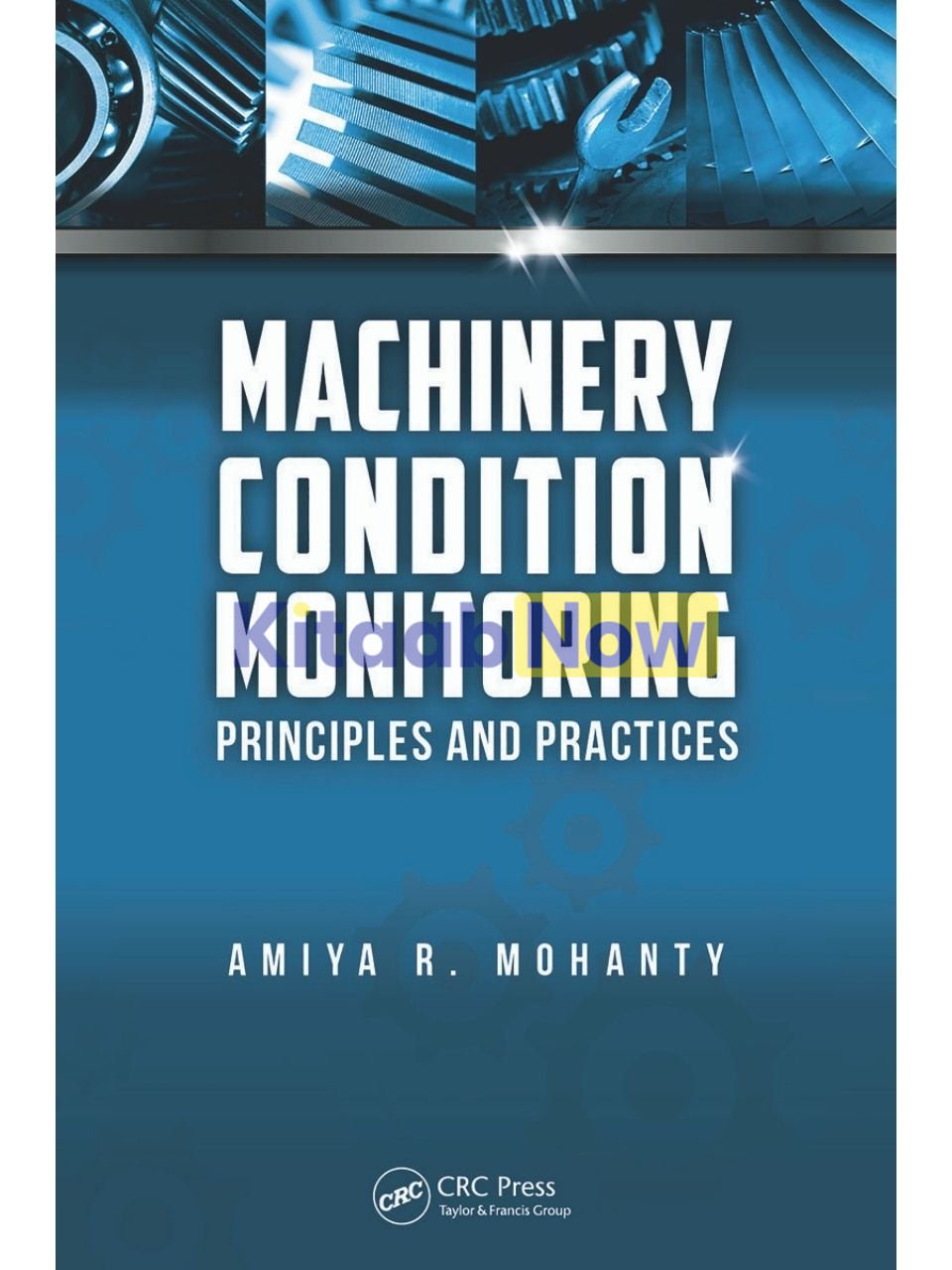
Machinery Condition Monitoring: Principles and Practices
- Author: Amiya Ranjan Mohanty
- ISBN: 9781138748255
- Publisher: CRC Press
- Edition: 1st
- Publication Date: July 27, 2017
- Format: Paperback – 262 Pages
- Language: English
Description
Find the Fault in the Machines
Drawing on the author’s more than two decades of experience with machinery condition monitoring and consulting for industries in India and abroad, Machinery Condition Monitoring: Principles and Practices introduces the practicing engineer to the techniques used to effectively detect and diagnose faults in machines. Providing the working principle behind the instruments, the important elements of machines as well as the technique to understand their conditions, this text presents every available method of machine fault detection occurring in machines in general, and rotating machines in particular.
A Single-Source Solution for Practice Machinery Conditioning Monitoring
Since vibration is one of the most widely used fault detection techniques, the book offers an assessment of vibration analysis and rotor-dynamics. It also covers the techniques of wear and debris analysis, and motor current signature analysis to detect faults in rotating mechanical systems as well as thermography, the nondestructive test NDT techniques (ultrasonics and radiography), and additional methods. The author includes relevant case studies from his own experience spanning over the past 20 years, and detailing practical fault diagnosis exercises involving various industries ranging from steel and cement plants to gas turbine driven frigates. While mathematics is kept to a minimum, he also provides worked examples and MATLAB® codes.
This book contains 15 chapters and provides topical information that includes:
- A brief overview of the maintenance techniques
- Fundamentals of machinery vibration and rotor dynamics
- Basics of signal processing and instrumentation, which are essential for monitoring the health of machines
- Requirements of vibration monitoring and noise monitoring
- Electrical machinery faults
- Thermography for condition monitoring
- Techniques of wear debris analysis and some of the nondestructive test (NDT) techniques for condition monitoring like ultrasonics and radiography
- Machine tool condition monitoring
- Engineering failure analysis
- Several case studies, mostly on failure analysis, from the author’s consulting experience
Machinery Condition Monitoring: Principles and Practices presents the latest techniques in fault diagnosis and prognosis, provides many real-life practical examples, and empowers you to diagnose the faults in machines all on your own.
Table of Contents
- Introduction
- Machinery Condition Monitoring
- Present Status
- Fault Prognosis
- Future Needs
- Principles of Maintenance
- Introduction
- Reactive Maintenance
- Preventive Maintenance
- Predictive Maintenance
- Enterprise Resource Planning
- Bath Tub Curve
- Failure Modes Effects and Criticality Analysis (FMECA)
- Fundamentals of Machinery Vibration
- Introduction
- Single Degree-of-Freedom Motion
- Forced Vibration Response
- Base Excitation
- Force Transmissibility and Vibration Isolation
- Tuned Vibration Absorber
- Unbalanced Response
- Characteristics of Vibrating Systems
- Vibration of Continuous Systems
- Mode Shapes and Operational Deflection Shapes
- Experimental Modal Analysis
- Rotordynamics
- Introduction
- Simple Rigid Rotor-Disc System
- Unbalance Response and Critical Speed
- Journal Bearings
- Oil Whirl and Oil Whip
- Squeeze Film Dampers
- Condition Monitoring in Large Rotor Systems
- Digital Signal Processing
- Introduction
- Classification of Signals
- Signal Analysis
- Frequency Domain Signal Analysis
- Fundamentals of Fast Fourier Transform
- Computer-Aided Data Acquisition
- Signal Conditioning
- Signal Demodulation
- Cepstrum Analysis
- Examples
- Instrumentation
- Introduction
- Measurement Standards
- Measurement Errors
- Calibration Principles
- Static and Dynamic Measurements
- Frequency Response
- Dynamic Range
- Basic Measuring Equipment
- Vibration
- Force Measurements
- Rotational Speed
- Noise Measurements
- Temperature Measurements
- Laser-Based Measurements
- Current Measurements
- Chemical Composition Measurement
- Ultrasonic Thickness Measurement
- Data Recorders
- Vibration Monitoring
- Principles of Vibration Monitoring
- Misalignment Detection
- Eccentricity Detection
- Cracked Shaft
- Bowed and Bent Shaft
- Unbalanced Shaft
- Looseness
- Rub
- Bearing Defects
- Gear Fault
- Faults in Fluid Machines
- Noise Monitoring
- Introduction
- Acoustical Terminology
- Noise Sources
- Sound Fields
- Anechoic Chamber
- Reverberation Chamber
- Noise Measurements
- Noise Source Identification
- Electrical Machinery Faults
- Introduction
- Construction of an Electric Motor
- Faults in Electric Motor
- Fault Detection in Electric Motors
- MCSA for Fault Detection in Electrical Motors
- Instrumentation for Motor Current Signature Analysis
- Fault Detection in Mechanical Systems by MCSA
- MCSA for Fault Detection in any Rotating Machine
- Fault Detection in Power Supply Transformers
- Fault Detection in Switchgear Devices
- Thermography
- Introduction
- Thermal Imaging Devices
- Use of IR Camera
- Industrial Applications of Thermography
- Applications of Thermography in Condition Monitoring
- Wear Debris Analysis
- Introduction
- Mechanisms of Wear
- Detection of Wear Particles
- Common Wear Materials
- Oil Sampling Technique
- Oil Analysis
- Limits of Oil Analysis
- Other Methods in Condition Monitoring
- Introduction
- Eddy Current Testing
- Ultrasonic Testing
- Radiography
- Acoustic Emission
- Machine Tool Condition Monitoring
- Introduction
- Tool Wear
- Sensor Fusion in Tool Condition Monitoring
- Sensors for Tool Condition Monitoring
- A Tool Condition Monitoring System
- Other Manufacturing Operations
- Engineering Failure Analysis
- Introduction
- Overview of Failure Analysis
- Failure Modes
- Failure Analysis
- Failure Analysis Sampling Guide
- Case Studies
- Introduction
- Bend Pulley Failure Analysis
- Root Cause Analysis of Torsion Shaft Failure in a Cement Plant
- Failure Analysis of a Conveyor System Support Structure
- Vibration Measurements on a Motor-Multistage Gearbox Drive Set
- Bibliography
- Appendices
- Index
Author Description
Amiya R. Mohanty has been a faculty member at the Indian Institute of Technology Kharagpur, India, since 1996, and is currently a professor of mechanical engineering. He has a B.ScEngg (Hons) in mechanical engineering from the National Institute of Technology, Rourkela. He holds a master’s degree in machine design specialization from the Indian Institute of Technology, Kharagpur, and a PhD in the area of noise control from the University of Kentucky in the United States. Prof. Mohanty is a fellow of the Acoustical Society of India. He has consulted more than 50 companies, and published more than 100 journal articles.
Additional information
| Weight | 0.454 kg |
|---|
Only logged in customers who have purchased this product may leave a review.
Related Products


Reviews
There are no reviews yet.