


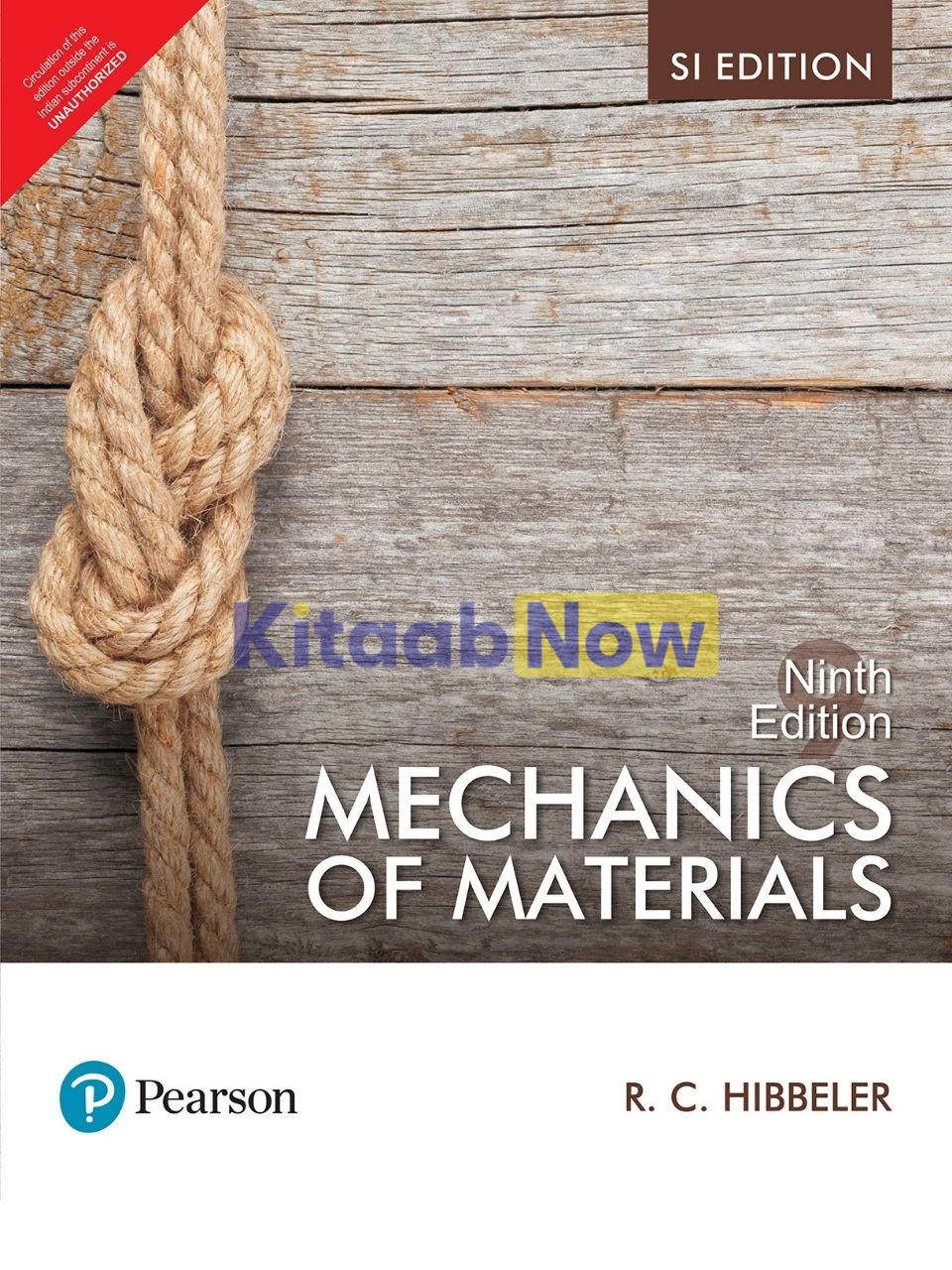
Mechanics of Material in SI Units (10th Edition)
- Author: Russell C. Hibbeler
- ISBN: 9781292178202
- Publisher: Pearson Education
- Edition: 10th
- Publication Date: February 1, 2018
- Format: Paperback – 896 pages
- Language: English
Description
For undergraduate Mechanics of Materials courses in Mechanical, Civil, and Aerospace Engineering departments.
Thorough coverage, a highly visual presentation, and increased problem solving from an author you trust.
Mechanics of Materials clearly and thoroughly presents the theory and supports the application of essential mechanics of materials principles. Professor Hibbeler’s concise writing style, countless examples, and stunning four-color photorealistic art program — all shaped by the comments and suggestions of hundreds of colleagues and students — help students visualize and master difficult concepts. The Tenth SI Edition retains the hallmark features synonymous with the Hibbeler franchise, but has been enhanced with the most current information, a fresh new layout, added problem solving, and increased flexibility in the way topics are covered in class.
Also available with Mastering Engineering™. This title is also available with Mastering Engineering, an online homework, tutorial, and assessment program designed to work with this text to engage students and improve results. Interactive, self-paced tutorials provide individualized coaching to help students stay on track. With a wide range of activities available, students can actively learn, understand, and retain even the most difficult concepts. The text and Mastering Engineering work together to guide students through engineering concepts with a multi-step approach to problems.
New to this Edition
- Approximately 430 problems, which is about 30% of all problems, have been added to this edition and involve applications to many different fields of engineering.
- UPDATED! Review problems have been updated and placed at the end of each chapter, so that instructors can assign them as additional preparation for exams.
- REVISED! Improved Preliminary and Fundamental Problems, located just after each group of example problems, now feature expanded solutions in the back of the book. They offer simple applications of the concepts covered in each section and, therefore, provide the chance to develop problem-solving skills before attempting the standard problems that follow. These problems are an excellent way to prepare for exams – including the Fundamentals of Engineering Exam.
- A new layout, with additional design features, provides a convenient display of the material. Almost all topics are presented in a one- or two-page spread to minimize page turning.
- UPDATED! Enhanced or updated photos illustrate how engineering principles apply to real-world situations, and how materials behave under load.
- REVISED! Updated and re-written material throughout, enhances clarity and makes the text more current. Some of the artwork has also been enlarged and improved to support these changes.
Table of Contents
- Stress
- Chapter Objectives
- Introduction
- Equilibrium of a Deformable Body
- Stress
- Average Normal Stress in an Axially Loaded Bar
- Average Shear Stress
- Allowable Stress Design
- Limit State Design
- Strain
- Chapter Objectives
- Deformation
- Strain
- Mechanical Properties of Materials
- Chapter Objectives
- The Tension and Compression Test
- The Stress—Strain Diagram
- Stress—Strain Behavior of Ductile and Brittle Materials
- Strain Energy
- Poisson’s Ratio
- The Shear Stress—Strain Diagram
- Failure of Materials Due to Creep and Fatigue
- Axial Load
- Chapter Objectives
- Saint-Venant’s Principle
- Elastic Deformation of an Axially Loaded Member
- Principle of Superposition
- Statically Indeterminate Axially Loaded Members
- The Force Method of Analysis for Axially Loaded Members
- Thermal Stress
- Stress Concentrations
- Inelastic Axial Deformation
- Residual Stress
- Torsion
- Chapter Objectives
- Torsional Deformation of a Circular Shaft
- The Torsion Formula
- Power Transmission
- Angle of Twist
- Statically Indeterminate Torque-Loaded Members
- Solid Noncircular Shafts
- Thin-Walled Tubes Having Closed Cross Sections
- Stress Concentration
- Inelastic Torsion
- Residual Stress
- Bending
- Chapter Objectives
- Shear and Moment Diagrams
- Graphical Method for Constructing Shear and Moment Diagrams
- Bending Deformation of a Straight Member
- The Flexure Formula
- Unsymmetric Bending
- Composite Beams
- Reinforced Concrete Beams
- Curved Beams
- Stress Concentrations
- Inelastic Bending
- Transverse Shear
- Chapter Objectives
- Shear in Straight Members
- The Shear Formula
- Shear Flow in Built-Up Members
- Shear Flow in Thin-Walled Members
- Shear Center for Open Thin-Walled Members
- Combined Loadings
- Chapter Objectives
- Thin-Walled Pressure Vessels
- State of Stress Caused by Combined Loadings
- Stress Transformation
- Chapter Objectives
- Plane-Stress Transformation
- General Equations of Plane-Stress Transformation
- Principal Stresses and Maximum In-Plane Shear Stress
- Mohr’s Circle–Plane Stress
- Absolute Maximum Shear Stress
- Strain Transformation
- Chapter Objectives
- Plane Strain
- General Equations of Plane-Strain Transformation
- Mohr’s Circle–Plane Strain
- Absolute Maximum Shear Strain
- Strain Rosettes
- Material Property Relationships
- Theories of Failure
- Design of Beams and Shafts
- Chapter Objectives
- Basis for Beam Design
- Prismatic Beam Design
- Fully Stressed Beams
- Shaft Design
- Deflection of Beams and Shafts
- Chapter Objectives
- The Elastic Curve
- Slope and Displacement by Integration
- Discontinuity Functions
- Slope and Displacement by the Moment-Area Method
- Method of Superposition
- Statically Indeterminate Beams and Shafts
- Statically Indeterminate Beams and Shafts–Method of Integration
- Statically Indeterminate Beams and Shafts–Moment-Area Method
- Statically Indeterminate Beams and Shafts–Method of Superposition
- Buckling of Columns
- Chapter Objectives
- Critical Load
- Ideal Column with Pin Supports
- Columns Having Various Types of Supports
- The Secant Formula
- Inelastic Buckling
- Design of Columns for Concentric Loading
- Design of Columns for Eccentric Loading
- Energy Methods
- Chapter Objectives
- External Work and Strain Energy
- Elastic Strain Energy for Various Types of Loading
- Conservation of Energy
- Impact Loading
- Principle of Virtual Work
- Method of Virtual Forces Applied to Trusses
- Method of Virtual Forces Applied to Beams
- Castigliano’s Theorem
- Castigliano’s Theorem Applied to Trusses
- Castigliano’s Theorem Applied to Beams
- Appendix
- A Geometric Properties of an Area
- B Geometric Properties of Structural Shapes
- C Slopes and Deflections of Beams
- Solutions and Answers for Preliminary Problems
- Fundamental Problems Partial Solutions and Answers
- Selected Answers
- Index
Author Description
Russell C. Hibbeler graduated from the University of Illinois at Urbana with a BS in Civil Engineering (major in Structures) and an MS in Nuclear Engineering. He obtained his PhD in Theoretical and Applied Mechanics from Northwestern University.
Hibbeler’s professional experience includes postdoctoral work in reactor safety and analysis at Argonne National Laboratory, and structural work at Chicago Bridge and Iron, as well as Sargent and Lundy in Tucson. He has practiced engineering in Ohio, New York, and Louisiana
Additional information
| Weight | 1.526 kg |
|---|
Only logged in customers who have purchased this product may leave a review.
Related Products



Reviews
There are no reviews yet.