
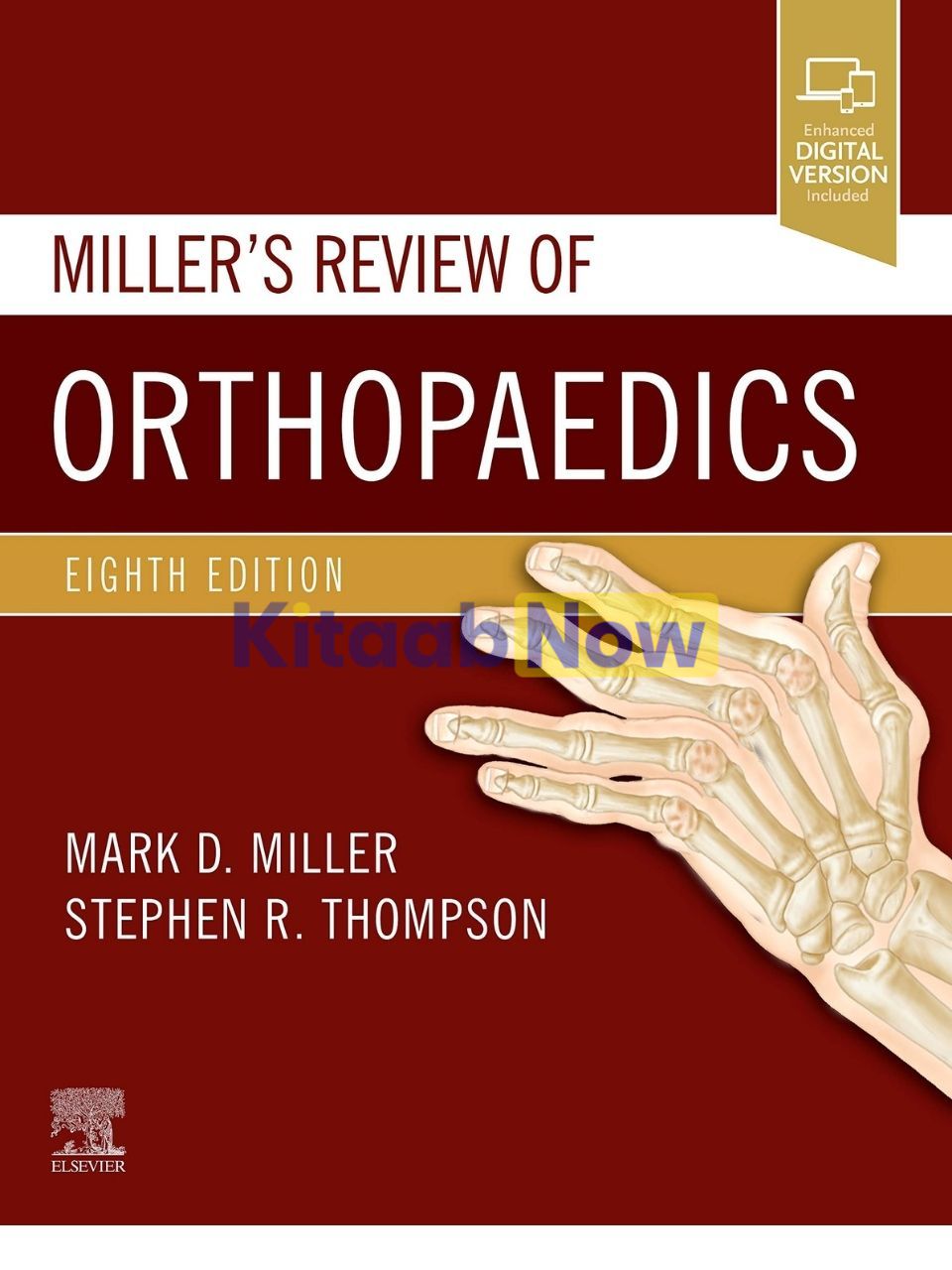
Miller’s Review of Orthopaedics (8th Edition)
- Author: Mark D. Miller, Stephen R. Thompson
- ISBN: 9780323609784
- Publisher: Elsevier Science Publishing
- Edition: 8th
- Publication Date: December 01, 2019
- Format: Paperback – 304 pages
- Language: English
Out of stock
Description
Miller’s Review of Orthopaedics has long been considered the go-to certification and recertification review guide for every orthopaedic resident, fellow, and surgeon – and the 8th Edition has been fully revised to efficiently and effectively prepare you for exam success. Drs. Mark D. Miller and Stephen R. Thompson, along with expert contributors in the field, ensure that this bestselling review tool provides you with maximum knowledge in the least amount of time, keeping you up to date with the latest medical advances and helping you improve the safety, effectiveness, and efficiency of your practice.
Key Features
- Contains content current in scope and emphasis for the ABOS (American Board of Orthopaedic Surgery) and OITE (Orthopaedic In-Service Training Exam), using detailed illustrations, surgical photos, and a succinct outline format.
- Ensures that you spend time studying only high-yield, testable material presented in a concise, readable format, including key points, multiple-choice review questions, quick-reference tables, pathology slides, bulleted text, “testable facts” in every chapter, and more.
- Includes over 750 new, detailed figures that show multiple key concepts in one figure to provide you with a full visual understanding of complex topics. Additional new figures cover important concepts such as tendinopathies, compression syndromes, wrist pathologies, rheumatoid arthritis syndromes of the hand and wrist, motor and sensory inner action of the upper extremity, and much more.
- Provides video clips and short-answer questions online for easy access.
- Enhanced eBook version included with purchase. Your enhanced eBook allows you to access all of the text, figures, and references from the book on a variety of devices.
Table of Contents
- 1 Basic Sciences
- SECTION 1 ORTHOPAEDIC TISSUES
- Bone
- Cartilage and Joint
- Muscle
- Tendon
- Ligament
- Neural Tissue and Intervertebral Disc?
- SECTION 2 ORTHOPAEDIC BIOLOGY
- Cellular and Molecular Biology and Immunology
- Infection and Microbiology
- SECTION 3 PERIOPERATIVE AND ORTHOPAEDIC MEDICINE
- Thromboprophylaxis
- Perioperative Disease and Comorbidities
- SECTION 4 OTHER BASIC PRINCIPLES
- Imaging and Special Studies
- Biomaterials and Biomechanics
- TESTABLE CONCEPTS
- 2 ANATOMY
- SECTION 1 INTRODUCTION
- Overview
- SECTION 2 UPPER EXTREMITY
- Shoulder
- Arm
- Forearm
- Wrist and Hand
- SECTION 3 LOWER EXTREMITY
- Pelvis, Hip, and Thigh
- Knee and Leg
- Ankle and Foot
- SECTION 4 SPINE
- Osteology
- Arthrology
- Surgical Approaches to the Spine
- TESTABLE CONCEPTS
- 3 PEDIATRIC ORTHOPAEDICS
- SECTION 1 UPPER EXTREMITY PROBLEMS
- Brachial Plexus Palsy
- Sprengel Deformity
- Fibrotic Deltoid Problems
- Congenital Pseudarthrosis of the Clavicle
- Poland Syndrome 3Apert Syndrome
- SECTION 2 LOWER EXTREMITY PROBLEMS: GENERAL
- Rotational Problems of the Lower Extremities
- Leg Length Discrepancy
- SECTION 3 HIP AND FEMUR
- Developmental Dysplasia of the Hip
- Congenital Coxa Vara
- Legg-Calvé-Perthes Disease (Coxa Plana)
- Slipped Capital Femoral Epiphysis
- Bladder Exstrophy
- Proximal Femoral Focal Deficiency
- Lower Extremity Inflammation and Infection
- SECTION 4 KNEE AND LEG
- Leg
- Tibial Bowing
- Osteochondritis Dissecans
- Osgood-Schlatter Disease
- Discoid Meniscus
- Congenital Dislocation of the Knee
- SECTION 5 FOOT
- Clubfoot (Congenital Talipes Equinovarus)
- Metatarsus Adductus and Skewfoot
- Pes Cavus (Cavus Foot)
- Congenital Vertical Talus (Congenital Convex Pes Valgus)
- Tarsal Coalitions
- Calcaneovalgus Foot
- Juvenile Bunions
- Kohler Disease
- Flexible Pes Planus
- Idiopathic Toe Walking
- Accessory Navicular
- Ball-and-Socket Ankle
- Congenital Toe Disorders
- SECTION 6 PEDIATRIC SPINE
- Adolescent Idiopathic Scoliosis
- Early-Onset Scoliosis
- Juvenile Idiopathic Scoliosis
- Infantile Idiopathic Scoliosis
- Congenital Spinal Deformities
- Neuromuscular Scoliosis
- Neurofribromatosis
- Kyphosis
- Cervical Spine Disorders
- Spondylolysis and Spondylolisthesis
- Other Spinal Conditions
- SECTION 7 CEREBRAL PALSY
- Introduction
- Classification
- Orthopaedic Assessment
- Spasticity Treatment
- Gait Disorders
- Spinal Disorders
- Hip Subluxation and Dislocation
- Knee Abnormalities
- Foot and Ankle Abnormalities
- Upper Extremity Management
- SECTION 8 NEUROMUSCULAR DISORDERS
- Arthrogrypotic Syndromes
- Myelodysplasia (Spina Bifida)
- Myopathies (Muscular Dystrophies)
- Polymyositis and Dermatomyositis
- Hereditary Neuropathies
- Myasthenia Gravis
- Anterior Horn Cell Disorders
- Acute Idiopathic Postinfectious Polyneuropathy (Guillain-Barré Syndrome)
- Overgrowth Syndromes
- SECTION 9 BONE DYSPLASIAS
- Introduction
- Achondroplasia
- Pseudoachondroplasia
- Multiple Epiphyseal Dysplasia
- Spondyloepiphyseal Dysplasia
- Chondrodysplasia Punctata
- Kniest Syndrome 53Metaphyseal Chondrodysplasia
- Progressive Diaphyseal Dysplasia (Camurati-Engelmann Disease)
- Mucopolysaccharidosis 53Diastrophic Dysplasia
- Cleidocranial Dysplasia (Dysostosis)
- Osteopetrosis
- Infantile Cortical Hyperostosis (Caffey Disease) ?
- SECTION 10 SYNDROMES WITH ORTHOPAEDIC MANIFESTATIONS
- Down Syndrome (Trisomy 21)
- Turner Syndrome
- Prader-Willi Syndrome
- Marfan Syndrome
- Homocystinuria
- Ehlers-Danlos Syndrome
- Fibrodysplasia Ossificans Progressiva
- Rett Syndrome
- Beckwith-Wiedemann Syndrome
- Nail-Patella Syndrome (Hereditary Onychoosteodysplasia)
- SECTION 11 HEMATOPOIETIC AND METABOLIC DISORDERS AND ARTHRITIDES
- Gaucher Disease
- Niemann-Pick Disease
- Sickle Cell Anemia
- Thalassemia 58Hemophilia
- Leukemia 58Rickets
- Osteogenesis Imperfecta
- Juvenile Idiopathic Arthritis
- Ankylosing Spondylitis
- TESTABLE CONCEPTS
- 4 SPORTS MEDICINE
- SECTION 1 KNEE
- Anatomy
- Biomechanics
- Diagnostic Techniques
- Knee Arthroscopy
- Meniscal Injuries
- Ligament Injuries
- Osteochondral Lesions
- Synovial Lesions
- Patellofemoral Disorders
- Pediatric Knee Injuries
- SECTION 2 PELVIS, HIP, AND THIGH
- Contusions
- Muscle Injuries
- Bursitis
- Nerve Entrapment Syndromes
- Bone Disorders
- Intraarticular Disorders
- Femoroacetabular Impingement
- Other Hip Disorders
- Hip Arthroscopy
- SECTION 3 SHOULDER
- Anatomy
- Biomechanics
- Diagnostic Techniques
- Shoulder Arthroscopy
- Shoulder Instability
- Subacromial Impingement Syndrome
- Rotator Cuff Disease
- Subscapularis Tears
- Rotator Cuff Tear Arthropathy
- Subcoracoid Impingement
- Internal Impingement
- SLAP Tears
- Proximal Biceps Tendon Pathology
- Acromioclavicular and Sternoclavicular Injuries
- Muscle Ruptures
- Shoulder Stiffness
- Nerve Disorders
- Other Shoulder Disorders
- SECTION 4 MEDICAL ASPECTS OF SPORTS MEDICINE
- Preparticipation Physical Examination
- Cardiac Abnormalities in Athletes
- Concussion 67Sickle Cell Disease
- Metabolic Issues in Athletes
- Ergogenic Drugs
- Female Athlete–Related Issues
- Infectious Disease in Athletes
- Miscellaneous Sports-Related Injuries and Issues
- TESTABLE CONCEPTS
- 5 ADULT RECONSTRUCTION
- SECTION 1 EVALUATION OF THE ADULT PATIENT WITH HIP PAIN
- Physical Examination Tests for Hip Irritability
- Imaging
- SECTION 2 STRUCTURAL HIP DISORDERS IN THE ADULT
- Natural History
- Spectrum of Presentation
- Anatomy of Adult Hip Dysplasia
- Treatment of Dysplasia
- Femoroacetabular Impingement
- Treatment of FAI
- SECTION 3 OSTEONECROSIS OF THE HIP
- Occurrence
- Etiology
- Clinical Presentation
- Imaging
- Staging
- Treatment
- Transient Osteoporosis of the Hip
- SECTION 4 TREATMENT OF HIP ARTHRITIS
- Nonoperative
- Operative
- SECTION 5 TOTAL HIP ARTHROPLASTY
- Indications
- Surgical Approaches
- Templating
- Implant Fixation
- Bone Ongrowth Fixation
- Hydroxyapatite
- Femoral Stem Loading
- Femoral Stress Shielding
- Femoral Stem Breakage
- SECTION 6 REVISION THA
- Presentation
- Acetabular Side
- Femoral Side
- SECTION 7 ARTICULAR BEARINGS AND CORROSION IN THA
- Introduction
- Polyethylene
- Polyethylene Wear and Osteolysis
- Osteolysis Process
- steolysis Around THA Prosthesis—Effective Joint Space
- Particle Debris Formation—Linear Versus Volumetric Wear
- Osteolysis—Radiographic Findings in THA
- Treatment of Polyethylene Wear
- Bearing Lubrication
- Metal and Ceramic on PE
- Metal on Metal
- Hip Resurfacing
- Ceramic-on-Ceramic Bearing
- Dual-Mobility Components
- Trunnion Corrosion
- SECTION 8 PERIPROSTHETIC THA FRACTURE
- Time of Fracture
- Intraoperative Fracture
- Early Postoperative Fracture
- Late Fracture
- SECTION 9 THA— MISCELLANEOUS
- Nerve Injury
- Anatomy
- Specific Complications and Host Risk Factors 31
- Venous Thrombosis 31
- Heterotopic Ossification 31
- Iliopsoas Impingement
- Implant Facts
- SECTION 10 THA—JOINT STABILITY
- Incidence of THA Dislocation
- Risk Factors for Dislocation
- Assessment
- Treatment
- SECTION 11 KNEE ARTHRITIS ASSESSMENT
- Clinical Presentation
- Imaging Studies 4
- SECTION 12 KNEE ARTHRITIS TREATMENT
- Consensus Treatment
- SECTION 13 TOTAL KNEE ARTHROPLASTY
- Indications
- Survival of TKA
- Technical Goals
- Preoperative Planning
- Goals of Bone Cuts in TKA
- Coronal Plane Ligament Balancing
- Flexion Deformity (i.e., Flexion Contracture)
- Sagittal Plane Balancing
- Perioperative Nerve Blocks
- Postoperative Therapy
- Complications
- SECTION 14 TKA DESIGN
- Design Categories
- Cruciate-Retaining Primary TKA Design
- Cruciate-Sacrificing Primary TKA Designs
- Tibial Rotating Platform in Primary TKA
- Modularity in Primary TKA
- All-Polyethylene Tibia (APT)
- Constraint in TKA
- SECTION 15 REVISION TKA
- Preoperative Evaluation
- Surgical Approach
- Implant System
- Modular Bearing Change for Premature Excessive Wear
- Technique of Revision TKA
- Revision TKA—Patella
- SECTION 16 PATELLAR TRACKING IN TKA
- Introduction
- Q Angle in TKA
- TKA Techniques to Optimize Patellar Tracking
- Intraoperative Assessment of Maltracking
- Postoperative Assessment of Maltracking
- Patella Baja
- Patellar Resurfacing Versus Nonresurfacing
- SECTION 17 CATASTROPHIC WEAR IN TKA
- Premature Failure of TKA Implant
- Factors Involved in Catastrophic Wear
- “Perfect Storm Scenario for Catastrophic Wear
- Measures to Mitigate Catastrophic PE Wear
- SECTION 18 GLENOHUMERAL ARTHRITIS
- Introduction
- History and Physical Examination
- Imaging
- Treatment
- SECTION 19 SHOULDER HEMIARTHROPLASTY
- Indications
- Requirements
- Complications
- Conversion From Hemiarthroplasty to TSA
- Hemiarthroplasty for Cuff Tear Arthropathy
- SECTION 20 TOTAL SHOULDER ARTHROPLASTY
- Introduction
- Requirements
- Component Positioning
- Rehabilitation
- Complications
- SECTION 21 REVERSE TOTAL SHOULDER ARTHROPLASTY
- Introduction
- Requirements
- Component Positioning
- Complications
- SECTION 22 INFECTION IN SHOULDER ARTHROPLASTY
- Introduction
- Common Organisms
- History and Physical Examination
- Investigations
- Microbiology
- Management
- TESTABLE CONCEPTS
- 6 DISORDERS OF THE FOOT AND ANKLE
- SECTION 1 BIOMECHANICS OF THE FOOT AND ANKLE
- Anatomy
- Foot Positions Versus Foot Motions
- Gait Cycle
- SECTION 2 PHYSICAL EXAMINATION OF THE FOOT AND ANKLE
- Inspection
- Gait Evaluation
- Vascular Examination
- Neurologic Examination
- Motor Examination
- Palpation and Stability Assessment
- Range of Motion (ROM)
- SECTION 3 RADIOGRAPHIC EVALUATION OF THE FOOT AND ANKLE
- SECTION 4 ADULT HALLUX VALGUS
- SECTION 5 JUVENILE AND ADOLESCENT HALLUX VALGUS
- SECTION 6 HALLUX VARUS
- SECTION 7 LESSER-TOE DEFORMITIES
- Anatomy and Function
- Deformities
- SECTION 8 HYPERKERATOTIC PATHOLOGIES
- Intractable Plantar Keratosis (IPK)
- Bunionette Deformity (Tailor’s Bunion)
- SECTION 9 SESAMOIDS
- Anatomy
- Deformities
- SECTION 10 ACCESSORY BONES
- SECTION 11 NEUROLOGIC DISORDERS
- Interdigital Neuritis (Morton Neuroma)
- Recurrent Neuroma
- Tarsal Tunnel Syndrome
- Plantar Nerve Problems
- Anterior Tarsal Tunnel Syndrome
- Superficial Peroneal Nerve Entrapment
- Sural or Saphenous Nerve Entrapment
- Sequelae of Upper Motor Neuron Disorders
- Charcot-Marie-Tooth (CMT) Disease
- Peripheral Nerve Injury and Tendon Transfers
- SECTION 12 ARTHRITIC DISEASE
- Crystalline Disease
- Seronegative Spondyloarthropathy (SNSA)
- Rheumatoid Arthritis
- Osteoarthritis
- SECTION 13 POSTURAL DISORDERS
- Pes Planus (Flatfoot Deformity)
- Pes Cavus Deformity
- SECTION 14 TENDON DISORDERS
- Achilles Tendon
- Peroneal Tendons
- Posterior Tibial Tendon
- Anterior Tibial Tendon
- Flexor Hallucis Longus
- SECTION 15 HEEL PAIN
- Plantar Heel Pain
- Achilles Disorders
- SECTION 16 ANKLE PAIN AND SPORTS INJURIES
- Ankle Sprains
- High Ankle Sprains
- Ankle Impingement
- Osteochondral Lesions
- Chronic Exertional Compartment Syndrome
- Technical Pearls for Ankle Arthroscopy
- SECTION 17 THE DIABETIC FOOT
- Pathophysiology
- Clinical Problems
- SECTION 18 TRAUMA
- Phalangeal Fractures
- Metatarsal Fractures
- First MTP Joint Injuries
- Tarsometatarsal Fractures and Dislocations (Lisfranc Injury)
- Midfoot Injuries (Excluding Lisfranc Injuries)
- Talus Fractures
- Calcaneus Fractures
- Peritalar (Subtalar) Dislocations
- Compartment Syndrome
- Ankle Fractures
- Pilon (Tibial Plafond) Fractures
- TESTABLE CONCEPTS
- 7 HAND, UPPER EXTREMITY, AND MICROVASCULAR SURGERY
- Anatomy
- Distal Radius Fractures
- Carpal Fractures and Instability
- Metacarpal and Phalangeal Injuries
- Tendon Injuries and Overuse Syndromes
- Distal Radioulnar Joint, Triangular Fibrocartilage Complex, and Wrist Arthroscopy
- Nail and Fingertip Injuries
- Soft Tissue Coverage and Microsurgery
- Vascular Disorders
- Compression Neuropathy
- Nerve Injuries and Tendon Transfers
- Arthritis
- Idiopathic Osteonecrosis of the Carpus
- Dupuytren Disease
- Hand Tumors
- Hand Infections
- Injection Injury
- Congenital Hand Differences
- Elbow
- TESTABLE CONCEPTS
- 8 SPINE
- Introduction
- Cervical Spine
- Thoracic Spine
- Lumbar Spine
- Adult Deformity
- Sacropelvis
- Spinal Tumors
- Spinal Infections and Inflammatory Arthritides
- Spinal Trauma
- TESTABLE CONCEPTS
- 9 ORTHOPAEDIC PATHOLOGY
- SECTION 1 PRINCIPLES OF PRACTICE
- Presentation
- Imaging
- Biopsy (Bone and Soft Tissue)
- Molecular Biology (Bone and Soft Tissue)
- Grading (Bone and Soft Tissue)
- Staging (Bone and Soft Tissue)
- Treatment (Bone and Soft Tissue)
- SECTION 2 SOFT TISSUE
- TUMORS
- Introduction
- Malignant Soft Tissue Tumors (Soft Tissue Sarcomas)
- Soft Tissue Sarcoma Subtypes
- Benign Soft Tissue Tumors
- Tumors of Fibrous Tissue
- Tumors of Fatty Tissue
- Tumors of Neural Tissue
- Vascular Tumors
- Synovial Proliferative Disorders
- Posttraumatic Conditions
- Clinical Pearls for Soft Tissue Sarcoma
- SECTION 3 BONE TUMORS
- Presentation
- Bone-Producing Lesions
- Nonosteogenic Osteosarcoma/Malignant Fibrous Hystiocytoma
- Chondrogenic Lesions
- Fibrous Lesions
- Notochordal Tissue Tumors
- Vascular Tumors
- Hematopoietic Tumors
- Tumors of Unknown Origin
- Tumorlike Conditions
- Metastatic Bone Disease
- TESTABLE CONCEPTS
- 10 REHABILITATION: GAIT, AMPUTATIONS, PROSTHESES, ORTHOSES, AND NEUROLOGIC INJURY 1
- SECTION 1 GAIT
- Walking
- Gait Dynamics
- Determinants of Gait (Motion Patterns)
- Muscle Action
- Pathologic Gait
- SECTION 2 AMPUTATIONS
- Introduction
- Metabolic Cost of Amputee Gait
- Load Transfer
- Amputation Wound Healing
- Pediatric Amputation
- Amputation After Trauma
- Risk Factors
- Musculoskeletal Tumors
- Technical Considerations
- Complications
- Upper Limb Amputations
- Lower Limb Amputations
- SECTION 3 PROSTHESES
- Upper Limb
- Lower Limb
- SECTION 4 ORTHOSES
- Introduction
- Shoes
- Foot Orthoses
- Ankle-Foot Orthoses
- Knee-Ankle-Foot Orthosis
- Hip-Knee-Ankle-Foot Orthosis
- Elbow Orthosis
- Wrist-Hand Orthosis
- Fracture Braces
- Pediatric Orthoses
- Spine Orthoses
- SECTION 5 SURGERY FOR STROKE AND CLOSED-HEAD INJURY
- Introduction
- Lower Limb
- Upper Limb
- SECTION 6 POSTPOLIO
- SYNDROME
- Cause
- Treatment
- TESTABLE CONCEPTS
- 11 TRAUMA
- SECTION 1 CARE OF THE MULTIPLY INJURED PATIENT
- Principles of Trauma Care
- Care of Injuries to Specific Tissues
- Biomechanics of Fracture Healing
- Biomechanics of Open Reduction and Internal Fixation (ORIF)
- SECTION 2 UPPER EXTREMITY
- Shoulder Injuries
- Humeral Injuries
- Elbow Injuries
- Forearm Fractures
- Wrist Fractures
- Carpal Injuries
- Hand Injuries
- SECTION 3 LOWER EXTREMITY AND PELVIS
- Pelvic and Acetabular Injuries
- Femoral and Hip Injuries
- Knee Injuries
- Tibial Injuries
- SECTION 4 PEDIATRIC
- TRAUMA
- Introduction
- Child Abuse
- Physeal Fractures
- Pediatric Polytrauma
- Shoulder and Arm Injuries
- Elbow Injuries
- Forearm Fractures
- Pediatric Scaphoid Fracture
- Lower Extremity Injuries
- TESTABLE CONCEPTS
- 12 PRINCIPLES OF PRACTICE
- Introduction
- Medical Professionalism in the New Millennium: A Physician Charter (2002)
- Aspirational Documents
- Standards of Professionalism
- Child, Elder, and Spousal Abuse
- Sexual Misconduct
- The Impaired Physician
- Sports Medicine Issues
- Research
- Medical Liability
- TESTABLE CONCEPTS
- 13 BIOSTATISTICS AND RESEARCH DESIGN
- INTRODUCTION
- Selecting a Research Study Design
- Evidence-Based Medicine
- Clinical Research Designs
- Common Flaws in Research Designs
- How Many Subjects Are Needed to Complete a Research Study?
- What Outcomes Should Be Included in a Research Study?
- Describing Your Data With Simple Statistics
- Concepts in Epidemiologic Research Studies
- Testing Your Hypotheses With Statistics
- What Statistical Test to Use in Research Studies
- Validity and Reliability
- Interpretation of Statistical Test Results
- TESTABLE CONCEPTS
Authors Biography
Mark D. Miller, MD, S. Ward Casscells Professor, Department of Orthopaedics, University of Virginia, Charlottesville, Virginia and
Stephen R. Thompson, MD, MEd, FRCSC, Orthopaedic Surgical Specialist, Eastern Maine Medicine Center, Bangor
Additional information
| Weight | 1.680 kg |
|---|
Only logged in customers who have purchased this product may leave a review.
Related Products




Reviews
There are no reviews yet.