

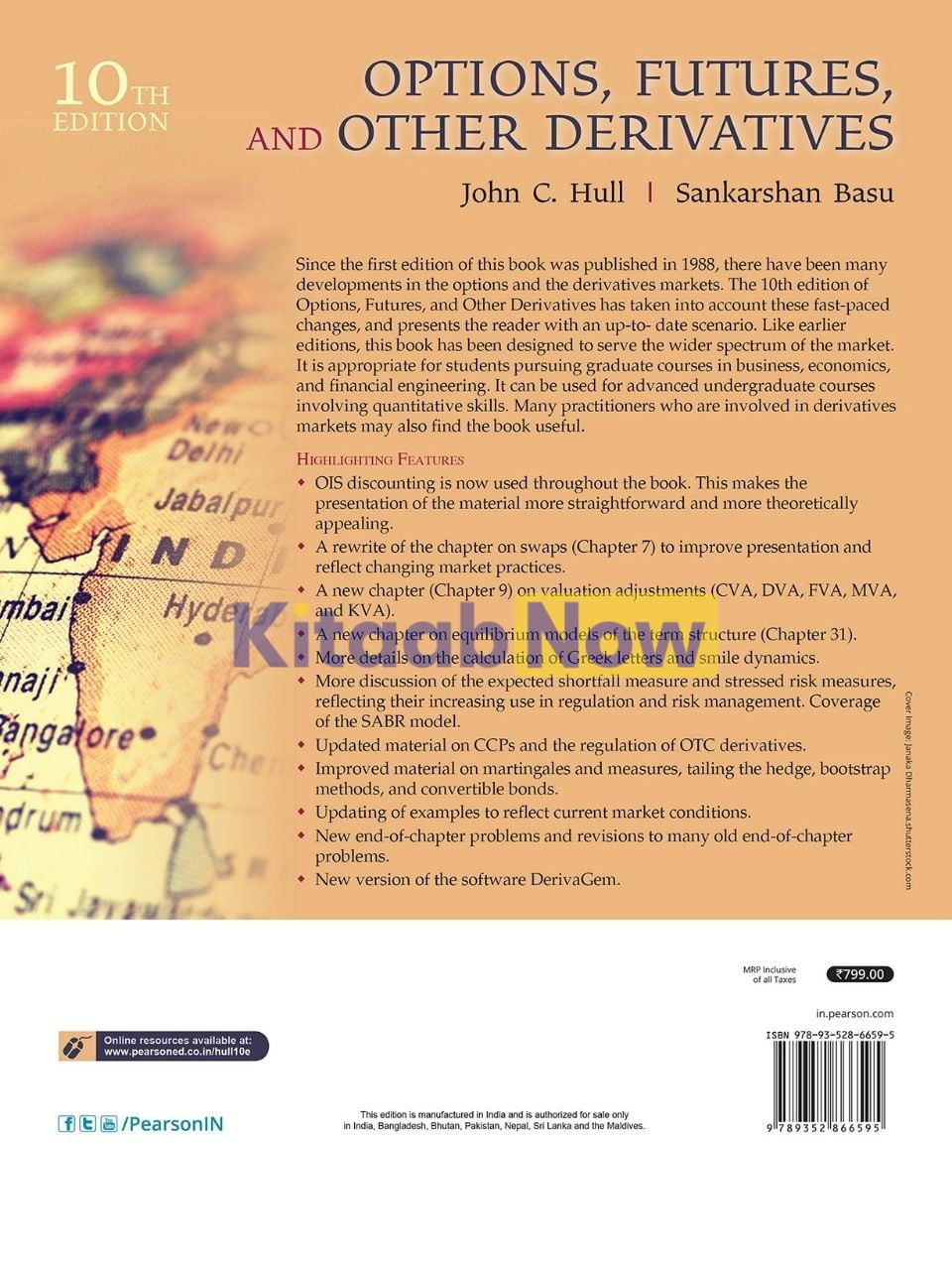
Options, Futures, and Other Derivatives (10th Edition)
- Author: John C. Hull
- ISBN: 9789352866595
- Publisher: Pearson Education
- Edition: 10th
- Publication Date: December 1, 2018
- Format: Paperback – 928 pages
- Language: English
Out of stock
Description
For courses in business, economics, and financial engineering and mathematics.
The definitive guide to derivatives markets, updated with contemporary examples and discussions
Known as “the bible” to business and economics instructors and a consistent best-seller in the university and college marketplace, Options, Futures, and Other Derivatives gives students a modern look at derivatives markets. By incorporating the industry’s hottest topics, such as the securitization and credit crisis, author John C. Hull helps bridge the gap between theory and practice. The 10th Edition covers all of the latest regulations and trends, including the Black-Scholes-Merton formulas, overnight indexed swaps, and the valuation of commodity derivatives.
Key Features
Available with the latest version of DerivaGem software–includes two Microsoft Excel® applications, Options Calculator, Applications Builder, and a Monte Carlo simulation worksheet:
- The Options Calculator features easy-to-use software to help value a wide range of options.
- The Applications Builder enables instructors and students to build their own applications, using a variety of Excel functions. Students can explore the properties of numerical procedures and options more effectively, and instructors can design more engaging assignments around custom applications. It also includes a number of sample applications.
- A Monte Carlo simulation worksheet illustrates how to use the simulation for valuing options.
Bridges the gap between theory and practice–considered “the bible” of derivatives markets by practitioners, the best-selling college text provides the most up-to-date information on key topics:
- Regulations for over-the-counter derivatives
- Overnight indexed swap (OIS) rates
- The Black-Scholes-Merton formulas
- Credit risk, discount rates, and funding costs
- Perpetual options and other perpetual derivatives
- Products such as DOOM options and CEBOs offered by CME Group
- Central Clearing, margin requirements, and swap execution facilities
- One-factor equilibrium models of the term structure
Provides a delicate balance of mathematical sophistication–careful attention to mathematical concepts and notation:
- Expanded numerical examples of key concepts
- End-of-chapter appendices for non-essential mathematical material
- Detailed explanations of concepts likely new to students
Offers a comprehensive understanding of important topics–includes helpful resources for teachers and students:
- Hundreds of PowerPoint® slides are available for download from Pearson’s Instructor Resource Center or the author’s website.
- The Solutions Manual features answers to the “Questions and Problems” at the end of each chapter.
- The Instructor’s Manual contains solutions to all end-of-chapter exercises, including “Further Questions” sections. The manual also includes test bank questions, relevant Excel worksheets, and notes on course organization and teaching each chapter.
- Technical Notes elaborate on points made in the text and can be downloaded from the author’s website
- UPDATED! Chapter 7 has been rewritten to improve presentation and reflect changing market practices in relation to swaps.
- NEW! Chapter 9 has been added to cover valuation adjustments, such as CVA, DVA, FVA, MVA, and KVA.
- NEW! Chapter 31 provides details about equilibrium models of the term structure, which are widely used in long-term scenario analysis.
- EXPANDED! Negative interest rates are now covered throughout the book to reflect a number of European and Asian markets.
- EXPANDED! More detailed explanations give a fuller picture of the calculation of Greek letters and smile dynamics.
- EXPANDED! Discussion of the expected shortfall measure and stressed risk measures has been expanded to reflect their increasing use in regulation and risk management.
- EXPANDED! Increased coverage of the SABR model gives students a more firm grasp on stochastic volatility.
- UPDATED! Materials on CCPs and OTC derivative regulation includes the most current information.
- UPDATED! Examples have been revisited to reflect current market conditions.
- REVISED! Improved material on martingales and measures, tailing the hedge, bootstrap methods, and convertible bonds helps students better understand important concepts.
- EXPANDED! End-of-chapter problems have been expanded and revised.
New to this Edition
- Chapter 7 has been rewritten to improve presentation and reflect changing market practices in relation to swaps.
- Chapter 9 has been added to cover valuation adjustments, such as CVA, DVA, FVA, MVA, and KVA.
- Chapter 31 provides details about equilibrium models of the term structure, which are widely used in long-term scenario analysis.
- Negative interest rates are now covered throughout the book to reflect a number of European and Asian markets.
- More detailed explanations give a fuller picture of the calculation of Greek letters and smile dynamics.
- Discussion of the expected shortfall measure and stressed risk measures has been expanded to reflect their increasing use in regulation and risk management.
- Increased coverage of the SABR model gives students a more firm grasp on stochastic volatility.
- Materials on CCPs and OTC derivative regulation includes the most current information.
- Examples have been revisited to reflect current market conditions.
- Improved material on martingales and measures, tailing the hedge, bootstrap methods, and convertible bonds helps students better understand important concepts.
- End-of-chapter problems have been expanded and revised.
Table of Contents
- List of Business Snapshots
- List of Technical Notes
- Preface
- Introduction
- Futures markets and central counterparties
- Hedging strategies using futures
- Interest rates
- Determination of forward and futures prices
- Interest rate futures
- Swaps
- Securitization and the credit crisis of 2007
- XVAs
- Mechanics of options markets
- Properties of stock options
- Trading strategies involving options
- Binomial trees
- Wiener processes and Itô’s lemma
- The Black—Scholes—Merton model
- Employee stock options
- Options on stock indices and currencies
- Futures options and Black’s model
- The Greek letters
- Volatility smiles
- Basic numerical procedures
- Value at risk and expected shortfall
- Estimating volatilities and correlations
- Credit risk
- Credit derivatives
- Exotic options
- More on models and numerical procedures
- Martingales and measures
- Interest rate derivatives: The standard market models
- Convexity, timing, and quanto adjustments
- Equilibrium models of the short rate
- No-arbitrage models of the short rate
- HJM, LMM, and multiple zero curves
- Swaps Revisited
- Energy and commodity derivatives
- Real options
- Derivatives mishaps and what we can learn from them
- Glossary of terms
- DerivaGem software
- Major exchanges trading futures and options
- Tables for N (x)
- Author index
- Subject index
Author Biography
John Hull is the Maple Financial Professor of Derivatives and Risk Management at the Joseph L. Rotman School of Management, University of Toronto. He is an internationally recognized authority on derivatives and risk management with many publications in this area. His work has an applied focus. In 1999, he was voted Financial Engineer of the Year by the International Association of Financial Engineers. He has acted as consultant to many North American, Japanese, and European financial institutions. He has won many teaching awards, including University of Toronto’s prestigious Northrop Frye award.
Additional information
| Weight | 1.347 kg |
|---|
Only logged in customers who have purchased this product may leave a review.
Related Products


Reviews
There are no reviews yet.