
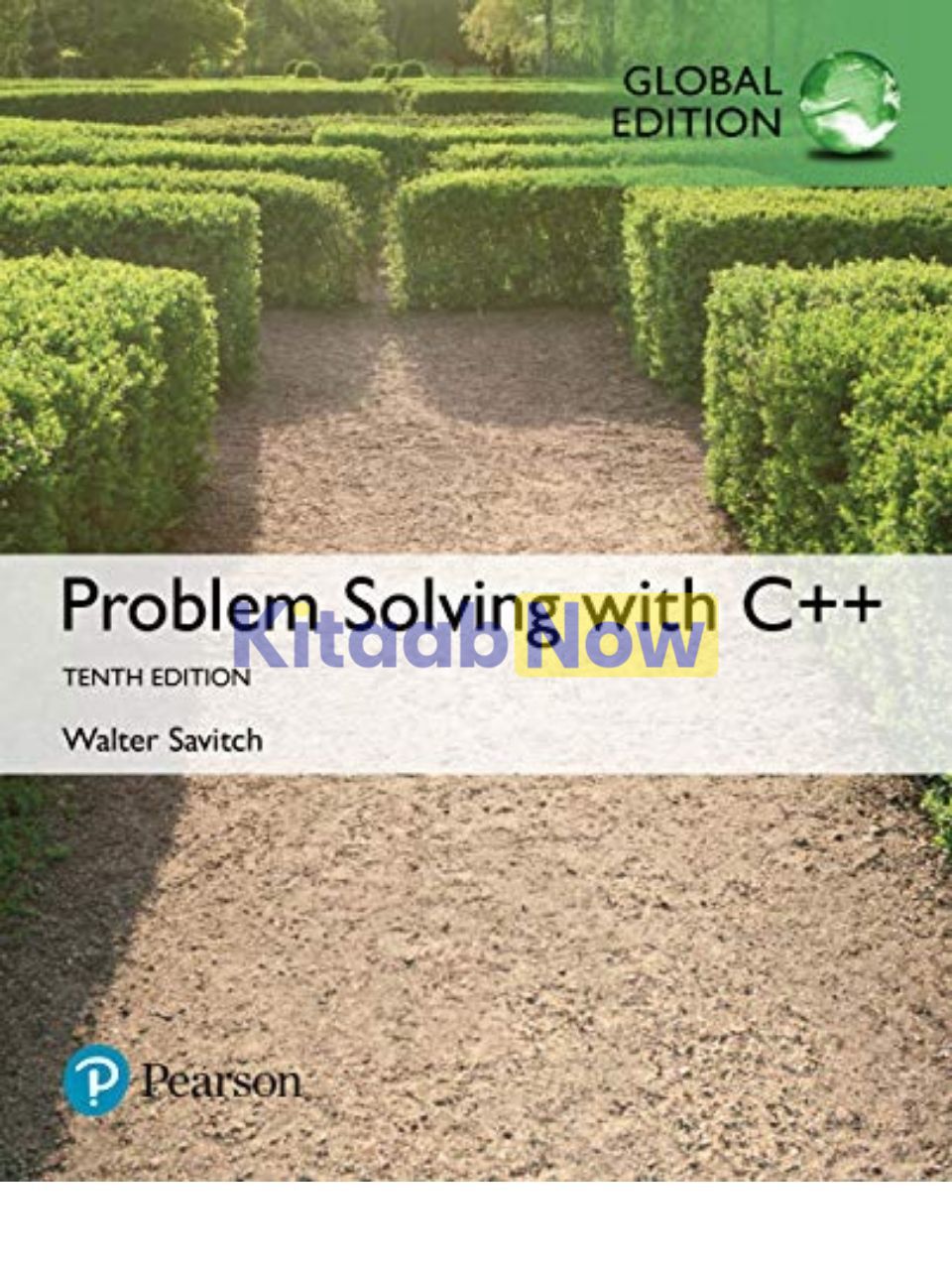
Problem Solving with C++ (Global 10th Edition)
- Author: Walter Savitch
- ISBN: 9781292222820
- Publisher: Pearson Education
- Edition: 10th
- Publication Date: January 10, 2018
- Format: Paperback – 1120 pages
- Language: English
Description
For courses in C++ introductory programming.
Teach the fundamentals of C++ programming with an emphasis on problem solving
Now in its 10th Edition, Problem Solving with C++ is written for the beginning programmer. The text cultivates strong problem-solving skills and programming techniques as it introduces students to the C++ programming language. Author Walt Savitch’s approach to programming emphasizes active reading through the use of well-placed examples and self-tests, while flexible coverage means instructors can easily adapt the order of chapters and sections to their courses without sacrificing continuity. Savitch’s clear, concise style is a hallmark feature of the text, receiving praise from students and instructors alike, and is supported by a suite of tried-and-true pedagogical tools. The 10th Edition includes ten new Programming Projects, along with new discussions and revisions.
Pearson Pearson MyLab Programming not included. Students, if MyLab is a recommended/mandatory component of the course, please ask your instructor for the correct ISBN and course ID. MyLab should only be purchased when required by an instructor. Instructors, contact your Pearson rep for more information.
Pearson MyLab Programming is an online learning system designed to engage students and improve results. Pearson MyLab Programming consists of programming exercises correlated to the concepts and objectives in this book. Through practice exercises and immediate, personalized feedback, Pearson MyLab Programming improves the programming competence of beginning students who often struggle with the basic concepts of programming languages.
Key Features
This title is a Pearson Global Edition. The Editorial team at Pearson has worked closely with educators around the world to include content which is especially relevant to students outside the United States.
A clear and student-friendly introduction to C++
- Savitch’s clear, concise style is a hallmark feature of the text, receiving praise from students and instructors alike.
- A flexible coverage of objects means that instructors can easily adapt the order in which chapters and sections are covered in their course without losing continuity. A dependency chart in the preface offers a quick reference for instructors who wish to rearrange coverage.
- Advanced topic coverage includes discussions of C++ templates, inheritance (including virtual functions), and exception handling, plus a full chapter on the Standard Template Library (STL).
- This edition is fully compatible with compilers that meet the latest ANSI/ISO C++ standard. At the time of this writing the latest standard is C++14.
- REVISED! Corrections of errata and edits for clarity have been made, such as indicating preferred methods for file I/O, naming of terminology, a better definition of encapsulation, and removing material that is now standard in C++11 and higher.
- NEW! camelCase notation, rather than underscore_case, is used consistently throughout the text.
Tried-and-True Pedagogy
- Concise, easy-to-understand programming examples, projects, exercises, tips, and pitfalls benefit student understanding.
- Boxed sections summarize major points and are spread throughout each chapter.
- Numerous Self-Test Exercises are contained at strategic points in each chapter. Complete answers for all the Self-Test Exercises are given at the end of each chapter.
- End-of-chapter programs are split into Practice Programs and Programming Projects.
- Practice Programs require a direct application of concepts presented in the chapter and solutions are usually short. Practice Programs are appropriate for laboratory exercises.
- Programming Projects require additional problem solving and solutions are generally longer than Practice Programs. Programming Projects are appropriate for homework problems.
- NEW! Ten new Programming Projects have been added.
- The password-protected Companion Website features support material available to all users of the book. A bound-in access card is included with the purchase of a new copy of the textbook.
- Source code from the book
- PowerPoint slides
Pearson Pearson MyLab Programming not included. Students, if MyLab is a recommended/mandatory component of the course, please ask your instructor for the correct ISBN and course ID. MyLab should only be purchased when required by an instructor. Instructors, contact your Pearson representative for more information.
- UPDATED! User Interface provides a new streamlined interface based on experienced user feedback. Course creation, configuration, and navigation are now easier than ever.
- EXPANDED! Exercise Editor now allows you to easily create new programming exercises. In addition to assigning the hundreds of programming exercises already available in MyLab Programming, you can create and assign programming exercises to customize your course.
- UPDATED! VideoNotes Tutorials provide step-by-step video tutorials specifically designed to enhance the programming concepts presented in Introduction to Java Programming. Students can view the entire problem-solving process outside of the classroom–when they need help the most.
- Interactive Practice provides first-hand programming experience in an interactive online environment.
- Immediate feedback for incorrect answers give students personalized feedback differentiating logical and compiler errors. The error messages include both the feedback from the compiler and plain English interpretations of likely causes for the incorrect answer.
- NEW! The Plagiarism Detection Tool alerts instructors of potential plagiarism issues by checking:
- Students’ average submission rate
- Students’ average number of attempts until correct.
- Dynamic grading and assessment provide auto-grading of student assignments, saving you time and offering students immediate learning opportunities:
- A dynamic roster tracks their performance and maintains a record of submissions.
- The color-coded gradebook gives you a quick glance of your classes’ progress. Easily drill down to receive information on a single student’s performance or a specific problem. Gradebook results can be exported to Excel to use with your LMS.
New to this Edition
- Corrections of errata and edits for clarity have been made, such as preferred methods for file I/O, naming of terminology, a better definition of encapsulation, and removal of material that is now standard in C++11 and higher.
- camelCase notation, rather than underscore_case, is used consistently throughout the text.
- Ten new Programming Projects have been added.
Content Updates
- A discussion in Chapter 10 concerning an example of shallow vs. deep copy.
- Additional material in Chapter 12 and 17 on compiling templates with header files.
- Additional material in Chapter 18 on the std::array class, regular expressions, threads, and smart pointers in C++11.
Pearson Pearson MyLab Programming not included. Students, if MyLab is a recommended/mandatory component of the course, please ask your instructor for the correct ISBN and course ID. MyLab should only be purchased when required by an instructor. Instructors, contact your Pearson representative for more information.
- User Interface provides a new streamlined interface based on experienced user feedback. Course creation, configuration, and navigation are now easier than ever.
- Exercise Editor now allows you to easily create new programming exercises. In addition to assigning the hundreds of programming exercises already available in MyLab Programming, you can create and assign programming exercises to customize your course. The Exercise Editor is easy to use and gives you the option to select different programming languages and exercise types.
- VideoNotes provide step-by-step video tutorials specifically designed to enhance the programming concepts presented in Introduction to Java Programming. Students can view the entire problem-solving process outside of the classroom—when they need help the most.
- The Plagiarism Detection Tool alerts instructors of potential plagiarism issues by checking
- Students’ average submission rate.
- Students’ average number of attempts until correct.
Table of Contents
- Introduction to Computers and C++ Programming
- C++ Basics
- More Flow of Control
- Procedural Abstraction and Functions That Return a Value
- Functions for All Subtasks
- I/O Streams as an Introduction to Objects and Classes
- Arrays
- Strings and Vectors
- Pointers and Dynamic Arrays
- Defining Classes
- Friends, Overloaded Operators, and Arrays in Classes
- Separate Compilation and Namespaces
- Pointers and Linked Lists
- Recursion
- Inheritance
- Exception Handling
- Templates
- Standard Template Library and C++11
- Appendices:
- C++ Keywords
- Precedence of Operators
- The ASCII Character Set
- Some Library Functions
- Inline Functions
- Overloading the Array Index Square Brackets
- The this Pointer
- Overloading Operators as Member
- Operators
- Index
Author Biography
Walter Savitch is Professor Emeritus of Computer Science at the University of California at San Diego. His interests include complexity theory, formal language theory, computational linguistics, and the development of computer science education materials, including several leading textbooks. He holds a PhD in mathematics from the University of California at Berkeley.
Additional information
| Weight | 1.569 kg |
|---|
Only logged in customers who have purchased this product may leave a review.
Related Products


Reviews
There are no reviews yet.