
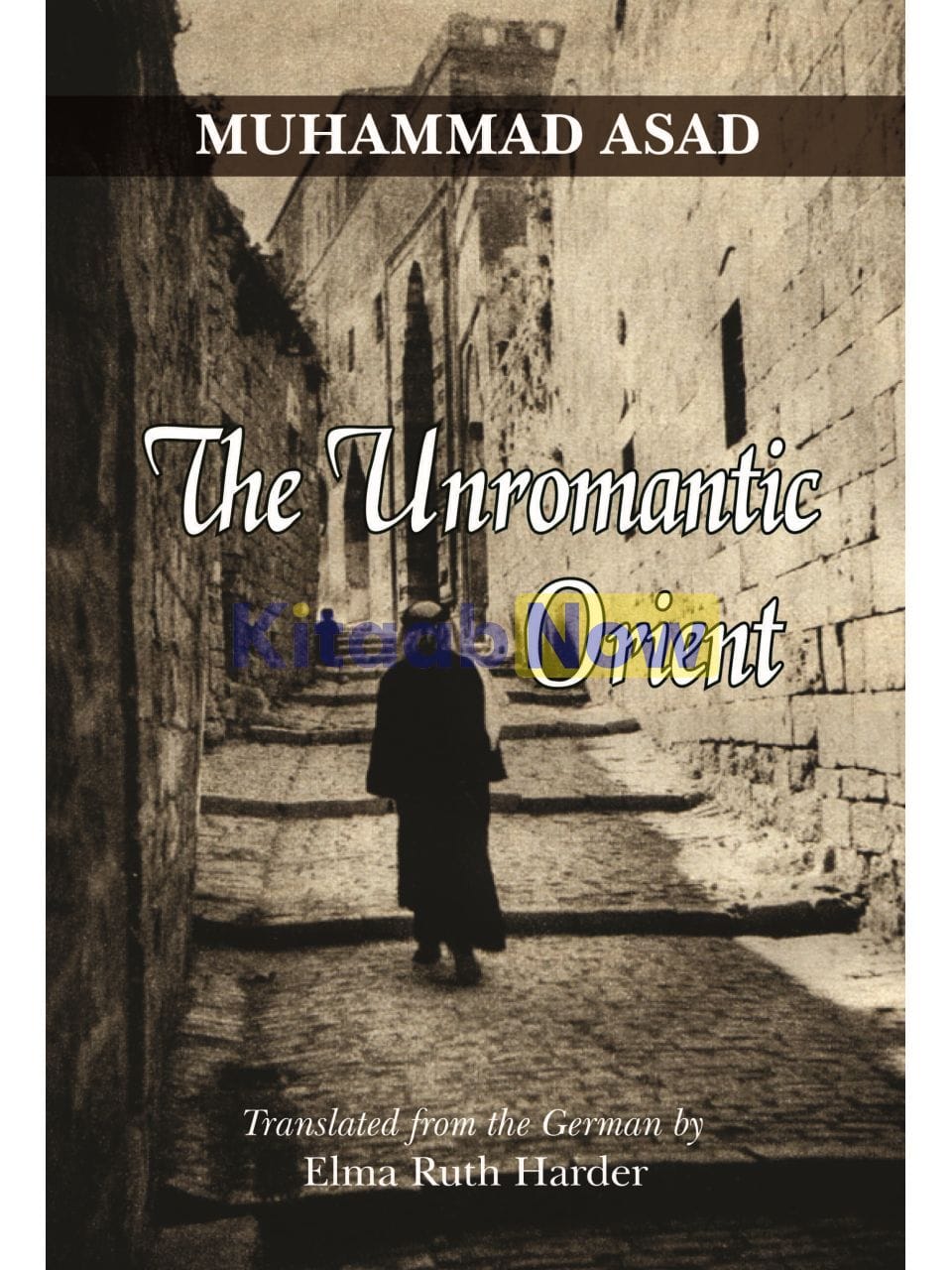
The Unromantic Orient
- Author: Muhammad Asad
- ISBN: 9789839154610
- Publisher: Islamic Book Trust
- Publication Date: January 1, 2004
- Format: Paperback – 192 pages
- Language: English
Description
In the spring of 1922, twenty-one year old Leopold Weiss received a letter from his uncle Dorian to come and live in his “delightful old Arab stone house” in Jerusalem on the fringe of the Old City near the Jaffa Gate. On a foggy morning in the summer of 1922, Leopold Weiss stood on the planks of a ship on his way to the East where he would experience his first Arab encounters as if they were a presentiment of what the future held in store for him. “It was as when you enter a strange house for the first time and an indefinable smell in the hallway dimly gives you a hint of things which will happen to you as if they are to be joyful things, and you feel a stab of rapture in your heart.” After several months of travel in the Middle East, Leopold Weiss returned to Germany and published his journal entries as Unromantisches Morgenland, aus dem Tagebuch einer Reise. This first English translation of a long forgotten work recaptures his initial experiences in an unknown and intriguing land where he found a new home and a new sense of belonging.
Author Biography
Muhammad Asad born Leopold Weiss; 12 July 1900 – 20 February 1992 was a Jewish-born Austro-Hungarian journalist, traveler, writer, linguist, thinker, political theorist, diplomat and Islamic scholar. Asad was one of the most influential European Muslims of the 20th century.
By the age of thirteen, young Weiss had acquired a passing fluency in Hebrew and Aramaic, other than his native languages German and Polish. By his mid-twenties, he could read and write in English, French, Persian and Arabic. In Mandatory Palestine, Weiss engaged in arguments with Zionist leaders like Chaim Weizmann, voicing his reservations about some aspects of the Zionist Movement. After travelling across the Arab World as a journalist, he converted to Islam in 1926 and chose for himself the Muslim name “Muhammad Asad”—Asad being the Arabic rendition of his root name Leo (Lion).
During his stay in Saudi Arabia, he spent time with Bedouins and enjoyed close company of Ibn Saud—the founder of modern Saudi Arabia.
On his visit to India, Asad became friends with Muslim poet-philosopher Muhammad Iqbal, who persuaded him to abandon his eastward travels and “help elucidate the intellectual premises of the future Islamic state”. He also spent five years in internment by the British Government at the outbreak of World War II. On 14 August 1947, Asad received Pakistani citizenship and later served at several bureaucratic and diplomatic positions including the Director of Department of Islamic Reconstruction, Deputy Secretary (Middle East Division) in the Foreign Ministry of Pakistan and Pakistan’s Envoy to the United Nations.
In the West, Asad rose to prominence as a writer with his best-selling autobiography, The Road to Mecca. Later, after seventeen years of scholarly research, he published his magnum opus: The Message of the Qur’an—an English translation and commentary of the Quran. The book, along with the translations of Pickthall and Yusuf Ali, is regarded as one of the most influential translations of the modern era. An ardent proponent of Ijtihad and rationality in interpreting religious texts, he dedicates his works “to People who Think”. In 2008, the entrance square to the UN Office in Vienna was named Muhammad Asad Platz in commemoration of his work as a “religious bridge-builder”. Asad has been described by his biographers as “Europe’s gift to Islam” and “A Mediator between Islam and the West”.
Additional information
| Weight | 0.280 kg |
|---|
Only logged in customers who have purchased this product may leave a review.
Related Products

Reviews
There are no reviews yet.