
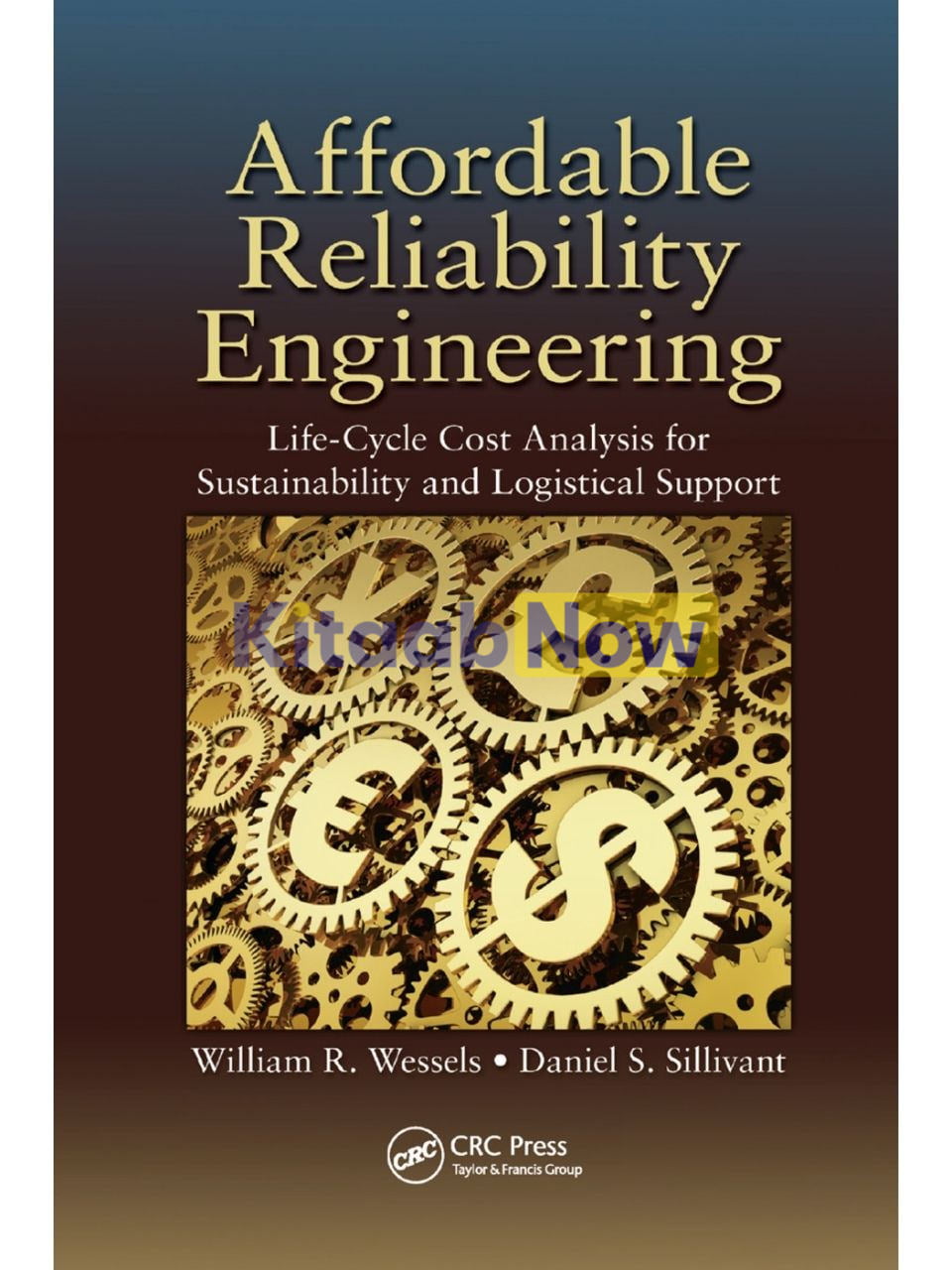
Affordable Reliability Engineering: Life-Cycle Cost Analysis for Sustainability & Logistical Support
- Author: William R. Wessels, Daniel Sillivant
- ISBN: 9781138747609
- Publisher: CRC Press
- Edition: 1st
- Publication Date: July 27, 2017
- Format: Paperback – 372 pages
- Language: English
Description
How Can Reliability Analysis Impact Your Company’s Bottom Line?
While reliability investigations can be expensive, they can also add value to a product that far exceeds its cost. Affordable Reliability Engineering: Life-Cycle Cost Analysis for Sustainability & Logistical Support shows readers how to achieve the best cost for design development testing and evaluation and compare options for minimizing costs while keeping reliability above specifications. The text is based on the premise that all system sustainment costs result from part failure. It examines part failure in the design and sustainment of fielded parts and outlines a design criticality analysis procedure that reflects system design and sustainment.
Achieve the Best Cost for Life-Cycle Sustainment
Providing a framework for managers and engineers to develop and implement a reliability program for their organizations, the authors present the practicing professional with the tools needed to manage a system at a high reliability at the best cost. They introduce analytical methods that provide the methodology for integrating part reliability, failure, maintainability, and logistic math models. In addition, they include examples on how to run reliability simulations, highlight tools that are commercially available for such analysis, and explain the process required to ensure a design will meet specifications and minimize costs in the process.
This text:
- Demonstrates how to use information gathered from reliability investigations
- Provides engineers and managers with an understanding of a reliability engineering program so that they can perform reliability analyses
- Seeks to resolve uncertainty and establish the value of reliability engineering
Affordable Reliability Engineering: Life-Cycle Cost Analysis for Sustainability & Logistical Support focuses on reliability-centered maintenance and is an ideal resource for reliability engineers and managers. This text enables reliability professionals to determine the lowest life-cycle costs for part selection, design configuration options, and the implementation of maintenance practices, as well as spare parts strategies, and logistical resources.
Table of Contents
- Scope of Reliability-Based Life-Cycle Economical Analysis
- Background
- Reliability Engineering Approaches
- Reliability Engineering Economics
- Reliability Engineering Analysis Impacts on Life-Cycle Costs
- Reliability Analysis for Part Design
- Failure
- Criticality Items List and Database
- Proposed Criticality Analysis Procedure
- Reliability Block Diagram
- Qualitative Part Failure Analysis
- Quantitative Failure Analysis
- Assembly Reliability Functions
- Fitting Reliability Data to Reliability Math Models
- Exponential Reliability Math Models
- Weibull Reliability Math Models
- Qualitative Maintainability Analysis
- Quantitative Maintainability Analysis
- System Logistics Downtime Math Model
- Summary of Reliability Math Models
- Availability
- Application of Reliability Math Models
- Reliability Analysis for System Sustainment
- Baseline Reliability Analysis
- Failure Report, Analysis, Corrective Action System—FRACAS
- Prerepair Logistics Downtime
- Postrepair Logistics Downtime
- Quantitative Reliability Analysis
- Exponential Reliability Math Models
- Weibull Reliability Math Models
- Quantitative Maintainability Analysis
- Mean Maintenance Time
- Mean Downtime
- System Logistics Downtime Math Model
- Summary of Reliability Math Models
- Availability
- Application of Reliability Math Models
- Engineering Economic Analysis
- Engineering Economic Analysis Information
- Fundamental Economic Concepts
- Amounts versus Equivalent Value
- Cost Estimation
- Classifications of Sources and Uses of Estimated Cash
- Cash Flow Timeline
- Equivalent Values
- Example 1: Project Cash Flow Timeline: m =
- Example 2: Project Cash Flow Timeline: m =
- Example 3: Project Cash Flow Timelines for Three Projects: m =
- Example 4: Project Cash Flow Timelines for Three Projects: m =
- Application to Reliability Based Life-Cycle Economic Analysis
- Reliability-Based Logistical Economic Analysis
- Failure Math Model
- Repair Math Model
- Logistics Downtime Math Model
- Impact of Preventive Maintenance on Logistics Downtime
- Special Cause Variability in Logistics Downtime
- Cost Objective Function
- Spare Parts Acquisition Strategies
- Specialty Tools
- Cash Flow Timeline
- Life-Cycle Economic Analysis
- Selection
- Cautionary Note
- Preventive Maintenance
- Life-Cycle Simulation Approach
- System Reliability Analysis
- Spare Parts Strategy
- Standby Design Configuration
- Reliability-Centered Maintenance
- Choosing the Correct Maintenance Plan
- RCM Challenges
- RCM Benefits
- Reliability Database
- Segment 1: Criticality Analysis
- Segment 2: Qualitative Failure Analysis
- Segment 3: Quantitative Failure Analysis
- Segment 4: Quantitative Repair Analysis
- Segment 5: Pre-Repair Logistics Downtime Quantitative Analysis
- Segment 6: Post-Repair Logistics Downtime Quantitative Analysis
- Segment 7: Spare Part Strategy
- Reliability Simulation and Analysis
- Reliability Simulations
- Assembly and System Simulations
- Summary
- A: Reliability Failure Math Models and Reliability Functions
- Exponential Reliability Math Modeling Approach
- Weibull Reliability Math Modeling Approach
- B: Maintainability Math Models and Maintainability Functions
- Time-to-Repair Math Model, Log-Normal Distribution Approach
- Time-to-Repair Math Model, Weibull Distribution Approach
- Comparison between the Log-Normal and Weibull Approach
- Logistics Downtime Functions
- Engineering Economics Functions
- Cost Estimation: Present Amount
- Cost Estimation: Future Amount
- Equivalent Present Value: Future Amount
- Cost Estimation: Uniform Recurring Amounts
- Recurring Amounts with Linear Gradient
- Recurring Amounts with Geometric Gradient
- Capital Recovery
- Sinking Fund
- Net Present Value and Equivalent Uniform Recurring Amount
- Less Common Engineering Economics Functions
- References
Author(s) Description
Bill Wessels has over 45 years of experience in system design and sustainability. He currently works at the University of Alabama in Huntsville, where he cofounded the Reliability and Failure Analysis Laboratory and performs basic and applied research in design-for-reliability, reliability-based maintainability, and reliability-based life-cycle economic analysis. Wessels has a BS in engineering from the United States Military Academy at West Point, an MBA in decision sciences from the University of Alabama in Tuscaloosa, and a PhD in systems engineering from the University of Alabama in Huntsville. He is a registered professional mechanical engineer and a certified reliability engineer.
Daniel S. Sillivant is a researcher at the University of Alabama in Huntsville performing basic and applied research and investigations in reliability life-cycle modeling for aviation and sensors systems. He is published in peer-reviewed proceedings for the International Mechanical Engineering Congress and Exposition; Reliability, Availability, Maintainability Workshop; and Industry, Engineering, and Management Systems. Sillivant has a bachelor’s degree in chemical engineering and a master’s degree in industrial/reliability engineering from UAH. He has begun his dissertation research in reliability based life-cycle economic modeling for implementation of reliability-centered maintenance. In addition, he holds certificates in Lean Concepts Training and Six Sigma Green Belt.
Additional information
| Weight | 0.455 kg |
|---|
Only logged in customers who have purchased this product may leave a review.
Related Products


Reviews
There are no reviews yet.