
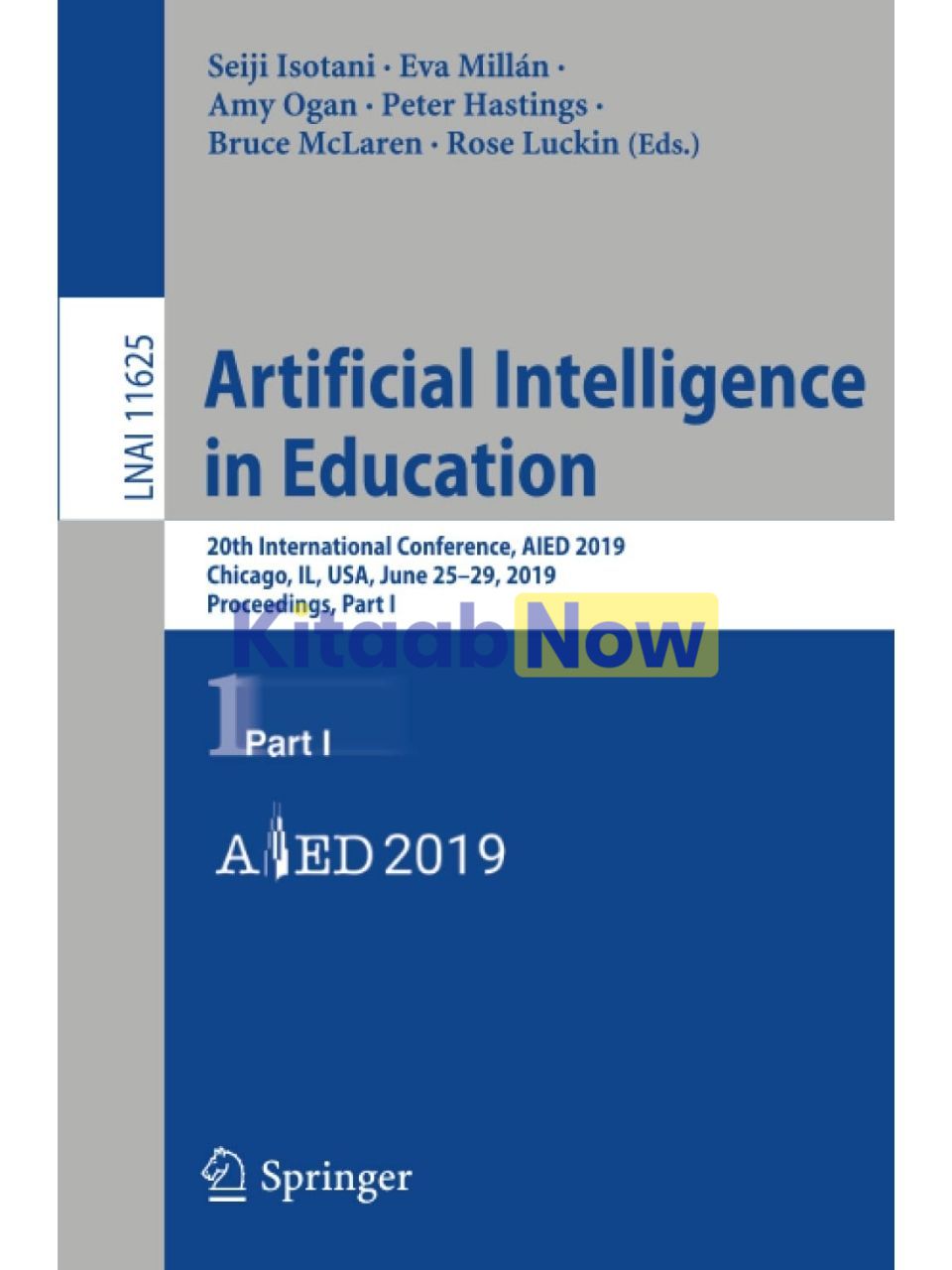

Artificial Intelligence in Education: 20th International Conference, AIED 2019, Chicago, IL, USA, June 25-29, 2019, Proceedings, Part I
- Edited By: Seiji Isotani, Eva Millan, Amy Ogan, Peter Hastings, Bruce McLaren, Rose Luckin
- ISBN: 9783030232030
- Publisher: Springer Publishing Company
- Publication Date: June 21, 2019
- Format: Paperback – 561 pages
- Language: English
Out of stock
Description
This two-volume set LNCS 11625 and 11626 constitutes the refereed proceedings of the 20th International Conference on Artificial Intelligence in Education, AIED 2019, held in Chicago, IL, USA, in June 2019.
The 45 full papers presented together with 41 short, 10 doctoral consortium, 6 industry, and 10 workshop papers were carefully reviewed and selected from 177 submissions. AIED 2019 solicits empirical and theoretical papers particularly in the following lines of research and application: Intelligent and interactive technologies in an educational context; Modelling and representation; Models of teaching and learning; Learning contexts and informal learning; Evaluation; Innovative applications; Intelligent techniques to support disadvantaged schools and students, inequity and inequality in education.
Table of Contents
- Front Matter
- Towards the Identification of Propaedeutic Relations in Textbooks
- Investigating Help-Giving Behavior in a Cross-Platform Learning Environment
- Predicting Academic Performance: A Bootstrapping Approach for Learning Dynamic Bayesian Networks
- The Impact of Student Model Updates on Contingent Scaffolding in a Natural-Language Tutoring System
- Item Ordering Biases in Educational Data
- A Comparative Study on Question-Worthy Sentence Selection Strategies for Educational Question Generation
- Effect of Discrete and Continuous Parameter Variation on Difficulty in Automatic Item Generation
- Automated Summarization Evaluation (ASE) Using Natural Language Processing Tools
- The Importance of Automated Real-Time Performance Feedback in Virtual Reality Temporal Bone Surgery Training
- Autonomy and Types of Informational Text Presentations in Game-Based Learning Environments
- Examining Gaze Behaviors and Metacognitive Judgments of Informational Text Within Game-Based Learning Environments
- Using “Idealized Peers” for Automated Evaluation of Student Understanding in an Introductory Psychology Course
- 4D Affect Detection: Improving Frustration Detection in Game-Based Learning with Posture-Based Temporal Data Fusion
- Designing for Complementarity: Teacher and Student Needs for Orchestration Support in AI-Enhanced Classrooms
- The Case of Self-transitions in Affective Dynamics
- How Many Times Should a Pedagogical Agent Simulation Model Be Run?
- A Survey of the General Public’s Views on the Ethics of Using AI in Education
- Promoting Inclusivity Through Time-Dynamic Discourse Analysis in Digitally-Mediated Collaborative Learning
- Evaluating Machine Learning Approaches to Classify Pharmacy Students’ Reflective Statements
- Comfort with Robots Influences Rapport with a Social, Entraining Teachable Robot
- A Concept Map Based Assessment of Free Student Answers in Tutorial Dialogues
- Deep (Un)Learning: Using Neural Networks to Model Retention and Forgetting in an Adaptive Learning System
- Checking It Twice: Does Adding Spelling and Grammar Checkers Improve Essay Quality in an Automated Writing Tutor?
- What’s Most Broken? Design and Evaluation of a Tool to Guide Improvement of an Intelligent Tutor
- Reducing Mind-Wandering During Vicarious Learning from an Intelligent Tutoring System
- Annotated Examples and Parameterized Exercises: Analyzing Students’ Behavior Patterns
- Investigating the Effect of Adding Nudges to Increase Engagement in Active Video Watching
- Behavioural Cloning of Teachers for Automatic Homework Selection
- Integrating Students’ Behavioral Signals and Academic Profiles in Early Warning System
- Predicting Multi-document Comprehension: Cohesion Network Analysis
- Student Network Analysis: A Novel Way to Predict Delayed Graduation in Higher Education
- Automatic Generation of Problems and Explanations for an Intelligent Algebra Tutor
- Generalizability of Methods for Imputing Mathematical Skills Needed to Solve Problems from Texts
- Using Machine Learning to Overcome the Expert Blind Spot for Perceptual Fluency Trainings
- Disentangling Conceptual and Embodied Mechanisms for Learning with Virtual and Physical Representations
- Adaptive Support for Representation Skills in a Chemistry ITS Is More Effective Than Static Support
- Confrustion in Learning from Erroneous Examples: Does Type of Prompted Self-explanation Make a Difference?
- Modeling Collaboration in Online Conversations Using Time Series Analysis and Dialogism
- Improving Short Answer Grading Using Transformer-Based Pre-training
- Uniform Adaptive Testing Using Maximum Clique Algorithm
- Rater-Effect IRT Model Integrating Supervised LDA for Accurate Measurement of Essay Writing Ability
- Collaboration Detection that Preserves Privacy of Students’ Speech
- How Does Order of Gameplay Impact Learning and Enjoyment in a Digital Learning Game?
- Analyzing Students’ Design Solutions in an NGSS-Aligned Earth Sciences Curriculum
- Hierarchical Reinforcement Learning for Pedagogical Policy Induction
- Back Matter
Editors Biography
Seiji Isotani
University of Sao Paulo, Sao Paulo, Brazil
Eva Millán
University of Malaga, Málaga, Spain
Amy Ogan, Bruce McLaren
Carnegie Mellon University, Pittsburgh, USA
Peter Hastings
DePaul University, Chicago, USA
Rose Luckin
University College London, London, UK
Additional information
| Weight | 0.902 kg |
|---|
Only logged in customers who have purchased this product may leave a review.
Related Products




Reviews
There are no reviews yet.