
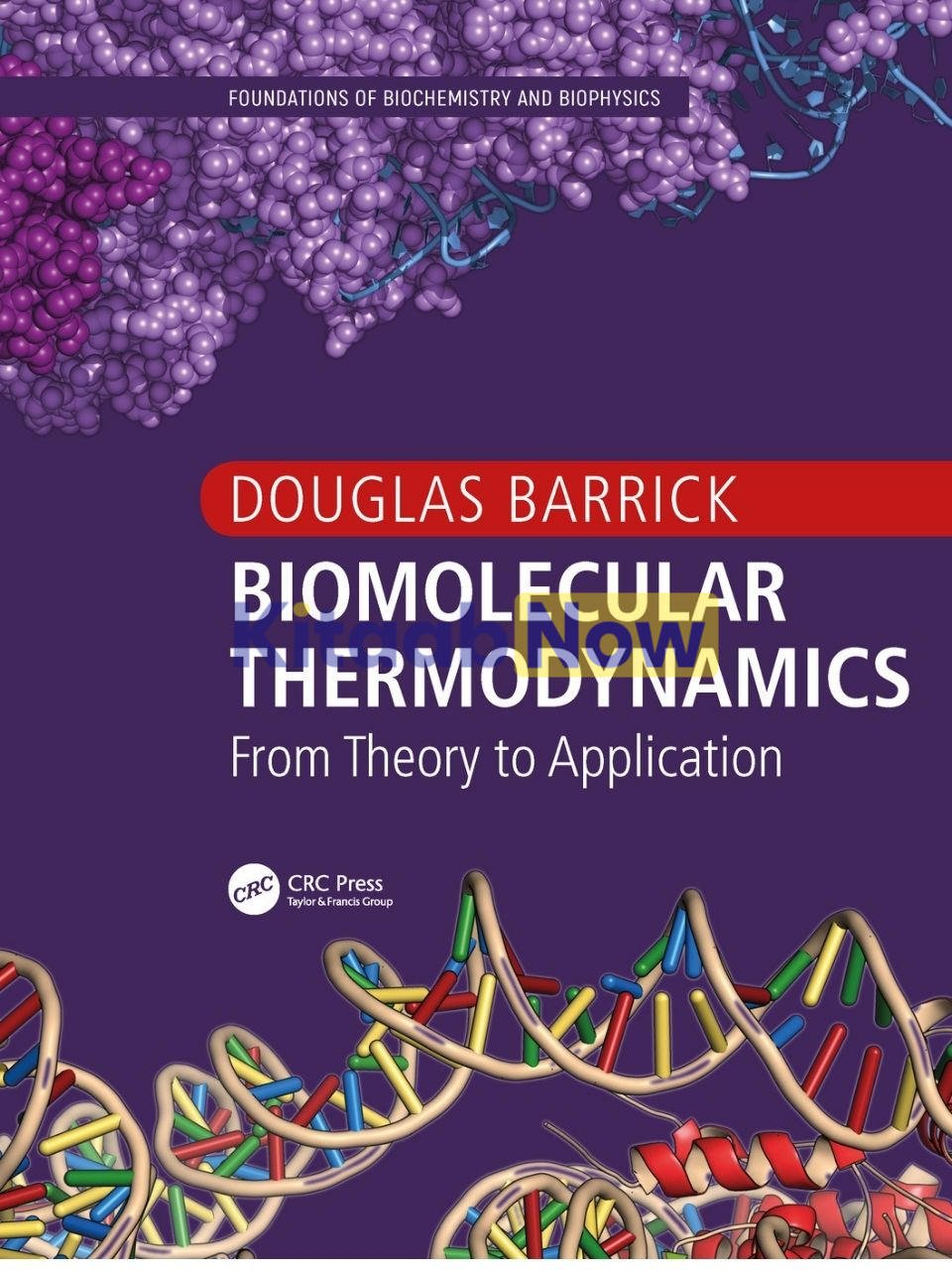
Biomolecular Thermodynamics: From Theory to Application
- Author: Douglas Barrick
- ISBN: 9781439800195
- Publisher: CRC Press
- Edition: 1st
- Publication Date: October 19, 2017
- Format: Paperback – 552 pages
- Language: English
Description
Biomolecular Thermodynamics: From Theory to Application provides a comprehensive, contemporary introduction to developing a quantitative understanding of how biological macromolecules behave using classical and statistical thermodynamics. The author focuses on practical skills needed to apply the underlying equations in real life examples. The text develops mechanistic models, showing how they connect to thermodynamic observables, presenting simulations of thermodynamic behavior, and analyzing experimental data. The reader is presented with plenty of exercises and problems to facilitate hands-on learning through mathematical simulation.
Table of Contents
- Probabilities and Statistics in Chemical and Biothermodynamics
- Elementary Events.
- How Probabilities Combine.
- Permutation versus composition.
- Discrete Probability Distributions
- Continuous Distributions
- Mathematical Tools in Thermodynamics
- Calculus in Thermodynamics.
- Fitting continuous curves to discrete data.
- Determining the covariance matrix in least-squares fitting.
- Model testing with the 2 and f-ratio probability distributions.
- The Framework of Thermodynamics and the First Law
- What is Thermodynamics and What Does it Treat?
- Dividing up the Universe: System and Surroundings
- Equilibrium, Changes of State, and Reversibility
- Thermodynamic Variables and Equations of State
- The First law of Thermodynamics Work
- The reversible work associated with four fundamental changes of state.
- The heat flow associated with the four fundamental changes in an ideal gas.
- The work associated with the irreversible expansion of an ideal gas.
- The connection between heat capacities and state functions.
- A non-ideal model: the van der Walls equation of state
- The Second Law and Entropy
- Some familiar examples of spontaneous change.
- Spontaneous change and statistics
- The directionality of heat flow at the macroscopic (classical) level
- Free Energy as a Potential for the Laboratory and Biology
- Internal energy as a potential–combining the first and second laws.
- Contributions of different chemical species to thermodynamic state functions—molar quantities.
- Partial pressures of mixtures of gases.
- Legendre transforms of a single variable.
- Using Chemical Potentials to Describe Phase Transitions
- Phases and their transformations.
- The condition for equilibrium between two phases.
- How chemical potentials of different phases depend on temperature and pressure: deriving a T-p phase diagram for water.
- Additional restrictions from the phase diagram: the Clausius-Clapeyron equation and Gibbs’ phase rule.
- The Concentration Dependence of Chemical Potential, Mixing, and Reactions
- The dependence of chemical potential on concentration.
- A simple lattice model for nonideal solution behavior.
- Chemical reactions
- Similarities (and differences) between free energies of reaction and mixing.
- How chemical equilibrium depends on temperature
- How chemical equilibrium depends on pressure
- Conformational Equilibrium
- Macromolecular structure.
- A simple two-state model for conformational transitions.
- Simultaneous visualization of N and D.
- The thermal unfolding transition as a way to determine Kfold and G°.
- A simple geometric way to connect Yobs to Kfold.
- Fitting conformational transitions to analyze the thermodynamics of unfolding.
- A more realistic model thermal unfolding of proteins: the constant heat capacity model.
- Measurement of thermal denaturation by differential scanning calorimetry.
- Chemical denaturation of proteins.
- APPENDIX 1: Differential Scanning Calorimetry
- Ensembles that Interact with their Surroundings
- Heat exchange and the canonical ensemble.
- The canonical partition function.
- A canonical ensemble representing a three particle isothermal system.
- The isothermal isobaric ensemble and Gibbs free energy.
- Partition Functions for Single Molecules and Chemical Reactions
- A canonical partition function for a system with one molecule.
- The relationship between the molecular and canonical partition functions.
- An isothermal-isobaric molecular partition function.
- A statistical thermodynamic approach to chemical reaction.
- The Helix-Coil Transition
- The noncooperative homopolymer model.
- The noncooperative heteropolymer model.
- Coupling between the sites and the basis for cooperativity
- Coupling between residues through “nearest-neighbor” models
- Ligand Binding Equilibria from a Macroscopic Perspective
- Ligand Binding to a single site
- Practical issues in measuring and analyzing binding curves
- Binding of multiple ligands
- A macroscopic representation of multiple ligand binding.
- The binding polynomial P: a partition function for ligand binding.
- An example—the macroscopic binding of two ligands.
- Binding to multiple different ligands: “heterotropic” binding
- A general framework to represent thermodynamic linkage between multiple independent ligands.
- Ligand Binding Equilibria from a Microscopic Perspective.
- An example of general microscopic binding: three ligand binding sites.
- Simplifications to microscopic binding models.
- Binding to s identical, independent sites.
- Binding to two classes of independent sites.
- Binding to identical coupled sites
- Explicit structural models for coupling among between binding sites
- Allostery in ligand binding
Reviews
“an impressive text that addresses a glaring gap in the teaching of physical chemistry, being specifically focused on biologically-relevant systems along with a practical focus…. the ample problems and tutorials throughout are much appreciated.” – Tobin R. Sosnick, Professor and Chair of Biochemistry and Molecular Biology, University of Chicago
“Presents both the concepts and equations associated with statistical thermodynamics in a unique way that is at visual, intuitive, and rigorous. This approach will greatly benefit students at all levels.” – Vijay S. Pande, Henry Dreyfus Professor of Chemistry, Stanford University
“a masterful tour de force…. Barrick’s rigor and scholarship come through in every chapter.” – Rohit V. Pappu, Edwin H. Murty Professor of Engineering, Washington University in St. Louis
Author Biography
Douglas E. Barrick is a professor in the Department of Biophysics at Johns Hopkins University. He earned a Ph.D. in biochemistry from Stanford University (1993) and Ph.D. in biophysics and structural biology from the University of Oregon (1996). He has been honored as recipient of the Beckman Young Investigator award, the Helen Hay Whitney Postdoctoral fellowship, and Howard Hughes Medical Institute Predoctoral Fellowship. He has been an editorial board member of the journals Protein Science and Biophysical Journal, and has been an organizer of the Gibbs Conference on Biothermodynamics. Research in his lab focuses on the study of protein evolution, folding, and assembly.
Additional information
| Weight | 1.520 kg |
|---|
Only logged in customers who have purchased this product may leave a review.
Related Products


Reviews
There are no reviews yet.