
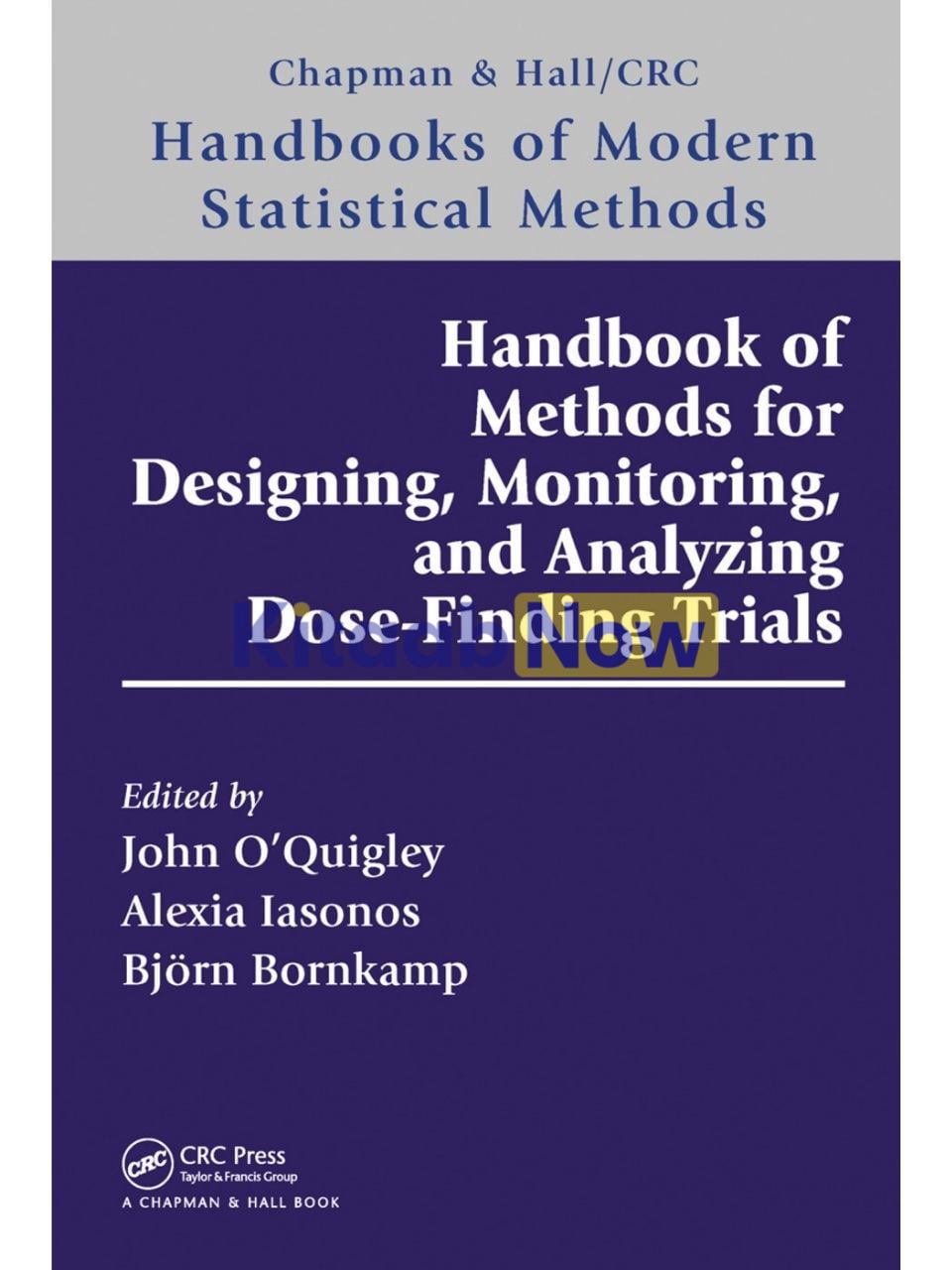
Handbook of Methods for Designing, Monitoring, and Analyzing Dose-Finding Trials
- Edited By: John O’Quigley, Alexia Iasonos, Björn Bornkamp
- ISBN: 9781498746106
- Publisher: CRC Press
- Edition: 1st
- Publication Date: May 22, 2017
- Format: Paperback – 320 pages
- Language: English
Description
Handbook of Methods for Designing, Monitoring, and Analyzing Dose-Finding Trials gives a thorough presentation of state-of-the-art methods for early phase clinical trials. The methodology of clinical trials has advanced greatly over the last 20 years and, arguably, nowhere greater than that of early phase studies. The need to accelerate drug development in a rapidly evolving context of targeted therapies, immunotherapy, combination treatments and complex group structures has provided the stimulus to these advances. Typically, we deal with very small samples, sequential methods that need to be efficient, while, at the same time adhering to ethical principles due to the involvement of human subjects.
Statistical inference is difficult since the standard techniques of maximum likelihood do not usually apply as a result of model misspecification and parameter estimates lying on the boundary of the parameter space. Bayesian methods play an important part in overcoming these difficulties, but nonetheless, require special consideration in this particular context. The purpose of this handbook is to provide an expanded summary of the field as it stands and also, through discussion, provide insights into the thinking of leaders in the field as to the potential developments of the years ahead. With this goal in mind we present:
- An introduction to the field for graduate students and novices
- A basis for more established researchers from which to build
- A collection of material for an advanced course in early phase clinical trials
- A comprehensive guide to available methodology for practicing statisticians on the design and analysis of dose-finding experiments
- An extensive guide for the multiple comparison and modeling (MCP-Mod) dose-finding approach, adaptive two-stage designs for dose finding, as well as dose–time–response models and multiple testing in the context of confirmatory dose-finding studies.
Table of Contents
- Phase I designs
- Overview of Phase I designs – Graham Wheeler
- Model based designs when safety is the primary aim (graded outcomes) – Emily Van Meter
- Dose finding methods for non-binary endpoints (TITE) – Ken Cheung and Shing Lee Pediatrics
- More advanced Phase I and Phase I/II methodology
- Safety and Efficacy: bivariate endpoints – Alex Sverdlov
- Combination studies – Ying Yuan
- Studies with multiple schedules – Nolan Wages
- Studies in the presence of patient heterogeneity – Mark Conaway
- Optimal designs – Nolan Wages
- Practical implementation: protocol development – Alexia Iasonos and John O’Quigley
- Dose-Finding Studies in Phase II
- Dose-Finding Studies in Phase II: Introduction and Overview – Bjőrn Bornkamp
- The MCP-Mod methodology: Practical Considerations and The DoseFinding R package – Xiaolei Xun and Frank Bretz
- Designing Phase II Dose-Finding Studies: Sample Size, Doses and Dose Allocation Weights – José Pinheiro and Bjőrn Bornkamp
- Two-stage designs in dose-finding – Tobias Mielke and Vladimir Dragalin
- Longitudinal dose-response models – Heinz Schmidli and Markus R. Lange
- Multiple Test Strategies for Comparing Several Doses with a Control in Confirmatory Trials – Frank Bretz, Franz Kőnig, and Bjőrn Bornkamp
- A Regulatory View on Dose-Finding Studies and on the value of Dose-Exposure-Response analysis – Sofia Friberg Hietala, Efthymios Manolis and Flora Musuamba Tshinanu
- Bibliography
- Index
Review
“This book provides different perspectives for revisiting drug development in both therapeutic areas. Statisticians involved in early phase clinical trials, whether in academia or in industry, may get benefit from this book. They will find descriptions of some innovative methods that will be helpful in designing dose-finding trials.”
– Xavier Paoletti, Biometric Journal
Editors Biography
John O’Quigley is a professor of mathematics and research director at the French National Institute for Health and Medical Research based at the Faculty of Mathematics, University Pierre and Marie Curie in Paris, France. He is author of Proportional Hazards Regression and has published extensively in the field of dose finding.
Alexia Iasonos is an associate attending biostatistician at the Memorial Sloan Kettering Cancer Center in New York. She has over one hundred publications in the leading statistical and clinical journals on the methodology and design of early phase clinical trials. Dr. Iasonos has wide experience in the actual implementation of model based early phase trials and has given courses in scientific meetings internationally.
Björn Bornkamp is a statistical methodologist at Novartis in Basel, Switzerland, researching and implementing dose-finding designs in Phase II clinical trials. He is one of the co-developers of the MCP-Mod methodology for dose finding and main author of the DoseFinding R package. He has published numerous papers on dose finding, nonlinear models and Bayesian statistics, and in 2013 won the Royal Statistical Society award for statistical excellence in the pharmaceutical industry.
Additional information
| Weight | 0.771 kg |
|---|
Only logged in customers who have purchased this product may leave a review.
Related Products




Reviews
There are no reviews yet.