
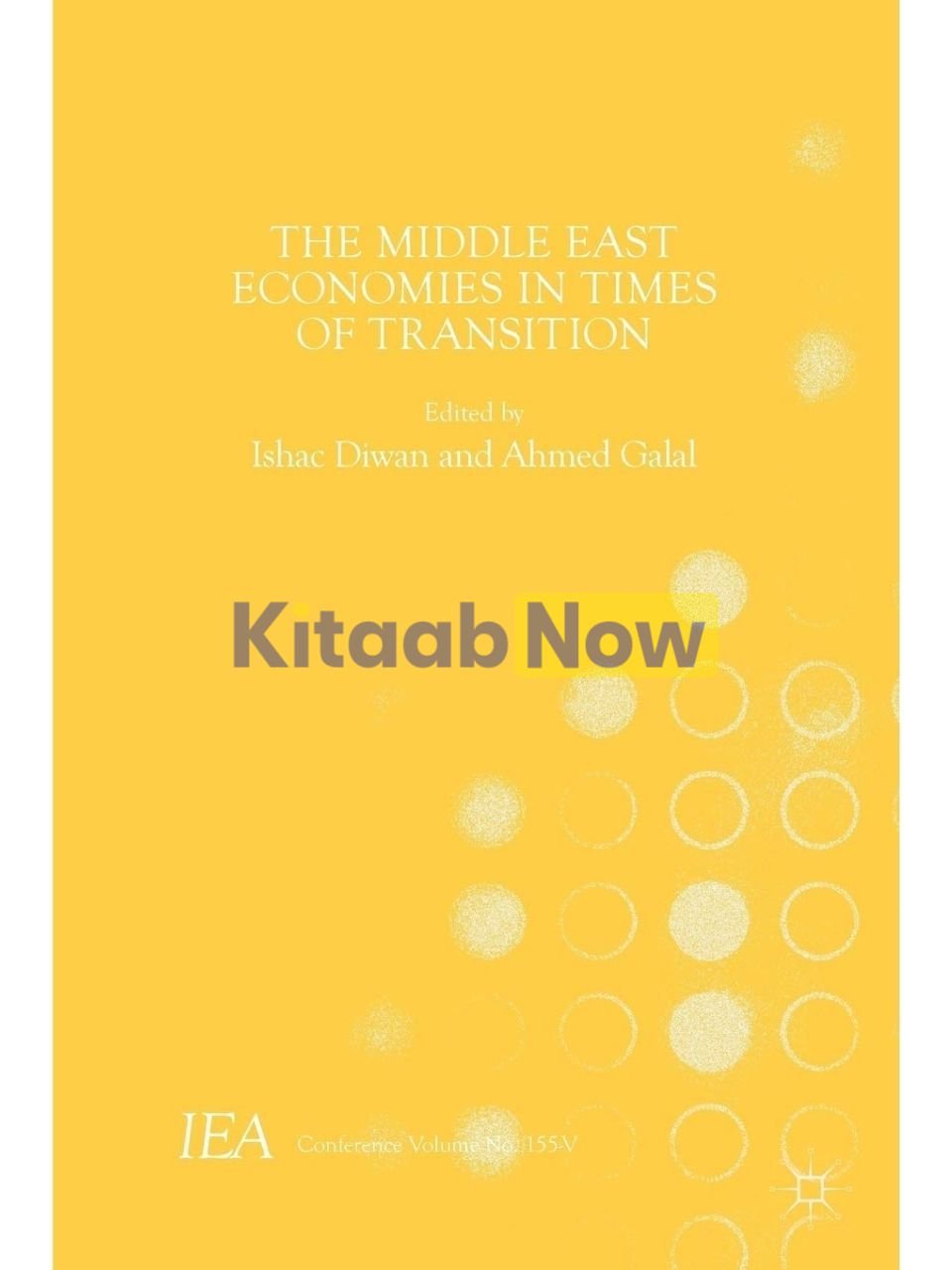

The Middle East Economies in Times of Transition
- Edited By: Ahmed Galal, Ishac Diwan
- ISBN: 9781137583949
- Publisher: Palgrave MacMillan
- Edition: 1st
- Publication Date: January 13, 2016
- Format: Paperback – 359 pages
- Language: English
Description
Diwan and Galal looks at the structure and prospects of the Middle East economies after the 2011 Uprisings, focusing on issues of economic growth, inequality, the impact of oil, and the unfolding political transitions.
On the growth question, the book looks into the extent of structural transformation of the economy, the political economy reasons for the lack of structural change, and the external conditions in the EU and in the GCC that underpin the lack of structural change. On inequality, the book offers new measures of equality of opportunity in human development and in the job market, and it also reviews the complex political economy of subsidy removal. Regarding natural resources, the volume provides three innovations: connecting the notion of ‘oil curse’ to the global phenomena of asset bubbles; evidence that resource curse effects do not rise monotonically with the size of the resource rent, but rather, according to an inverted U shape; and an extension of the concept of rent to the other non-oil rents that are also predominant in the region. Finally, the volume places the political transition in the region in a global perspective using various methods – theoretical, comparative, and empirical, and it explores the relationship between democracy in its variety of forms and economic development.
Table of Contents
- List of Figures
- List of Tables
- Foreword
- Preface
- Notes on Contributors
- Ishac Diwan and Ahmed Galal: Introduction: Puzzles and Clues An Overview
- PART I: ECONOMIC GROWTH AND STRUCTURAL TRANSFORMATION
- Doerte Doemeland and Marc Schiffbauer: Structural Transformation
- Melani Cammett and Ishac Diwan: Fiscal Policy and Crony Capitalism
- Ishac Diwan and Elias El-Mouhoub Mouhoud: Regional and Global Integration
- PART II: INEQUALITY AND SOCIAL JUSTICE
- Ragui Assaad and Caroline Kraft: Inequality of Opportunity in Human Development in the Middle East and North Africa
- Caroline Kraft and Ragui Assaad: Inequality of Opportunity in the Labor Market for Higher Education Graduates in Egypt and Jordan
- Djavad Salehi Isfahani: Energy Subsidy Reform in Iran
- PART III: ‘RENTIER’ STATES RECONSIDERED
- Hazem Beblawi: The Concept of ‘Rentier States’ Revisited
- Ibrahim Elbadawi: Thresholds Matter: Resource Abundance, Development and Democratic Transition in the Arab World
- Adeel Malik: Beyond the Resource Curse: Rents and Development
- Tarik Youssef and Robert Beschel. Public Sector Reform in a Rentier State
- PART IV: POLITICAL TRANSITIONS
- Melani Cammett: Transition Experiences and Relevant Lessons for the Arab Transitions
- Mustapha Nabli: Democracy and Economic Development
- Caroline Freund and Melise Jaud: Transition Experiences – A Statistical Analysis
- Index
Editors Biography
Ishac Diwan is currently affiliated with Dauphine University and the Paris School of Economics in France, and is a research fellow at the Economic Research Forum where he directs its political economy programmes. His recent books include A Political Economy of the Middle East (co-authored, 2015), and Understanding the Political Economy of the Arab Uprisings (2014).
Ahmed Galal is Managing Director of the Economic Research Forum. He was Egypt’s Finance Minister in 2013. Before that, he held various positions at the World Bank for about 18 years. In 2000-2007, he was the Director of the Egyptian Center for Economic Studies. Galal holds a PhD in Economics from Boston University, USA. He authored more than a dozen books and several journal articles.
Additional information
| Weight | 5.737 kg |
|---|
Only logged in customers who have purchased this product may leave a review.
Related Products



Reviews
There are no reviews yet.