
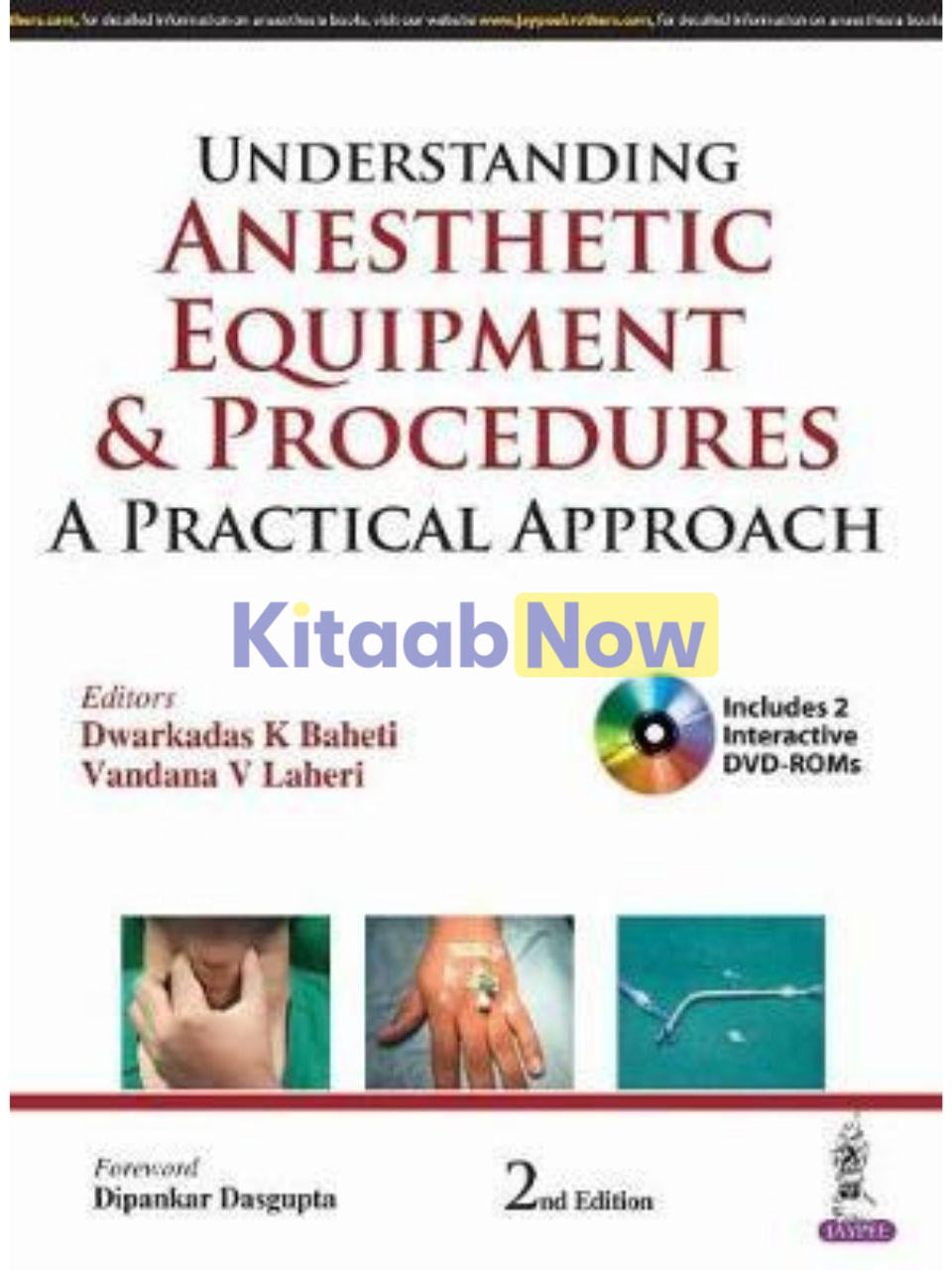
Understanding Anesthetic Equipment & Procedures: A Practical Approach (2nd Edition)
- Authors: Dwarkadas K Baheti, Vandana Laheri
- ISBN: 9789352703166
- Publisher: Jaypee Brothers Medical Publishers
- Edition: 2nd
- Publication Date: March 31, 2018
- Format: Paperback – 578 pages
- Language: English
Out of stock
Description
This new edition presents practising and trainee anaesthesiologists with the latest advances and guidelines in their field.
Beginning with an introduction to the history of anaesthesia, basic physics, and medical gases, the following sections cover the anaesthesia machine, airway and monitoring equipment, and apparatus for central neuraxial and regional blocks.
The final chapters discuss interpretation of radiological images, simulators in anaesthesia, maintenance, safety and cleaning; and more.
The second edition has been fully revised to provide up to date information and a clear understanding of practices and techniques for anaesthesia.
The book features clinical photographs and diagrams and includes two interactive DVD ROMs demonstrating and explain day to day anaesthetic procedures.
Key Features
- This is the second edition after tremendous success of the first
- Written by experts with high academic credentials, inclination, and capability
- Divided into nine sections for a fluid flow of content with a focused approach; covering 49 chapters, out of which 19 chapters have been revised with latest information and remaining 30 chapters in improvised format
- Gives an insight into the basic physics as well as the mechanism involved in the structure of various equipment used in anesthesia and critical care clinic
- Helps in better understanding the procedures and techniques of administering anesthesia
- Only “anesthesia equipment” book that includes DVD-ROM that serves as an audiovisual aid for a clear understanding of day-to-day anesthetic procedures
- Targeted towards undergraduates, postgraduates, and practicing anesthesiologists interested in better understanding of the basics of anesthesia equipment.
Table of Contents
- Section 1: Historical Perspective
- Evolution of Anesthesia Practice
- Anesthesia Equipment in India-A Historical Perspective
- Section 2: Role of Physical Principles
- Utility of Physical Principles in Anesthetic Practice
- Section 3: Medical Gases and Distribution System
- Medical Gas Supply, Storage, and Safety
- Section 4: Anesthesia Machine and Its Components
- The Anesthesia Machine
- Pressure-reducing Valves (Pressure Regulators)
- Flowmeters
- Vaporizers
- Anesthetic Breathing Systems
- Anesthesia Ventilators
- Section 5: Airway Equipment
- Face Masks
- Laryngoscopes
- Tracheal Tubes
- Double Lumen Tubes and Bronchial Blockers
- Cricothyrotomy: Emergency Surgical Airway of Choice
- Supraglottic Airway Devices
- Nonrebreathing Valves
- Airways
- Ventilating Systems-Manual Resuscitators
- Accessories, Connectors, Bite Block, Magill’s Forceps, Stylet, and Laryngeal Sprays
- Oxygen Therapy Devices and Humidification
- Video Laryngoscopy
- Fiberoptic Airway Management
- Section 6: Monitoring Equipment
- Electrocardiogram Monitoring and Defibrillators
- Pulse Oximeters
- Noninvasive and Invasive Blood Pressure Monitoring
- Capnography
- Respiratory Gas Monitoring and Minimum Alveolar Concentration
- Bispectral Index
- Temperature Regulation and Patient Warming Devices
- Neuromuscular Blocks and Their Monitoring with Peripheral Nerve Stimulator
- Pulmonary Function Tests
- Peripheral Venous Cannulation
- Central Venous and Arterial Cannulation
- Pulmonary Artery Catheterization
- Cardiac Output Monitors
- Entropy
- Somatosensory-evoked Potentials
- Point-of-care Monitoring Equipment
- Section 7: Equipment for Central Neuraxial and Regional Blocks
- Spinal, Epidural, and Combined Spinal-Epidural Anesthesia
- Peripheral Nerve Stimulators/Locators, Needles, and Catheters
- Ultrasound-guided Blocks
- Infusion and Syringe Pumps
- Section 8: Miscellaneous
- How to Interpret X-rays, CT Scan, and MRI in Clinical Anesthesia Practice
- Equipment for Anesthesia in Remote Locations
- Role of Anesthetist in Preventing Nosocomial Infections
- Simulators in Anesthesia
- Section 9: Maintenance, Safety, and Hazards
- Cleaning and Sterilization of Anesthetic Equipment
- Anesthesia: Safety and Prevention of Hazards and Accidents
- Appendices
Additional information
| Weight | 0.850 kg |
|---|
Only logged in customers who have purchased this product may leave a review.
Related Products



Reviews
There are no reviews yet.