

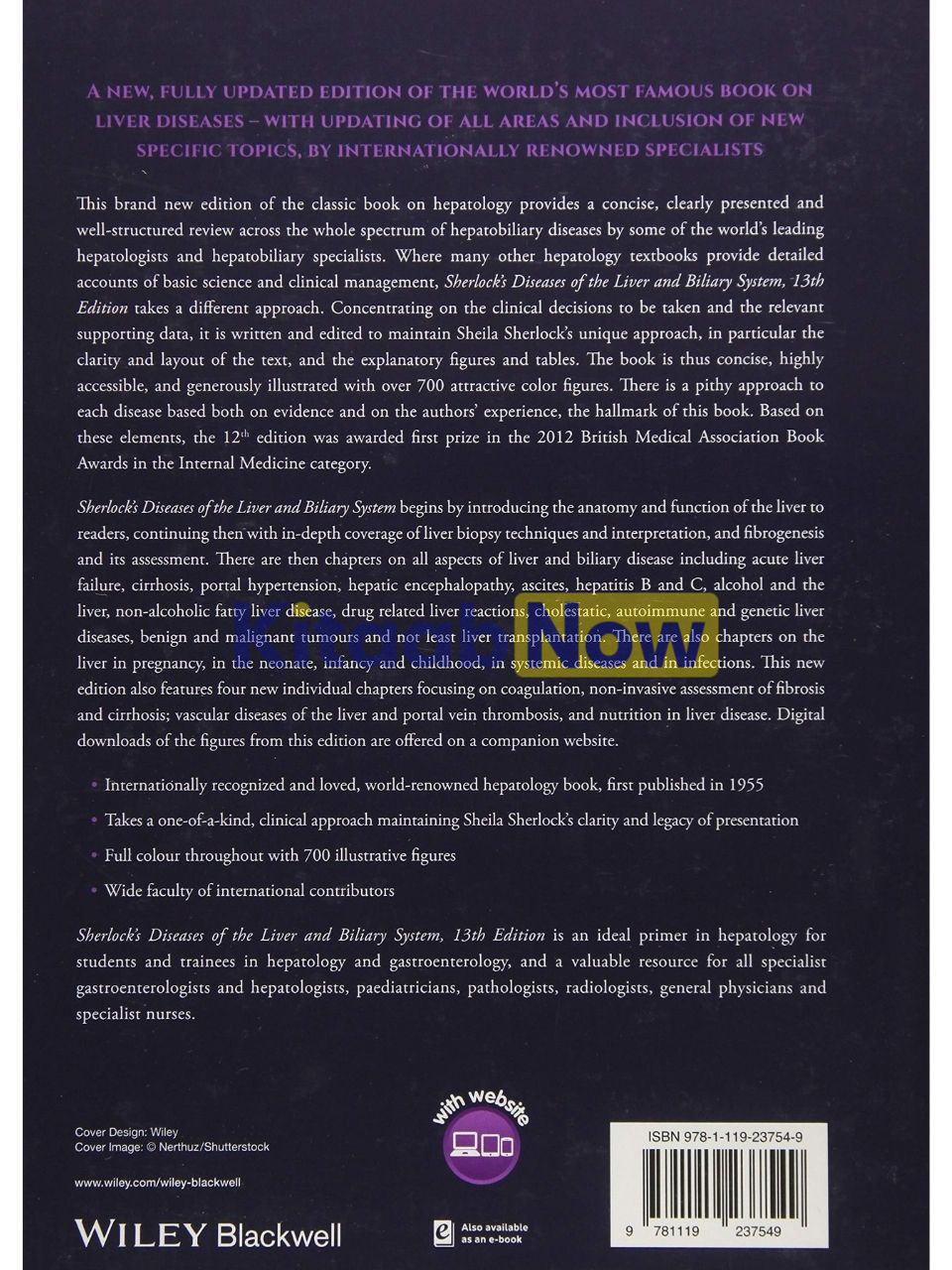
Sherlock’s Diseases of the Liver and Biliary System (13th Edition)
- Edited by: James S. Dooley, Anna S. F. Lok, Guadalupe Garcia-Tsao, Massimo Pinzani
- ISBN: 9781119237549
- Publisher: Wiley Publishing
- Edition: 13th
- Publication Date: August 06, 2018
- Format: Hardback – 832 pages
- Language: English
Description
A new, fully updated edition of the world’s most famous book on liver diseases—with updating of all areas and inclusion of new specific topics, by internationally renowned specialists
This brand new edition of the classic book on hepatology provides a concise, clearly presented and well-structured review across the whole spectrum of hepatobiliary diseases by some of the world’s leading hepatologists and hepatobiliary specialists. Where many other hepatology textbooks provide detailed accounts of basic science and clinical management, Sherlock’s Diseases of the Liver and Biliary System, 13th Edition takes a different approach. Concentrating on the clinical decisions to be taken and the relevant supporting data, it is written and edited to maintain Sheila Sherlock’s unique approach, in particular the clarity and layout of the text, and the explanatory figures and tables. The book is thus concise, highly accessible, and generously illustrated with over 700 attractive color figures. There is a pithy approach to each disease based both on evidence and on the authors’ experience, the hallmark of this book. Based on these elements, the 12th edition was awarded first prize in the 2012 British Medical Association Book Awards in the Internal Medicine category.
Sherlock’s Diseases of the Liver and Biliary System begins by introducing the anatomy and function of the liver to readers, continuing then with in-depth coverage of liver biopsy techniques and interpretation, and fibrogenesis and its assessment. There are then chapters on all aspects of liver and biliary disease including acute liver failure, cirrhosis, portal hypertension, hepatic encephalopathy, ascites, hepatitis B and C, alcohol and the liver, non-alcoholic fatty liver disease, drug related liver reactions, cholestatic, autoimmune and genetic liver diseases, benign and malignant tumours and not least liver transplantation. There are also chapters on the liver in pregnancy, in the neonate, infancy and childhood, in systemic diseases and in infections. This new edition also features four new individual chapters focusing on coagulation, non-invasive assessment of fibrosis and cirrhosis; vascular diseases of the liver and portal vein thrombosis, and nutrition in liver disease. Digital downloads of the figures from this edition are offered on a companion website.
- Internationally recognized and loved, world-renowned hepatology book, first published in 1955
- Takes a one-of-a-kind, clinical approach maintaining Sheila Sherlock’s clarity and legacy of presentation
- Full colour throughout with 700 illustrative figures
- Wide faculty of international contributors
Sherlock’s Diseases of the Liver and Biliary System, 13th Edition is an ideal primer in hepatology for students and trainees in hepatology and gastroenterology, and a valuable resource for all specialist gastroenterologists and hepatologists, paediatricians, pathologists, radiologists, general physicians and specialist nurses.
Table of Contents
- List of Contributors xi
- Preface to the Thirteenth Edition xv
- Preface to the First Edition xvi
- Anatomy and Function 1 – Jay H. Lefkowitch
- Development of the liver and bile ducts 1
- Anatomy of the liver 1
- Functional liver anatomy: sectors and segments 3
- Anatomical abnormalities of the liver 3
- Anatomy of the biliary tract 4
- Surface marking 5
- Methods of examination 6
- Microanatomy of the liver 7
- Hepatic ultrastructure (electron microscopy) and organelle functions 9
- Functional heterogeneity of the liver 13
- Dynamics of the hepatic microenvironment in physiology and disease 14 Hepatocyte death and regeneration 15 References 16
- 2 Liver Function in Health and Disease: Clinical Application of Liver Tests 20 – George Mells and Graeme Alexander
- Bilirubin metabolism 21
- Bile acids 23
- Lipid and lipoprotein metabolism 26
- Amino acid metabolism 28
- Plasma proteins 29
- Carbohydrate metabolism 31
- Markers of hepatocellular injury: the serum transaminases 32
- Markers of cholestasis: alkaline phosphatase (ALP) and gamma‐glutamyl transferase (GGT) 33
- Haematology in liver disease 34
- Effects of ageing on the liver 35
- References 36
- 3 Biopsy of the Liver 39 – David Patch and Tu Vinh Luong
- Selection and preparation of the patient 39
- Techniques 40
- Risks and complications 43
- Sampling variability 45
- Naked‐eye appearances 46
- Preparation of the specimen 46
- Interpretation: a stepwise diagnostic approach 46
- Indications 48
- Special methods 49
- References 50
- 4 Coagulation in Cirrhosis 53 – Nicolas M. Intagliata and Stephen H. Caldwell
- Introduction 53
- Normal coagulation pathways: a hepatologist’s perspective 54
- The coagulation system in cirrhosis 56
- Bleeding and thrombosis in cirrhosis 57
- Clinical laboratory tests of the coagulation system in cirrhosis 58
- Conclusion 60
- References 60
- 5 Acute Liver Failure 62 – Shannan R. Tujios and William M. Lee
- Definition 62
- Epidemiology and aetiologies 63
- Clinical features 66
- Initial investigations 67
- Complications and management of acute liver failure 68
- Specific therapies 73
- Prognosis 75
- Liver transplantation 76
- Conclusion 78
- References 78
- 6 Hepatic Fibrogenesis 82 – Meena B. Bansal and Scott L. Friedman
- Introduction 82
- Natural history of hepatic fibrosis 82
- Cellular and molecular features of hepatic fibrosis 83
- Clinical aspects of hepatic fibrosis 89
- Emerging antifibrotic targets and strategies 89
- References 90
- 7 Non‐invasive Assessment of Fibrosis and Cirrhosis 93 – Avik Majumdar and Massimo Pinzani
- Introduction 93
- The use of invasive and non‐invasive tests 93
- Non‐invasive tests: specifics 95
- Conclusions 102
- References 103
- 8 Hepatic Cirrhosis 107 – P. Aiden McCormick and Rajiv Jalan
- Definition 107
- Causes of cirrhosis 107
- Anatomical diagnosis 108
- Reversible cirrhosis 110
- Clinical cirrhosis: compensated versus
- decompensated 110
- Prognosis (Child–Pugh score, MELD, UKELD) 111
- Clinical and pathological associations 112
- Management 119
- Acute‐on‐chronic liver failure 120
- References 123
- 9 Ascites 127 – Guadalupe Garcia‐Tsao
- Mechanisms of ascites formation 127
- Clinical features 130
- Differential diagnosis 132
- Spontaneous bacterial peritonitis 132
- Treatment of cirrhotic ascites 134
- Hyponatraemia 138
- Refractory ascites 139
- Hepatorenal syndrome 141
- Prognosis 144
- References 145
- 10 Hepatic Encephalopathy in Patients with Cirrhosis 151 – Marsha Y. Morgan
- Clinical Features 151
- Classification 153
- Prevalence and consequences 154
- Diagnosis 154
- Diagnostic comorbidities, confounders, and alternatives 160
- Pathogenesis 161
- Management 167
- Prevention 174
- References 174
- 11 Portal Hypertension in Cirrhosis 180 – Jaime Bosch and Annalisa Berzigotti
- Introduction 180
- Pathophysiology and rational basis of therapy 185
- Evaluation and diagnosis 188
- Natural history and prognosis 194
- Management 196
- Treatment of portal hypertension according to clinical scenarios 200
- References 205
- 12 Vascular Disorders of the Liver and Extrahepatic Portal Hypertension 209 – Dominique‐Charles Valla
- Hepatic artery occlusion 209
- Aneurysms of the hepatic artery 210
- Hepatic arterioportal fistula 211
- Hepatic vascular malformations in hereditary haemorrhagic telangiectasia 212
- Congenital portosystemic shunts – Abernethy malformation 213
- Budd–Chiari syndrome – hepatic venous outflow tract obstruction 214
- Extrahepatic portal vein obstruction – portal vein thrombosis and portal cavernoma in the absence of cirrhosis 217
- Portal vein thrombosis in patients with cirrhosis 220
- Idiopathic non‐cirrhotic intrahepatic portal hypertension 221
- Hypoxic hepatitis 223
- Congestive cardiac hepatopathy 223
- Non‐obstructive sinusoidal dilation (NOSD) and peliosis 225
- References 226
- 13 Jaundice and Cholestasis 231 – Peter L. M. Jansen
- Introduction 231
- Mechanics of bile formation 233
- Syndrome of cholestasis 238
- Causes of isolated hyperbilirubinaemia 239
- Causes of cholestatic and hepatocellular jaundice 242
- Consequences of cholestasis and their management 244
- Investigation of the jaundiced patient 247
- Decisions to be made in the jaundiced patient Management of cholestatic disorders 251
- References 251
- 14 Gallstones and Benign Biliary Disease 256 – James S. Dooley, Kurinchi S. Gurusamy, and Brian R. Davidson
- Introduction 256
- Imaging the gallbladder and biliary tract 256
- Gallstones 259
- Symptoms and complications of gallstones 264
- Cholecystectomy 266
- Complicated acute gallbladder disease 268
- Percutaneous cholecystostomy 269
- Asymptomatic gallbladder stones 269
- Non‐surgical treatment of gallstones in the gallbladder 269 Common bile duct stones 270 Acute gallstone pancreatitis 272 Large common duct stones 272 Mirizzi syndrome 273
- Intrahepatic gallstones 274
- Haemobilia 274
- Functional gallbladder and sphincter of Oddi disorders 274
- Other gallbladder pathologies 276
- Relationships to malignant change 279
- Benign biliary strictures 279
- Anastomotic strictures following biliary surgery 282
- IgG4‐related sclerosing cholangitis 283
- Chronic pancreatitis 283
- References 284
- 15 Malignant Biliary Diseases 294 – Rahul S. Koti and John Bridgewater
- Carcinoma of the gallbladder 294
- Carcinoma of the bile duct (cholangiocarcinoma) 296
- Other biliary malignancies 301 Metastases at the hilum 301
- Ampullary and periampullary carcinomas 301
- Conclusion 305
- References 305
- 16 Fibropolycystic Liver Diseases and Congenital Biliary Abnormalities 308 – Nedim Hadić and Mario Strazzabosco
- Overview 308
- Polycystic liver disease 309
- Fibropolycystic diseases 313
- Autosomal recessive polycystic kidney disease 314
- Congenital hepatic fibrosis 314
- Caroli disease 316
- Microhamartomas (von Meyenberg complexes) Choledochal cysts 318
- Solitary non‐parasitic liver cyst 320
- Congenital anomalies of the biliary tract 321
- References 324
- 17 Primary Biliary Cholangitis 328 – David E. J. Jones
- Clinical features 328
- Diagnosis 329
- Epidemiology 333
- Aetiology and pathogenesis 334
- Management 335
- Prognosis 337
- References 338
- 18 Sclerosing Cholangitis 341 – Tom Hemming Karlsen and Kirsten Muri Boberg
- Introduction 341
- Primary sclerosing cholangitis 341
- Secondary sclerosing cholangitis 350
- Sclerosing cholangitis in systemic inflammatory
- diseases 351
- References 351
- 19 Autoimmune Hepatitis and Overlap Syndromes 355 – Ashnila Janmohamed and Gideon M. Hirschfield
- Introduction 355
- Disease overview 356
- Biological determinants of disease 357
- Disease presentation 359
- Laboratory features 361
- Imaging 363
- Liver biopsy and histological features 363
- Differential diagnosis 365
- Diagnostic dilemmas 366
- Making a diagnosis in practice 367
- Management strategies 368
- Pretreatment and on‐treatment considerations 371
- Treatment challenges and alternative agents 371
- Pregnancy and autoimmune hepatitis 372
- The elderly and autoimmune hepatitis 372
- Childhood‐onset autoimmune hepatitis 373
- Autoimmune hepatitis and liver transplantation 373
- Overlap syndromes 374
- Conclusion 377
- References 377
- 20 Enterically Transmitted Viral Hepatitis: Hepatitis A and Hepatitis E 380 – Rinjal D. Brahmbhatt and Anna S. F. Lok
- General features of enterically transmitted viral hepatitis 380
- Hepatitis A virus 385
- Hepatitis E virus 389
- References 391
- 21 Hepatitis B 395 – Anna S. F. Lok
- Introduction 395
- Hepatitis B virus 395
- Immune response and mechanisms of hepatic injury 398
- Epidemiology 399
- Prevention 400
- Diagnosis 402
- Clinical manifestations 404
- Natural history 405
- Treatment 408
- HBV and HCV coinfection 414
- HBV and HDV coinfection 414
- HBV and HIV coinfection 414
- References 415
- 22 Hepatitis D 421 – Patrizia Farci and Grazia Anna Niro
- History 421
- Hepatitis D virus 421
- Epidemiology 422
- Pathogenesis 425
- Modes of infection and clinical course 425
- Diagnosis 428
- Treatment 429
- Prevention 432
- References 432
- 23 Hepatitis C 436 – Geoffrey Dusheiko
- Introduction 436
- Epidemiology 436
- Virology 438
- Pathology and pathogenesis 439
- Diagnostic tests for hepatitis C 440
- Acute hepatitis C 441
- Chronic hepatitis C 441
- References 459
- 24 Drug‐Induced Liver Injury 468 – Frank W. DiPaola and Robert J. Fontana
- Introduction 468
- Epidemiology 468
- Complications of DILI 469
- Classification of hepatotoxicity 469
- Drug metabolism and pharmacokinetics 469
- Hepatic drug metabolism 471
- Molecular mechanisms in drug‐induced liver injury 472
- Non‐genetic risk factors for DILI 473
- Diagnosis of DILI 474
- Medical management 478
- Pharmacogenetic risk factors 478
- Potential immunological mechanisms in idiosyncratic DILI 479
- Liver injury from specific drugs 479
- References 486
- 25 Alcohol and the Liver 494 – Stephen Stewart and Ewan Forrest
- Introduction 494
- Alcohol metabolism 494
- Pathogenesis 496
- Susceptibility 497
- Histological features 498
- Clinical features 501
- Clinical syndromes 503
- Prognosis 504
- Treatment 506
- Conclusions 507
- References 508
- 26 Iron Overload States 511 – Paul Adams and Heinz Zoller
- Normal iron physiology 511
- Iron overload and liver damage 515
- Genetic haemochromatosis 516
- Other iron storage diseases 521
- References 523
- 27 Wilson Disease 526 – Eve A. Roberts and Karl Heinz Weiss
- Molecular genetics: pathogenesis 527
- Pathology 528
- Clinical picture 529
- Laboratory tests 532
- Genetic strategies 533
- Diagnostic difficulties 533
- Treatment 533
- Prognosis 536
- Non-Wilsonian copper-related cirrhosis 536
- References 536
- 28 Non‐Alcoholic Fatty Liver Disease 540 – Timothy Hardy and Christopher P. Day
- Introduction 540
- Further definitions, terminology, and diagnosis 541
- Liver biopsy, classification of NAFLD, and non‐ invasive markers of NASH and fibrosis 541
- Clinical features 543
- Laboratory testing 544
- Epidemiology 545
- Ethnic variation in NAFLD 545
- Pathogenesis of NASH 545
- Natural history of NAFLD 550
- NAFLD and hepatocellular carcinoma (HCC) 551
- Therapy for non‐alcoholic fatty liver disease 552
- Other forms of NAFLD 554
- References 555
- 29 Nutrition and Chronic Liver Disease 561 – Manuela Merli
- Introduction 561
- Epidemiology and general characteristics 562
- Causes of malnutrition 562
- Consequences of malnutrition 564
- Diagnosis and assessment 565
- Treatment and management 568
- References 570
- 30 Pregnancy and the Liver 572 – Rachel H. Westbrook and Catherine Williamson
- Introduction 572
- Normal physiology in pregnancy 572
- Pregnancy‐related liver diseases 573
- Pre‐existing liver diseases and pregnancy 578
- Liver transplantation and pregnancy 580
- Liver disease coincidentally
- arising with pregnancy 581
- Conclusion 582
- References 582
- 31 The Liver in the Neonate, in Infancy, and Childhood 588 – Susan M. Siew and Deirdre A. Kelly
- Investigation of liver disease in children 588
- Neonatal jaundice 589
- Neonatal unconjugated hyperbilirubinaemia 589
- Neonatal liver disease (conjugated hyperbilirubinaemia) 591
- Neonatal hepatitis 594
- Inherited disease in the neonate 596
- Genetic cholestatic syndromes 598
- Structural abnormalities: biliary atresia and choledochal cyst 600
- Acute liver failure in infancy 602
- Liver disease in older children 605
- Metabolic disease in older children 607
- Cirrhosis and portal hypertension 613
- Liver transplantation 613
- Tumours of the liver 614
- References 615
- 32 The Liver in Systemic Diseases 622 – James S. Dooley and Christopher McNamara
- Collagen‐vascular and autoimmune disorders 622
- Hepatic granulomas 624
- Sarcoidosis 626
- The liver in endocrine disorders 628
- Amyloidosis 629
- Porphyrias 632
- The liver in haemolytic anaemias 634
- The liver in myelo‐ and lymphoproliferative disease 638
- Bone marrow transplantation 639
- Lymphoma 640
- Extramedullary haemopoiesis 642
- Rare haematological disorders that may involve the liver 643
- Lipid storage diseases 643
- Non‐metastatic complications of malignancy 646
- References 646
- 33 The Liver in Infections 652 – Sanjay Bhagani and Ian Cropley
- Introduction 652
- Jaundice of infections 652
- Pyogenic liver abscess 652
- Hepatic amoebiasis 655
- Tuberculosis of the liver 657
- Hepatic actinomycosis 659
- Syphilis of the liver 659
- Perihepatitis 660
- Leptospirosis 660
- Relapsing fever 663
- Lyme disease 663
- Rickettsial infections 663
- Fungal infections 664
- Schistosomiasis (bilharzia) 665
- Malaria 667
- Kala‐azar (visceral leishmaniasis) 668
- Echinococcosis (hydatid disease) 668
- Ascariasis 673
- Strongyloides stercoralis 674
- Trichinosis 674
- Toxocara canis (visceral larva migrans) 674
- Liver flukes 675
- References 676
- 34 Imaging of the Liver and Diagnostic Approach of Space‐Occupying Lesions 682 – Neil H. Davies and Dominic Yu
- Ultrasound 682
- Computed tomography 683
- Magnetic resonance imaging 685
- Radioisotope scanning 688
- Positron emission tomography 691
- MR spectroscopy 691
- Conclusions and choice of imaging technique 691
- References 691
- 35 Benign Liver Tumours 693 – Ian R. Wanless
- Diagnosis of focal liver lesions 693
- Hepatocellular lesions 693
- Biliary and cystic lesions 699
- Mesenchymal tumours 700
- References 701
- 36 Primary Malignant Neoplasms of the Liver 705 – Adam Doyle and Morris Sherman
- Hepatocellular carcinoma 705
- Intrahepatic cholangiocarcinoma 718
- Other malignant neoplasms of the liver 721
- Other sarcomas 722
- References 722
- 37 Hepatic Transplantation 730 – Lindsay Y. King and Carl L. Berg
- Selection of patients 730
- Candidates 732
- Absolute and relative contraindications 737
- General preparation of the patient 738
- Donor selection and operation 738
- The recipient operation 739
- Immunosuppression 742
- Postoperative course 743
- Post‐transplantation complications 744
- Conclusion 751
- References 752
- 38 Hepatic Transplantation and HBV, HCV, and HIV Infections 758 – Norah A. Terrault
- Introduction 758
- Hepatitis B and liver transplantation 759
- Hepatitis C and liver transplantation 763
- HIV and liver transplantation 770
- References 773
- Index 781
Author Biography
James S. Dooley, The Royal Free Hospital, London, UK.
Anna S. Lok, Michigan Medicine, University of Michigan, Ann Arbor, MI, USA.
Guadalupe Garcia-Tsao, Yale University School of Medicine, VA-CT Healthcare System, CT, USA.
Massimo Pinzani, UCL Institute for Liver and Digestive Health, London, UK.
Additional information
| Weight | 2.244 kg |
|---|
Only logged in customers who have purchased this product may leave a review.
Related Products



Reviews
There are no reviews yet.