
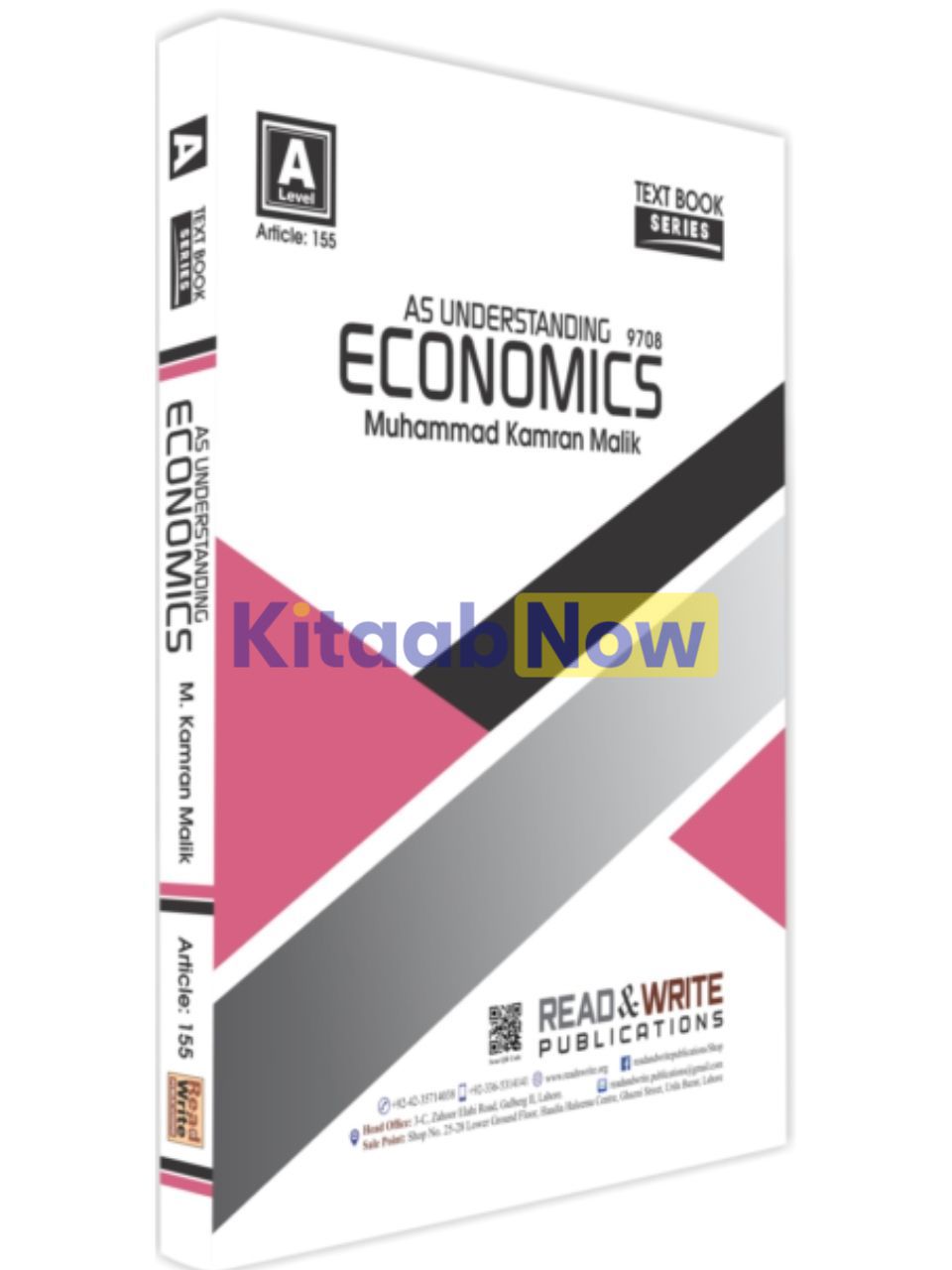
155 Understanding Economics AS Level Book
Rs. 1,125
- Author: Kamran Malik
- Publisher: Read and Write Publications
- Format: Paperback
- Language: English
Share
Description
155 Understanding Economics AS Level Book by Kamran Malik
Table of Contents
- Preface
- How to Use this Book
- Section 1 Basic Economic Problem
- Scarcity and Opportunity Cost
- Multiple Choice Questions
- Section 2 Production Possibility Curve
- PPC and Scarcity
- PPC and Opportunity Cost
- PPC and Economic Efficiency
- Shifts in PPC
- Consumer Goods and Capital Goods
- Multiple Choice Questions
- Section 3 Economic Systems
- Free Market Economy
- Command Economy
- Mixed Economy
- Multiple Choice Questions
- Section 4 Positive and Normative Statements
- Multiple Choice Questions
- Section 5 Demand
- Law of Demand
- Demand Schedule
- Demand Curve
- Factors Causing Shifts in the Demand Curve (DEMAND Determinants)
- Multiple Choice Questions
- Section 6 Supply
- Law of Supply
- Supply Schedule
- Supply Curve
- Multiple Choice Questions
- Section 7 Market Equilibrium
- Changes in The Equilibrium Price
- Multiple Choice Questions
- Section 8 Elasticity of Demand
- Price Elasticity of Demand (P)
- Total Revenue (TR) or Total Expenditures (TE) Method 89
- Graphical Method 92
- Point Elasticity of Demand
- Income Elasticity of Demand (M)
- Cross Price Elasticity of Demand (C) 102
- Limitations of Demand Elasticities 104
- Multiple Choice Questions
- Section 9 Price Elasticity of Supply
- Determinants of Price Elasticity of Supply
- Multiple Choice Questions
- Section 10 Consumer and Producer Surplus
- Consumer Surplus
- Changes in Consumer Surplus 140
- Producer Surplus
- Changes in Producer Surplus 142
- Prices as Rationing and Allocative Mechanisms
- Multiple Choice Questions
- Section 11 Taxes and Subsidies
- Taxes 156
- Specific Tax 156
- Ad Valorem Tax (percentage Tax) 156
- Subsidies
- Specific Subsidy 161
- Ad Valorem Subsidy (percentage Subsidy) 161
- Multiple Choice Questions
- Taxes 156
- Section 12 Maximum and Minimum Prices
- Maximum Price
- Impacts of a Maximum Price 175
- Minimum Price
- Multiple Choice Questions
- Section 13 Public and Private Goods
- Public Goods
- Private Goods
- Merit Goods
- Demerit Goods
- Multiple Choice Questions
- Section 14 Factors of Production
- Land
- Capital
- Labour
- Entrepreneurship
- Division of Labour
- Multiple Choice Questions
- Section 15 Unemployment
- Costs of Unemployment
- Reducing Unemployment
- Multiple Choice Questions
- Section 16 Money
- Evolution of Money
- Functions of Money
- Multiple Choice Questions
- Section 17 Aggregate Demand & Aggregate Supply 229
- Aggregate Demand (AD)
- Aggregate Supply (AS)
- Multiple Choice Questions
- Section 18 General Price Level: Price Indices
- Limitations of Price Index
- Nominal and Real Changes
- Multiple Choice Questions
- Section 19 Inflation
- Types of Inflation
- Causes of Inflation
- Consequences of Inflation
- Multiple Choice Questions
- Section 20 Principles of Absolute & Comparative Advantage
- Theory of Absolute Advantage
- Theory of Comparative Advantage
- Exceptions to The Theories of Absolute & Comparative Advantage
- Limitations to The Theories
- Challenges of International Trade
- Multiple Choice Questions
- Section 21 Terms of Trade
- Multiple Choice Questions
- Section 22 Arguments For Free Trade & Motives For Protection 296
- Arguments For Free Trade
- Types (METHODS) of Protection and Their Effects
- Multiple Choice Questions
- Section 23 Economic Integration
- Free Trade Area
- Customs Union
- Common Market
- Full Economic Union
- Political Union
- Multiple Choice Questions
- Section 24 Balance of Payments
- Current Account
- Financial (CAPITAL) Account
- Balance of Payments Problems
- Why Is a Trade Deficit Bad? 321
- Why Is a Trade Surplus Bad? 322
- Multiple Choice Questions
- Section 25 Exchange Rates
- Nominal Exchange Rate
- Real Exchange Rate
- Purchasing Power Parity Theory
- Managed Floating
- Flexible or Floating Exchange Rates
- Changes in Exchange Rates
- Fixed Exchange Rates
- Managed Float
- Advantages & Disadvantages of Fixed & Floating Exchange Rates
- Policies to Correct Balance of Payments Disequilibrium
- Policies to Correct a Trade Surplus
- Impacts of Changes in Interest Rate
- Multiple Choice Questions
- Section 26 Fiscal Policy
- Monetary Policy
- Supply Side Policies and Natural Rate of Unemployment
- Systems of Taxation
- Multiple Choice Questions
- Answers 393
Only logged in customers who have purchased this product may leave a review.
Related Products





Reviews
There are no reviews yet.