

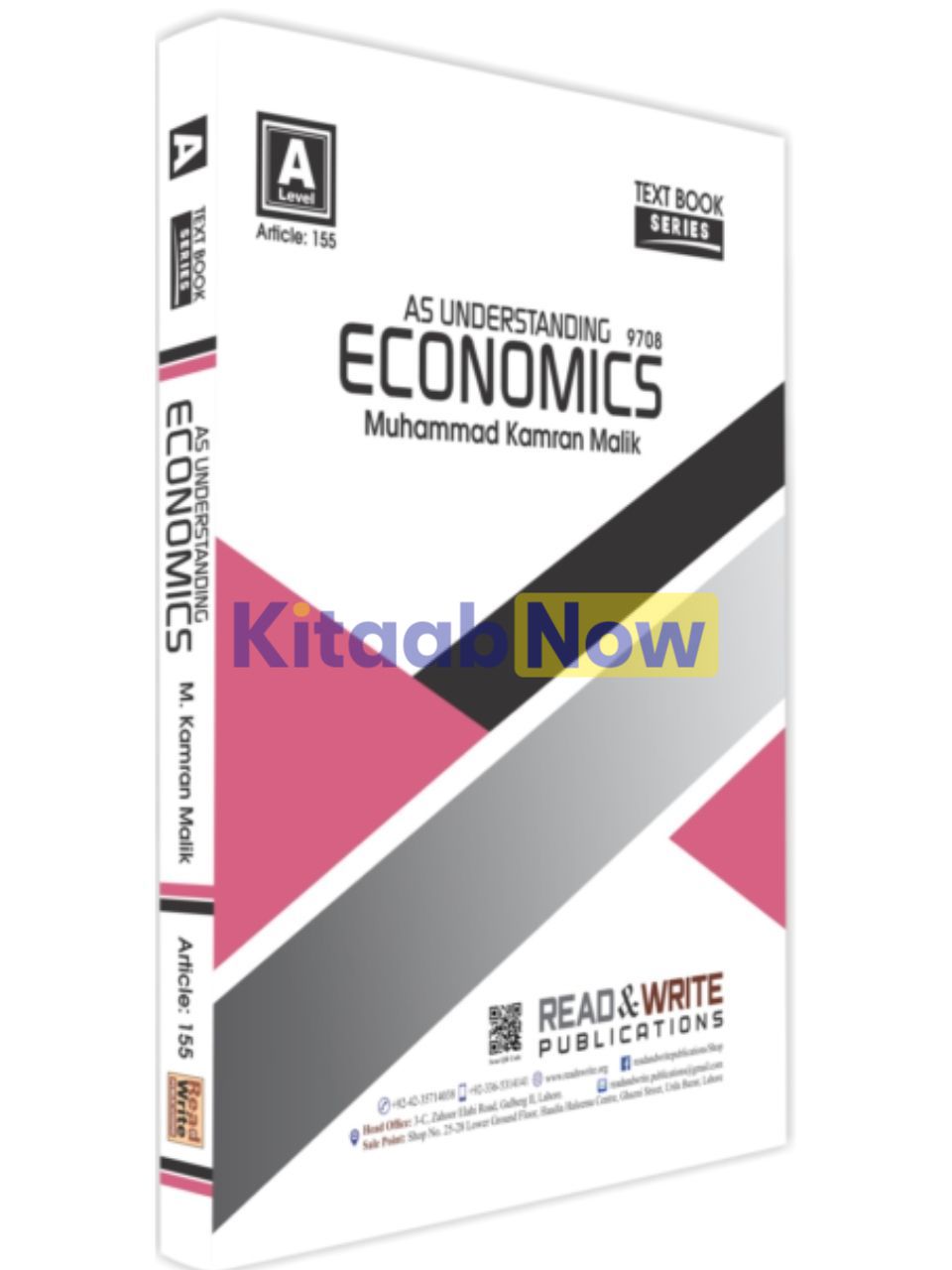
156 Understanding Economics A2 Level Book
Rs. 1,400
- Author: Kamran Malik
- Publisher: Read and Write Publications
- Format: Paperback
- Language: English
Share
Description
156 Understanding Economics A2 Level Book by Kamran Malik
Table of Contents
- Section: 1 Utility
- Law of Diminishing Marginal Utility
- Law of Equi Marginal Utility
- Indifference Analysis
- Multiple Choice Questions
- Section: 2 Budget Line
- Shifts In Budget Line
- Multiple Choice Questions
- Section: 3 Normal, Inferior and Giffen Goods
- Real Income and Substitution Effects of a Price Change
- Consumer’s Equilibrium
- Income Consumption Curve (ICC)
- Impacts of Changes in Price
- Multiple Choice Questions
- Section: 4 Costs of the businesses
- Laws of Variable Proportion
- Multiple Choice Questions
- Section: 5 Cost Curves in the Long Run
- Economies of Scale
- Least Cost Combination
- Isoquant and Isocost Approach
- Minimum Efficient Scale (MES)
- Minimum Efficient Scale (MES) And The Size Of Firms
- Natural Monopoly
- Reasons For The Existence Of Small Firms
- Section: 6 Economist’s Versus Accountant’s Definition of Costs
- Decisions to Continue or Shutdown Businesses
- Multiple Choice Questions
- Section: 7 Market Structures
- Perfect Competition
- Multiple Choice Questions
- Section: 8 Monopoly
- Multiple Choice Questions
- Section: 9 Externalities
- Negative Externalities
- Positive Externalities
- Multiple Choice Questions
- Section: 10 Cost Benefit Analysis
- Multiple Choice Questions
- Section: 11 Comparison between Perfect Competition and Monopoly
- Efficiency: Productive and Allocative Efficiency
- Remedies to Monopoly Abuse
- Multiple Choice Questions
- Section: 12 Objectives of Firms
- Multiple Choice Questions
- Section: 13 Price Discrimination
- Multiple Choice Questions
- Section: 14 Monopolistic Competition
- Oligopoly(Understanding Economics As Level Book)
- Price rigidness in Oligopoly
- Cartels
- Non-Collusive Oligopoly: Game Theory
- Prisoner’s Dilemma
- Concentration Ratio (Lorenz Curve & Gini Coefficient)
- Growth of Firms
- Multiple Choice Questions
- Section: 15 Contestable Market
- Multiple Choice Questions
- Section: 16 Factor Market
- Marginal Revenue Productivity Theory
- Labour Supply Curve
- Multiple Choice Questions
- Section: 17 Monopsony
- Trade Unions(Understanding Economics As Level )
- Wage Differentials
- Economic Rent
- Multiple Choice Questions
- Section: 18 National Income Accounting
- Multiple Choice Questions
- Section: 19 Per Capita Income and Standard of Living
- Poverty Trap
- Intergenerational Equity
- Net Economic Welfare (NEW)
- An Introduction of BRICS
- Human Poverty Index
- Multidimensional Poverty Index (MPI)
- Kuznets Curve
- Multiple Choice Questions
- Section: 20 Equilibrium National Income
- Squaring The Economic Cycle(Understanding Economics As Level )
- Equilibrium Income (a Graphical Treatment)
- Close Economy without Government
- Investment Expenditures
- Equilibrium National Income
- A Situation of Disequilibrium
- Multiple Choice Questions
- Section: 21 Close Economy with Government
- Equilibrium Income in a Close Economy with Government
- Equilibrium National Income (Three Sectoral Economy)- Graphical Analysis
- Transfer Payment Multiplier
- Induced Taxes
- Inflationary and Deflationary Gaps
- Systems of Taxation
- Laffer Curve
- Nudge Theory
- Means-Tested Benefit
- Negative Income Tax
- Multiple Choice Questions
- Section: 22 Open Economy
- Equilibrium Income in an Open Economy
- Multiple Choice Questions
- Section: 23 Principle of Accelerator
- Multiple Choice Questions
- Section: 24 Aggregate Demand (AD)
- Comparison: Classicals, Monetarists and Keynesians
- Aggregate Supply (AS)
- Multiple Choice Questions
- Section: 25 Liquidity Preference Theory
- Loanable Fund Theory
- Multiple Choice Questions
- Section: 26 Quantity Theory of Money
- Credit Creation Process
- Multiple Choice Questions
- Section: 27 Unemployment
- Philips Curve
- Supply Side Policies And Natural Rate Of Unemployment
- Multiple Choice Questions
- Section: 28 Interdependence of Economic Policies
- Multiple Choice Questions
- Section: 29 Developing Economies
- Multiple Choice Questions
- Answer Key
Only logged in customers who have purchased this product may leave a review.
Related Products







Reviews
There are no reviews yet.